


Campaigners accused the Kremlin yesterday on Friday of killing off the last vestiges of independent TV in Russia, after it emerged that the two remaining private TV channels would come under state control next year.
REN TV and St Petersburg’s Fifth Channel, which are sometimes critical of the authorities, have until now been Russia’s last semi-independent private stations. They are the only channels on which opposition politicians can air their views, or where dissenting voices may be heard.
Next year both channels’ news bulletins will be restructured, Russia’s Kommersant newspaper reported on Friday. The state-owned, pro-Kremlin English language station Russia Today will take over responsibility for their news broadcasts from next year, the paper said.
Journalists said they were appalled by the move.
“This means independent TV will be destroyed. It will disappear,” said Oleg Ptashkin, a former correspondent with Russia’s state-run Channel One TV. Ptashkin added: “Russians won’t be able to find alternative views to state propaganda. We are returning to the Soviet regime and Soviet model.”
Asked what he thought of Russia Today, founded by the Kremlin in 2005 to counter perceived “hostile” Western reporting of Russia, he said: “It’s a third-rate channel, which produces Soviet propaganda.”
Soon after becoming president in 2000, Vladimir Putin squashed the country’s independent TV stations, bringing them under the control of government-friendly corporations. Until now, the Kremlin has not interfered with REN TV or the Fifth Channel. But the economic crisis, and fear of an uprising, appears to have persuaded Russia’s risk-averse leadership to pull the plug on the last surviving television platforms for liberal views and discussion.
“Speaking personally, I’m sad. They have a brilliant team of professionals. They’ve won several prizes from the academy of Russian television,” Olga Shorina, spokeswoman for the democratic opposition movement Solidarity, said.

Crowds in Bangladesh are flocking to snap photographs with an unlikely social media star — an albino buffalo with flowing blond hair nicknamed “Donald Trump” that is due to be sacrificed within days. Owner Zia Uddin Mridha, 38, said his brother named the 700kg bull over its flowing helmet of hair resembling the signature look of the US president. “My younger brother picked this name because of the buffalo’s extraordinary hair,” he said at his farm in Narayanganj, just outside the capital, Dhaka. Mridha said that a constant stream of curious visitors — social media fans, onlookers and children — have come throughout
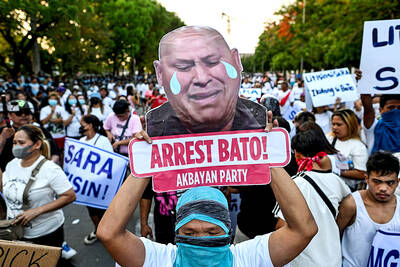
The Philippines said it has asked the country’s Supreme Court to allow it to arrest former Philippine president Rodrigo Duterte’s chief drug war enforcer to stand trial in an international tribunal. The International Criminal Court (ICC) last week unsealed an arrest warrant against Philippine Senator Ronald dela Rosa, accusing him along with Duterte and other “coperpetrators” of the “crime against humanity of murder.” Dela Rosa briefly sought refuge in the Philippine Senate last week while asking the Philippine Supreme Court to stop an ongoing attempt by government agents to arrest him. “By his own conduct, he has placed himself outside the protection of

It began as a satirical online project. Now millions of young people in India are flocking to it as an outlet for their frustration. A parody political party called the Cockroach Janta Party, with the insect as its symbol, has exploded across India’s social media by turning absurdist humor into protest. Memes and short videos mocking corruption, joblessness and political dysfunction have flooded social media sites, where millions of users are embracing the cockroach — known for its ability to survive harsh conditions — as a tongue-in-cheek symbol of endurance. The online movement’s rise has been unusually rapid. The Cockroach Janta Party (CJP)

The researchers in Ireland looked at their computer screen, marveling at a medieval book tracked down in a Roman library. They flipped through its digitized pages and found their sought-after treasure: the oldest surviving English poem. “We were extremely surprised. We were speechless. We couldn’t believe our eyes when we first saw that,” said Elisabetta Magnanti, a visiting research fellow at Trinity College Dublin’s school of English. The poem was also within the main body of Latin text, she said, calling it “extraordinary.” Composed in Old English by a Northumbrian agricultural worker in the 7th century, Caedmon’s Hymn appears within some copies of


 RSS
RSS