


Israeli police deployed in force throughout Jerusalem yesterday ahead of a mass annual march as tensions simmered in the Holy City after two days of clashes with Palestinian youths.
“We are maintaining a state of alert and are deploying in force,” Jerusalem police spokesman Shmuel Ben Rubi said, adding that about 2,000 police officers and border guards were on the streets.
Thousands of people were expected to march through the streets of Jerusalem later yesterday for the Jewish festival of Sukkot, with at least one march passing through the mostly Arab eastern part of the city.
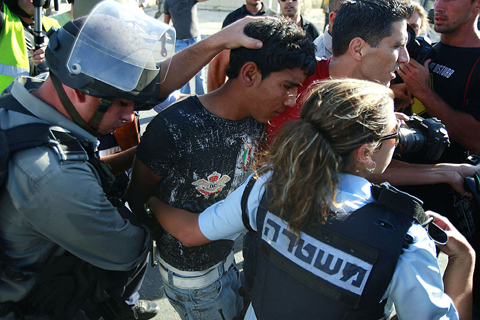
PHOTO: AFP
Tensions have run high in Jerusalem over the past several days after clashes broke out near the flashpoint site of the al-Aqsa mosque compound, revered by both Jews and Muslims, on Sunday for the second time in a week.
On Monday, Palestinian youths hurled stones at Israeli police in several neighborhoods of east Jerusalem, with one officer lightly wounded after being stabbed in the neck.
About 20 Palestinians were arrested following the clashes, police said.
Israeli authorities yesterday continued to limit access to the mosque compound in the Old City to Muslim men aged 50 and over, with no restrictions for women, after Sunday’s clashes in which seven Palestinian protesters were injured and three arrested.
The annual Sukkot marches in Jerusalem, with participants varying from Israeli health enthusiasts walking for the sport to evangelical Christians from abroad marching to show support for the Jewish state, have increasingly taken on a nationalist flavor over the past several years.
Israel captured east Jerusalem in 1967 and later annexed it in a move not recognized by the international community.
It considers Jerusalem to be its “eternal, indivisible” capital, while the Palestinians want to make the eastern part of the city the capital of their promised state.
Tensions flared on Sunday after police closed access to the al-Aqsa compound — known to Muslims as Al-Haram Al-Sharif (the Noble Sanctuary) and to Jews as the Temple Mount.
Clashes broke out after more than 150 people gathered to pray outside the compound. After the prayers, worshippers threw stones and security forces responded with stun grenades and a water cannon.
Rumors had earlier swept through the Old City that the Israeli authorities would allow right-wing Jewish settlers to enter the compound during the week-long festival.
The site of the al-Aqsa compound is the holiest in Judaism and third holiest in Islam, and it has often been a flashpoint for Israeli-Palestinian violence.
The second Palestinian intifada broke out there in September 2000 after a visit by Ariel Sharon, the right-wing politician who became prime minister the following year.
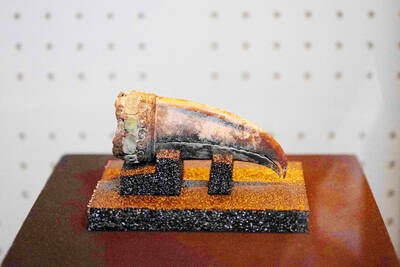
Archeologists in Peru on Thursday said they found the 5,000-year-old remains of a noblewoman at the sacred city of Caral, revealing the important role played by women in the oldest center of civilization in the Americas. “What has been discovered corresponds to a woman who apparently had elevated status, an elite woman,” archeologist David Palomino said. The mummy was found in Aspero, a sacred site within the city of Caral that was a garbage dump for more than 30 years until becoming an archeological site in the 1990s. Palomino said the carefully preserved remains, dating to 3,000BC, contained skin, part of the
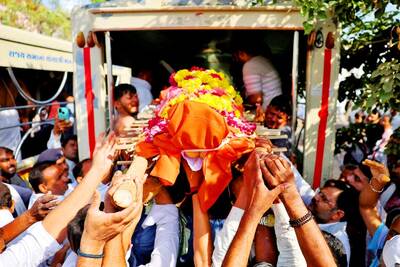
‘WATER WARFARE’: A Pakistani official called India’s suspension of a 65-year-old treaty on the sharing of waters from the Indus River ‘a cowardly, illegal move’ Pakistan yesterday canceled visas for Indian nationals, closed its airspace for all Indian-owned or operated airlines, and suspended all trade with India, including to and from any third country. The retaliatory measures follow India’s decision to suspend visas for Pakistani nationals in the aftermath of a deadly attack by shooters in Kashmir that killed 26 people, mostly tourists. The rare attack on civilians shocked and outraged India and prompted calls for action against their country’s archenemy, Pakistan. New Delhi did not publicly produce evidence connecting the attack to its neighbor, but said it had “cross-border” links to Pakistan. Pakistan denied any connection to

TRUMP EFFECT: The win capped one of the most dramatic turnarounds in Canadian political history after the Conservatives had led the Liberals by more than 20 points Canadian Prime Minister Mark Carney yesterday pledged to win US President Donald Trump’s trade war after winning Canada’s election and leading his Liberal Party to another term in power. Following a campaign dominated by Trump’s tariffs and annexation threats, Carney promised to chart “a new path forward” in a world “fundamentally changed” by a US that is newly hostile to free trade. “We are over the shock of the American betrayal, but we should never forget the lessons,” said Carney, who led the central banks of Canada and the UK before entering politics earlier this year. “We will win this trade war and
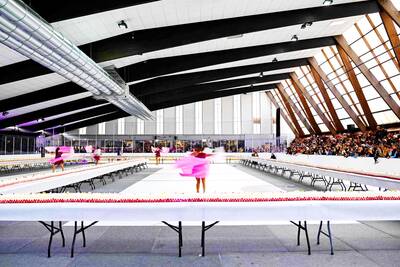
Armed with 4,000 eggs and a truckload of sugar and cream, French pastry chefs on Wednesday completed a 121.8m-long strawberry cake that they have claimed is the world’s longest ever made. Youssef El Gatou brought together 20 chefs to make the 1.2 tonne masterpiece that took a week to complete and was set out on tables in an ice rink in the Paris suburb town of Argenteuil for residents to inspect. The effort overtook a 100.48m-long strawberry cake made in the Italian town of San Mauro Torinese in 2019. El Gatou’s cake also used 350kg of strawberries, 150kg of sugar and 415kg of


 RSS
RSS