


Claudia Moncada adjusted her yellow dress one last time to show off her curves. In a few minutes she was to take part in a beauty contest with a difference: the contenders for the crown have been convicted of murder, robbery and drug trafficking.
For the past 15 years every September, Colombian prison authorities let their hair down, and let female inmates let theirs down, too. To mark the celebration of the Holy Virgin in this heavily Roman Catholic country, inmates hold concerts and — in a beauty obsessed country — pageants.
“In Colombia there are beauty contests everywhere, it’s part of our culture,” said Teresa Moya, the director of Colombia’s prisons, explaining the decision to hold the pageant.
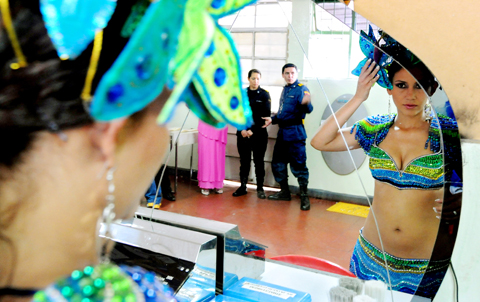
PHOTO: AFP
For inmates it is certainly a welcome respite from the difficulties of day-to-day life behind bars.
“It is an opportunity to forget all the pain and sadness of the prison. Today the food is better, the guards are nice and all the girls are happy,” said 30-year-old Moncada, who has spent two years in prison but refuses to reveal what her crime was.
“Sorry darling, I haven’t got any foundation for your legs!” shouted someone in one of the two bustling salons in the Buen Pastor prison, Bogota, where Moncada has two more years to serve.
The outburst came from Alfonso Llano, a professional hairdresser better known as “Pocho,” who said he helped out because the contestants are “decent and generous girls, who once made a mistake.
“They show me lots of affection and I treat them as I would any model,” he said with emotion.
Claudia Moncada was nervous. She was representing Section Four of the prison, one of only 16 prisoners out of 1,493 chosen to compete by their peers.
The other inmates were dressed in elegant white gowns lent to them by designers and they formed a cortege as the contestants were escorted to a podium in the prison yard.
When Claudia climbed the stairs, her comrades drowned her in confetti made from old magazines, shouting words of encouragement.
She kicked off proceedings, opening four hours of concerts, parades and even a moonwalk by foreign prisoners in homage to Michael Jackson.
Finally the jurors began their deliberations and the director of the prison stepped forward to announce the winner.
Claudia, like last year, was runner-up.
“It’s like that,” she said laconically, trying to contain her disappointment.
This year’s winner of the Buen Pastor — or Good Shepherd — crown is Sonia Vergara.
She is serving a five-year sentence for a high-profile kidnapping plot, in which she aided Carlos Ayala Saavedra, a European Commission official responsible for development projects in Colombia who had orchestrated his own disappearance for ransom money.
Gradually, the sense of joy evaporated into the prison’s flaking concrete walls and the girls returned to their cells.
“Thank you, Pocho,” whispered Ninfa, one of the participants, as she embraced the hairdresser.
With tears in his eyes Pocho held her in his arms and asked, “how long are you staying?”

Australians were downloading virtual private networks (VPNs) in droves, while one of the world’s largest porn distributors said it was blocking users from its platforms as the country yesterday rolled out sweeping online age restriction. Australia in December became the first country to impose a nationwide ban on teenagers using social media. A separate law now requires artificial intelligence (AI)-powered chatbot services to keep certain content — including pornography, extreme violence and self-harm and eating disorder material — from minors or face fines of up to A$49.5 million (US$34.6 million). The country also joined Britain, France and dozens of US states requiring

Hungarian authorities temporarily detained seven Ukrainian citizens and seized two armored cars carrying tens of millions of euros in cash across Hungary on suspicion of money laundering, officials said on Friday. The Ukrainians were released on Friday, following their detention on Thursday, but Hungarian officials held onto the cash, prompting Ukraine to accuse Hungary’s Russia-friendly government of illegally seizing the money. “We will not tolerate this state banditism,” Ukrainian Minister of Foreign Affairs Andrii Sybiha said. The seven detained Ukrainians were employees of the Ukrainian state-owned Oschadbank, who were traveling in the two armored cars that were carrying the money between Austria and
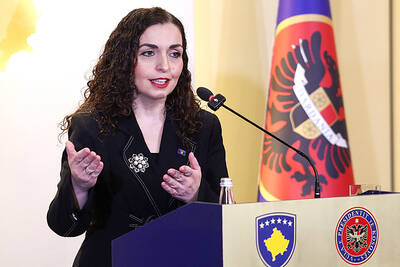
Kosovar President Vjosa Osmani on Friday after dissolving the Kosovar parliament said a snap election should be held as soon as possible to avoid another prolonged political crisis in the Balkan country at a time of global turmoil. Osmani said it is important for Kosovo to wrap up the upcoming election process and form functional institutions for political stability as the war rages in the Middle East. “Precisely because the geopolitical situation is that complex, it is important to finish this electoral process which is coming up,” she said. “It is very hard now to imagine what will happen next.” Kosovo, which declared

MORE BANS: Australia last year required sites to remove accounts held by under-16s, with a few countries pushing for similar action at an EU level and India considering its own ban Indonesia on Friday said it would ban social media access for children under 16, citing threats from online pornography, cyberbullying, online fraud and Internet addiction. “Accounts belonging to children under 16 on high-risk platforms will start to be deactivated, beginning with YouTube, TikTok, Facebook, Instagram, Threads, X, Bigo Live and Roblox,” Indonesian Minister of Communications and Digital Meutya Hafid said. “The government is stepping in so that parents no longer have to fight alone against the giants of the algorithm. Implementation will begin on March 28, 2026,” she said. The social media ban would be introduced in stages “until all platforms fulfill their


 RSS
RSS