


A black combination of water, hops, yeast and roasted barley could hardly be said to contain the soul of a nation.
But for the many lovers of Guinness, it’s a close-run thing.
Guinness, the legendary black stout of Ireland celebrated by poet, poor man, ad man and drunk, has reached the age of 250.
In Ireland and internationally, this was to be celebrated by a toast to its founder, Arthur Guinness, yesterday at one minute to 6pm.
When Guinness celebrated its 200th anniversary in 1959, advertisements still proclaimed the legend “Guinness is good for you.”
Although this slogan has been dropped along with the equally pithy “Guinness for Strength,” Guinness can still to run a slick promotional campaign.
Arthur’s Day, as the company has dubbed yesterday’s events, will be celebrated in Lagos, New York and Kuala Lumpur as well as Dublin, with gigs planned for St James’ Brewery, the home of Guinness in Dublin and music venues throughout the city.
Publicans and their customers around the country will also be joining in the celebrations by raising a Guinness to Arthur and the musical events will be broadcast live into pubs.
Ireland’s post office, An Post, has also printed a stamp to commemorate Arthur’s achievements, as it did in 1959.
What Arthur Guinness would have made of all this, is anybody’s guess, but there’s no doubt he shared the marketing acumen for which the brand is renowned.
He had the foresight to promote the health-giving properties of ale and porter at a time when the temperance movement in Ireland was targeting spirits.
In December 1759, he signed a lease on the St James’ Gate Brewery for 9,000 years and ever since Dublin has been synonymous with the drink.
By 1833 St James’ Gate Brewery had become the largest brewery in Ireland and by 1886, Guinness had become the largest brewery in the world, with an annual production of 1.2 million barrels.
It was then that the dream job at the Guinness company emerged — that of overseas traveler.
These were international quality controllers, who traveled abroad to ensure that the Guinness sold outside of Ireland was of the same high quality as that found at home.
Of course, it never was. According to Guinness myth, the black brew doesn’t travel well and will always taste best in Dublin.
Guinness is now owned by multinational drinks company Diageo, with annual revenues of more than 10 billion euros (US$14.7 billion).
No member of the Guinness family sits on the Diageo board and their share ownership has shrunk to 1 percent (worth 200 million euros), according to Irish Times reports.
Visitors are no longer shepherded around the brewery where they were given a free glass of Guinness. Instead, they are directed to the Guinness Storehouse, where they can watch a video and buy merchandise.
Despite all these changes, the special relationship between Ireland and Guinness is still in place and Dublin, in particular, remains famous for its writers and its Guinness.
There could be said to be a symbiotic relationship between these two as Irish literature is soaked in Guinness.
Flann O’Brien’s tribute, The Workman’s Friend, from his comic novel At Swim Two Birds has rarely been surpassed in its expression of the role Guinness has played in the lives of the Irish:
“When things go wrong and will not come right, Though you do the best you can, When life looks black as the hour of night, A pint of plain is your only man.
“When money’s tight and hard to get, And your horse has also ran, When all you have is a heap of debt, A pint of plain is your only man.”
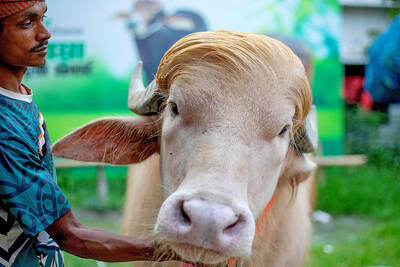
Crowds in Bangladesh are flocking to snap photographs with an unlikely social media star — an albino buffalo with flowing blond hair nicknamed “Donald Trump” that is due to be sacrificed within days. Owner Zia Uddin Mridha, 38, said his brother named the 700kg bull over its flowing helmet of hair resembling the signature look of the US president. “My younger brother picked this name because of the buffalo’s extraordinary hair,” he said at his farm in Narayanganj, just outside the capital, Dhaka. Mridha said that a constant stream of curious visitors — social media fans, onlookers and children — have come throughout

It began as a satirical online project. Now millions of young people in India are flocking to it as an outlet for their frustration. A parody political party called the Cockroach Janta Party, with the insect as its symbol, has exploded across India’s social media by turning absurdist humor into protest. Memes and short videos mocking corruption, joblessness and political dysfunction have flooded social media sites, where millions of users are embracing the cockroach — known for its ability to survive harsh conditions — as a tongue-in-cheek symbol of endurance. The online movement’s rise has been unusually rapid. The Cockroach Janta Party (CJP)

HOTTER: While Indians are accustomed to summer heat, climate change has caused northwestern India to warm faster than other parts of the country, an academic said Roads and markets have emptied during afternoons and some farmers have switched to nighttime work to avoid scorching temperatures as a heat wave grips large parts of India. The India Meteorological Department forecast maximum temperatures for yesterday of about 45°C in the capital, New Delhi, where authorities have opened temporary “cooling zones” to help people cope. The weather department warned that conditions would likely persist across several northern regions in the coming days, with temperatures staying well above seasonal averages. Authorities urged people to stay indoors during the hottest hours and take precautions against heat-related illnesses. India declares a heat wave whenever maximum temperatures

BIGGER ROLE: Beijing has said it maintains an impartial stance on the war in Ukraine, but by training Russian troops, China is far more involved than previously known China’s armed forces secretly trained about 200 Russian military personnel in China late last year, and some have since returned to fight in Ukraine, according to three European intelligence agencies and documents seen by Reuters. While China and Russia have held a number of joint military exercises since Moscow’s full-scale invasion of Ukraine in 2022, Beijing has repeatedly said that it is neutral in the conflict and presents itself as a peace mediator. The covert training sessions, which predominantly focused on the use of drones, were outlined in a dual-language Russian-Chinese agreement signed by senior Russian and Chinese officers in Beijing on


 RSS
RSS