


The choice of a scandal-tainted former leader of Japan’s new ruling party for a key role raised concerns yesterday that incoming prime minister Yukio Hatoyama had created a rival power center that would muddle policymaking.
Veteran lawmaker Ichiro Ozawa will assume the post of secretary-general of the Democratic Party of Japan (DPJ), months after a fundraising furor forced him to resign.
Ozawa was the DPJ’s chief campaign strategist and helped mastermind its historic defeat of the long-ruling Liberal Democratic Party (LDP) in an election for parliament’s lower house last Sunday.
Since Ozawa can take much of the credit for the victory, this will boost his clout within the party anyway, but his appointment to the No. 2 position makes it all the more likely that he will try to pull strings, as he did the only other time the LDP was ousted.
“The question is to what extent Ozawa can restrain himself,” said Tomoaki Iwai, a professor at Nihon University in Tokyo. “There may be times when he can’t and speaks out on policies at news conferences or tries to decide things without going through the proper decision-making process.”
Katsuya Okada, the current secretary-general, dismissed concerns about a dual party structure.
“The party leader and Mr Ozawa agreed that policy-making would be unified and that the secretary-general would not interfere,” he said in an interview yesterday.
Parliament will formally vote Hatoyama in as prime minister on Sept. 16. Hatoyama has said he will announce his Cabinet shortly after that, emphasizing that he will choose its members himself.
Ozawa, 67, stepped down as party leader in May after his close aide was charged with accepting illegal donations. The scandal is likely to come back into focus when the aide’s trial gets under way in the coming months.
Although the appointment had been expected, newspapers speculated that Ozawa would act as the power behind the throne and some voters were concerned.
“I am a bit worried,” said 41-year-old banker Shintaro Yamaoka. “Ozawa has power and numbers in the party. I wonder if Hatoyama will be able to carry out his own intentions.”
Broadcaster NHK said yesterday that Hatoyama had picked close ally Hirofumi Hirano for chief Cabinet secretary, a position that includes the role of chief government spokesman.
Hatoyama wants two other former party leaders, Okada and Naoto Kan, to take top portfolios, newspapers said.
Okada and Kan have been tipped as candidates for finance minister, a vital post as Japan struggles out of its worst recession since World War II.
The head of a new National Strategy Bureau, likely to be deeply involved in drawing up the budget and setting policy priorities, will also be a key appointment.
Investors have expressed concern that the new government will need to increase already high borrowing to fund its election promises and the appointments will be key to identifying the balance between social spending and reining in the fiscal deficit.
“The biggest concern — even bigger than who will be the new finance minister — is how they will secure funding for all their promised programs,” said Yutaka Miura, senior technical analyst at Mizuho Securities.
A third name often floated for the finance post is Hirohisa Fujii, who served as finance minister in an anti-LDP coalition from 1993 to 1994.
Hatoyama’s choice for foreign minister will be closely watched after concerns the Democratic Party’s policy of building a more independent stance from the US could damage ties with Tokyo’s biggest security ally.
Negotiations continued yesterday on a coalition agreement with two tiny parties that could help make up for the Democrats’ lack of a majority in the less powerful upper house of parliament.
Mizuho Fukushima, leader of the Social Democratic Party, said on Thursday the alliance was very likely to go ahead, but media said the talks would run into next week.
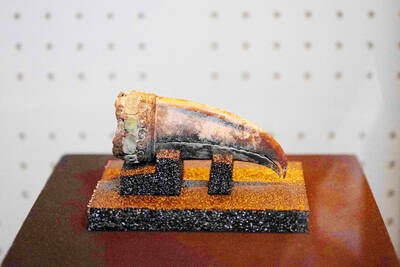
Archeologists in Peru on Thursday said they found the 5,000-year-old remains of a noblewoman at the sacred city of Caral, revealing the important role played by women in the oldest center of civilization in the Americas. “What has been discovered corresponds to a woman who apparently had elevated status, an elite woman,” archeologist David Palomino said. The mummy was found in Aspero, a sacred site within the city of Caral that was a garbage dump for more than 30 years until becoming an archeological site in the 1990s. Palomino said the carefully preserved remains, dating to 3,000BC, contained skin, part of the

TRUMP EFFECT: The win capped one of the most dramatic turnarounds in Canadian political history after the Conservatives had led the Liberals by more than 20 points Canadian Prime Minister Mark Carney yesterday pledged to win US President Donald Trump’s trade war after winning Canada’s election and leading his Liberal Party to another term in power. Following a campaign dominated by Trump’s tariffs and annexation threats, Carney promised to chart “a new path forward” in a world “fundamentally changed” by a US that is newly hostile to free trade. “We are over the shock of the American betrayal, but we should never forget the lessons,” said Carney, who led the central banks of Canada and the UK before entering politics earlier this year. “We will win this trade war and

‘BODIES EVERYWHERE’: The incident occurred at a Filipino festival celebrating an anti-colonial leader, with the driver described as a ‘lone suspect’ known to police Canadian police arrested a man on Saturday after a car plowed into a street party in the western Canadian city of Vancouver, killing a number of people. Authorities said the incident happened shortly after 8pm in Vancouver’s Sunset on Fraser neighborhood as members of the Filipino community gathered to celebrate Lapu Lapu Day. The festival, which commemorates a Filipino anti-colonial leader from the 16th century, falls this year on the weekend before Canada’s election. A 30-year-old local man was arrested at the scene, Vancouver police wrote on X. The driver was a “lone suspect” known to police, a police spokesperson told journalists at the
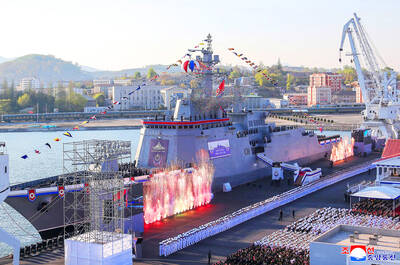
North Korean leader Kim Jong-un has unveiled a new naval destroyer, claiming it as a significant advancement toward his goal of expanding the operational range and preemptive strike capabilities of his nuclear-armed military, state media said yesterday. North Korea’s state-run Korean Central News Agency (KCNA) said Kim attended the launching ceremony for the 5,000-tonne warship on Friday at the western port of Nampo. Kim framed the arms buildup as a response to perceived threats from the US and its allies in Asia, who have been expanding joint military exercises amid rising tensions over the North’s nuclear program. He added that the acquisition


 RSS
RSS