


Who are Europe’s top tea and coffee drinkers?
If you thought it was the British and the Italians, think again.
“In terms of general coffee drinking, Northern Europe is the most important market: The Finns drink a huge quantity of coffee,” Giacomo Biviano, head of the European, Middle Eastern and African markets for Italian espresso maker Illy, told the German Press Agency (DPA).
Among Europe’s tea fanatics, meanwhile, Britain comes a humble third, behind Ireland and world champion tea-drinker Turkey, and not far above Russia and Poland, said Michiel Leijnse, global marketing manager at the Lipton tea company, a subsidiary of leading multinational Unilever.
Indeed, when it comes to hot drinks, you could argue that variety is Europe’s leading feature.
The continent’s biggest coffee drinkers are the Finns, who consume up to 12kg of coffee per year — the highest rate in the world, double that of Italy. Norwegians and Danes are not far behind.
But the Nordic nations tend to prefer relatively weak, drip-brewed coffee, while Mediterranean countries are far more partial to the concentrated impact of espresso, Biviano said.
In Italy, for example, espresso is by far the dominant form of coffee consumed: Italians drink around 14 billion espressos per year.
Milky blends such as the cappuccino and latte make up just one-fifth of Italian consumption, “because Italians only drink cappuccino at breakfast,” Biviano said.
In Northern Europe, by contrast, the ratio is reversed: Milk blends sell four times as well as espresso shots, according to Illy’s research.
That might suggest that North Europeans prefer weaker hot drinks. But curiously enough, if coffee starts strong in the south and weakens as you travel north, tea goes in the other direction.
“A typical tea bag for the British market would contain 3 grams of tea, in France the same bag would hold 2 grams, and in Italy it’s 1.5 grams,” Leijnse said.
That, again, is largely because of milk: British and Irish drinkers regularly take it in their tea, while in southern and eastern countries such as Italy, Russia and Turkey, it is more often drunk with lemon, or unadulterated.
And while traditional tea-drinking nations such as Britain and Russia prefer black tea, tea drinkers in traditional coffee nations are far more willing to experiment.
“In Russia and Britain, flavored teas make up a small percentage of total sales. But in France, they’re less focused on black tea because tea is more often drunk at 4 o’clock with pastries, so there’s a larger variety of flavors and infusions: We even have four different types of Earl Grey in France,” Leijnse said.
Companies from both sides of the hot-drink divide are now moving in to one another’s markets: Illy recently took over French tea firm Dammann Freres, while British tea company Twining’s is now marketing its own coffee blends.
And with drinking habits evolving ever faster in the melting pot — or coffee pot — of globalization, it looks as if variety, more than anything else, is now Europe’s cup of tea.
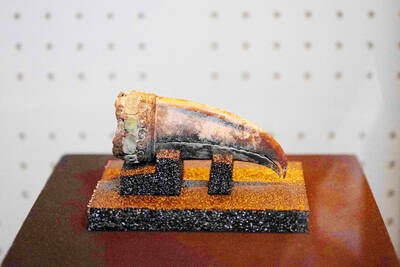
Archeologists in Peru on Thursday said they found the 5,000-year-old remains of a noblewoman at the sacred city of Caral, revealing the important role played by women in the oldest center of civilization in the Americas. “What has been discovered corresponds to a woman who apparently had elevated status, an elite woman,” archeologist David Palomino said. The mummy was found in Aspero, a sacred site within the city of Caral that was a garbage dump for more than 30 years until becoming an archeological site in the 1990s. Palomino said the carefully preserved remains, dating to 3,000BC, contained skin, part of the

TRUMP EFFECT: The win capped one of the most dramatic turnarounds in Canadian political history after the Conservatives had led the Liberals by more than 20 points Canadian Prime Minister Mark Carney yesterday pledged to win US President Donald Trump’s trade war after winning Canada’s election and leading his Liberal Party to another term in power. Following a campaign dominated by Trump’s tariffs and annexation threats, Carney promised to chart “a new path forward” in a world “fundamentally changed” by a US that is newly hostile to free trade. “We are over the shock of the American betrayal, but we should never forget the lessons,” said Carney, who led the central banks of Canada and the UK before entering politics earlier this year. “We will win this trade war and

‘BODIES EVERYWHERE’: The incident occurred at a Filipino festival celebrating an anti-colonial leader, with the driver described as a ‘lone suspect’ known to police Canadian police arrested a man on Saturday after a car plowed into a street party in the western Canadian city of Vancouver, killing a number of people. Authorities said the incident happened shortly after 8pm in Vancouver’s Sunset on Fraser neighborhood as members of the Filipino community gathered to celebrate Lapu Lapu Day. The festival, which commemorates a Filipino anti-colonial leader from the 16th century, falls this year on the weekend before Canada’s election. A 30-year-old local man was arrested at the scene, Vancouver police wrote on X. The driver was a “lone suspect” known to police, a police spokesperson told journalists at the
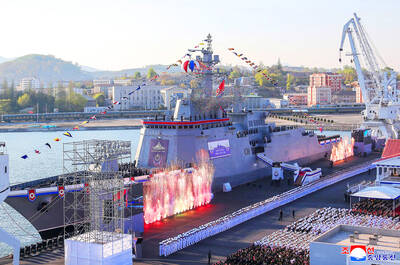
North Korean leader Kim Jong-un has unveiled a new naval destroyer, claiming it as a significant advancement toward his goal of expanding the operational range and preemptive strike capabilities of his nuclear-armed military, state media said yesterday. North Korea’s state-run Korean Central News Agency (KCNA) said Kim attended the launching ceremony for the 5,000-tonne warship on Friday at the western port of Nampo. Kim framed the arms buildup as a response to perceived threats from the US and its allies in Asia, who have been expanding joint military exercises amid rising tensions over the North’s nuclear program. He added that the acquisition


 RSS
RSS