


South Korea’s first space rocket blasted off yesterday, less than a week after a launch was aborted at the last minute, but it failed to place a satellite into the designated orbit.
The launch, dubbed a partial success by officials, came less than five months after nuclear-armed rival North Korea incurred international anger by firing its own long-range rocket.
Seoul’s Korea Space Launch Vehicle-1 lifted off on schedule at 5pm atop a tail of flame, to the jubilation of officials and guests at the Naro Space Centre.
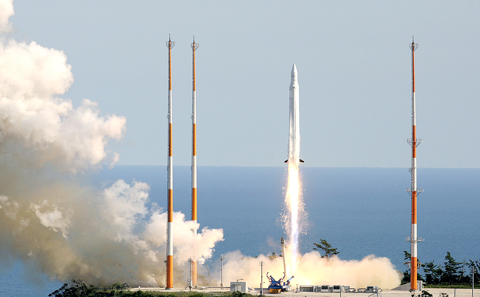
PHOTO: REUTERS
The Russian-made first stage separated successfully less than five minutes later and the South Korean-built 100kg scientific research satellite was then placed into Earth orbit.
But Science and Technology Minister Ahn Byong-Man said it was not following the designated track.
“All aspects of the launch were normal, but the satellite exceeded its planned orbit and reached an altitude of 360km,” Ahn said.
It should have separated at around 302km.
“A joint probe is under way by South Korean and Russian engineers to find the exact cause,” the minister said.
Korea Aerospace Research Institute head Lee Joo-jin told reporters it was too early to say whether the space center would be able to communicate with the satellite.
Asked if the launch should be seen as a success or failure, Lee said: “We can say it is partially successful, although we have yet to analyze data precisely.”
The satellite’s first signal had originally been expected to come 12 or 13 hours after lift-off.
North Korea, smarting at UN Security Council censure of its April 5 blast-off, had vowed to closely monitor reaction to its neighbor’s launch from Goheung on the south coast.
Pyongyang said it merely put a peaceful communications satellite into orbit and it wants Seoul’s launch also to be referred to the council.
Washington and its allies have said no North Korean satellite was detected in orbit and its launch was in fact a disguised test of a Taepodong-2 missile.
The US State Department said last week that South Korea — in contrast to the North — had developed its program transparently and in keeping with international agreements.
A 2001 accord with Washington bars Seoul from developing missiles with a range of more than 300km.
The launch follows seven delays since 2005. Last week a software problem halted the countdown with just eight minutes to go.
Television showed about 100 invited guests led by South Korean Prime Minister Han Seung-soo applauding and shaking hands after the initial announcement that the satellite was successfully placed into orbit.
They were visibly disappointed when the science minister later announced the hitch.
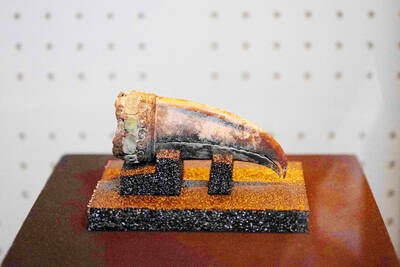
Archeologists in Peru on Thursday said they found the 5,000-year-old remains of a noblewoman at the sacred city of Caral, revealing the important role played by women in the oldest center of civilization in the Americas. “What has been discovered corresponds to a woman who apparently had elevated status, an elite woman,” archeologist David Palomino said. The mummy was found in Aspero, a sacred site within the city of Caral that was a garbage dump for more than 30 years until becoming an archeological site in the 1990s. Palomino said the carefully preserved remains, dating to 3,000BC, contained skin, part of the

TRUMP EFFECT: The win capped one of the most dramatic turnarounds in Canadian political history after the Conservatives had led the Liberals by more than 20 points Canadian Prime Minister Mark Carney yesterday pledged to win US President Donald Trump’s trade war after winning Canada’s election and leading his Liberal Party to another term in power. Following a campaign dominated by Trump’s tariffs and annexation threats, Carney promised to chart “a new path forward” in a world “fundamentally changed” by a US that is newly hostile to free trade. “We are over the shock of the American betrayal, but we should never forget the lessons,” said Carney, who led the central banks of Canada and the UK before entering politics earlier this year. “We will win this trade war and

‘BODIES EVERYWHERE’: The incident occurred at a Filipino festival celebrating an anti-colonial leader, with the driver described as a ‘lone suspect’ known to police Canadian police arrested a man on Saturday after a car plowed into a street party in the western Canadian city of Vancouver, killing a number of people. Authorities said the incident happened shortly after 8pm in Vancouver’s Sunset on Fraser neighborhood as members of the Filipino community gathered to celebrate Lapu Lapu Day. The festival, which commemorates a Filipino anti-colonial leader from the 16th century, falls this year on the weekend before Canada’s election. A 30-year-old local man was arrested at the scene, Vancouver police wrote on X. The driver was a “lone suspect” known to police, a police spokesperson told journalists at the
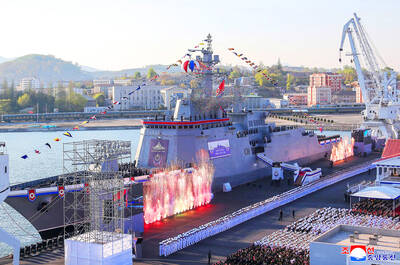
North Korean leader Kim Jong-un has unveiled a new naval destroyer, claiming it as a significant advancement toward his goal of expanding the operational range and preemptive strike capabilities of his nuclear-armed military, state media said yesterday. North Korea’s state-run Korean Central News Agency (KCNA) said Kim attended the launching ceremony for the 5,000-tonne warship on Friday at the western port of Nampo. Kim framed the arms buildup as a response to perceived threats from the US and its allies in Asia, who have been expanding joint military exercises amid rising tensions over the North’s nuclear program. He added that the acquisition


 RSS
RSS