


On the surface, the Mediterranean coastal city of Beirut is an upmarket tourist destination, offering Arab tourists good weather, good food, and good times, but beyond the tables heavy with food and the shining lights, Beirut’s greatest attraction is sex.
Arab tourists flock in the thousands to Lebanon from Gulf countries every summer. More and more, Arab men seem to be attracted by the growing opportunities to engage in sex tourism.
Lebanon has long been known to cater to all desires: A place where Arab tourists can break taboos they must contend with in their home countries.
Some just want some freedom. Hind, an 18-year-old Saudi girl, is spending her summer in Lebanon, enjoying the chance to show off her striking red lipstick, large black eyes and black veil.
She cruises in her three-wheel all-terrain vehicle at midnight in the overcrowded main streets of Aley, a town 30km from Beirut, where most of the cafes and restaurants are packed with Gulf tourists and Lebanese expatriates.
“For me this is total freedom, I can meet people and enjoy the night life as well,” Hind said.
But much of the growing tourism industry is still focused on men interested in sex. One man from Saudi Arabia, who requested not to be identified said: “In Beirut there is good life, good weather, good service and most of all beautiful girls.”
Lebanese women — with their outgoing characters, love of life and, most of all, their trendy European looks — have in recent years become central to attracting more Arab tourists into the country.
One of the hottest spots for such tourism is Maameltein, the red-light district of Lebanon, 20km north of Beirut.
It’s a place where Arab tourists can watch beautiful women from Belarus, Ukraine, and Romania performing naked on stage. A night out with one of the dancers can cost US$1,000.
One pimp in Maameltein, who asked to be identified as Carlos, told said there is no shortage of women, either local or from Europe, in Maameltein.
“The rates vary, the Eastern European girls are the most highly paid, Lebanese come next, and then Iraqis,” Carlos said.
“During the summer our main clients are men from Saudi Arabia, Kuwait and other Gulf states, while in winter we have many Lebanese clients,” he said.
In his late 40s, Carlos is often described as the best pimp in the district, catering to a clientele of mostly rich Saudi men.
Touring Maameltein with Carlos, one can see dozens of cars packed with young and middle-aged Gulf tourists cruising the area to get what Carlos describes as a “good catch.”
During the drive, Carlos receives calls from his clients.
“My friend, I need three Ukrainian and one Lebanese for tonight to come to a party at my residence,” Carlos quoted the caller, whom he said was from Saudi Arabia.
This would cost “between US$5,000 and US$6,000 per night because this is delivery to the residence,” he said, puffing a large cigar.
Elsewhere, many of the women are Iraqis who have fled their country and discovered prostitution as an easy way to earn money.
“I fled to Lebanon after the war in Iraq, with my mother and sister after my father and two brothers were killed,” said one woman who wanted to be identified as Noura. “We were without money, so we started working here.”
Noura, her mother and sister work in three different bars.
“I know this is not a good job, but we want to live and this is the easiest way to earn a living,” she said, waving goodbye as her client arrived.
Noura’s pimp, who asked to be identified as Kamal, said Iraqi women find that “this is their only means of survival, especially if they have no other training or skills in which to support themselves.”
Asked the rate for an Iraqi woman, Kamal says: “If they are virgins and it is their first time, I can get a good price: between US$1,000 and US$1,500. If they are experienced, then it’s between US$400 and US$500.”
As for Lebanese women, “we sell them only to foreign men for fear that one day their families would know about their secret job,” Kamal said.


When a hiker fell from a 55m waterfall in wild New Zealand bush, rescuers were forced to evacuate the badly hurt woman without her dog, which could not be found. After strangers raised thousands of dollars for a search, border collie Molly was flown to safety by a helicopter pilot who was determined to reunite the pet and the owner. A week earlier, an emergency rescue helicopter found the woman with bruises and lacerations after a fall at a rocky spot at the waterfall on the South Island’s West Coast. She was airlifted on March 24, but they were forced to

HIGH HOPES: The power source is expected to have a future, as it is not dependent on the weather or light, and could be useful for places with large desalination facilities A Japanese water plant is harnessing the natural process of osmosis to generate renewable energy that could one day become a common power source. The possibility of generating power from osmosis — when water molecules pass from a less salty solution to a more salty one — has long been known. However, actually generating energy from that has proved more complicated, in part due the difficulty of designing the membrane through which the molecules pass. Engineers in Fukuoka, Japan, and their private partners think they might have cracked it, and have opened what is only the world’s second osmotic power plant. It generates
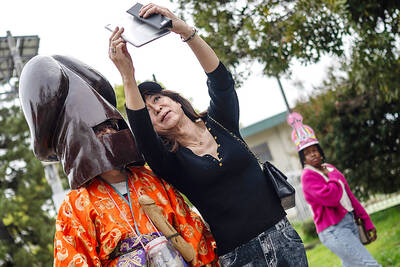
Showcasing phallus-shaped portable shrines and pink penis candies, Japan’s annual fertility festival yesterday teemed with tourists, couples and families elated by its open display of sex. The spring Kanamara Matsuri near Tokyo features colorfully dressed worshipers carrying a trio of giant phallic-shaped objects as they parade through the street with glee. The festival, as legend has it, honors a local blacksmith in the Edo Period (1603-1868) who forged an iron dildo to break the teeth of a sharp-toothed demon inhabiting a woman’s vagina that had been castrating young men on their wedding nights. A 1m black steel phallus sits in the courtyard of

Hundreds of Filipinos and tourists flocked to a sun-bleached field north of Manila yesterday, on Good Friday, to witness one of the country’s most blood-soaked displays of religious fervor, undeterred by rising fuel prices. Scores of bare-chested flagellants with covered faces walked barefoot through the dusty streets of Pampanga Province’s San Fernando as they flogged their backs with bamboo whips in the scorching heat. Agence France-Presse (AFP) journalists said they saw devotees deliberately puncturing their skin with glass shards attached to a small wooden paddle to ensure their bleeding during the ritual, a way to atone for sins and seek miracles from


 RSS
RSS