


Fugitive henchmen of ousted Iraqi president Saddam Hussein have adopted the cover of influential Muslim mystic groups to pose a real threat to stability in ethnically divided northern Iraq, Iraqi and US commanders said.
The so-called Sufi orders have a large historical following in the disputed oil-rich region and commanders said that the exploitation by Saddam Hussein loyalists of the orders’ extensive network of lodges holds more dangers than al-Qaeda.
“They have a pretty significant long-term potential to be a threat to the powers that be,” said Major Chuck Assadourian, the intelligence chief of the US Army’s 2nd Brigade, 1st Cavalry Division, who is based outside the oil city of Kirkuk.
Known as the Army of the Followers of the Naqshbandiya Order, or JRTN from its Arabic acronym, the insurgent group operates under the cover of the order’s many lodges across Kirkuk and neighboring provinces, and counts Saddam Hussein’s fugitive No. 2 Izzat Ibrahim al-Duri among its leaders.
It was founded under the auspices of Ibrahim and former Iraqi interior minister Mohammed Yunus on the night of Saddam Hussein’s execution for crimes against humanity at the end of the end of 2006, Assadourian said.
The members of its military wing are mainly made up of Sunni Arab former members of the Baath party and Saddam Hussein’s disbanded armed forces, even though the Sufi orders traditionally claim to draw support from across the region’s ethnic divide.
The JRTN has capitalized on the unpopularity of al-Qaeda and its foreign fighters, whose brutal tactics and enforcement of a strict version of Islam out of kilter with local traditions has alienated the region’s population.
TURN-OFF
“They’re [al-Qaeda] not really as concerned with winning the hearts and minds of the people, they still have their extremist ideology — no alcohol, no smoking, those sort of things — and that’s a big turn-off for the population,” Assadourian said.
Provincial police chief Major General Jamal Taher Bakr agreed that the JRTN were now “the big threat,” surpassing even al-Qaeda despite its continued mounting of spectacular, mass-casualty bombings.
However, he took issue with the JRTN’s claim to focus its campaign of violence on US targets rather than Iraqi ones.
“They will attack civilian targets in cities, everywhere,” Bakr said.
Assadourian said that overcoming the JRTN threat would take time and would need a political approach as much as a military one to woo former rank-and-file Baathists away from the diehards of the ousted regime.
“Obviously national elections would help, if there was a more proportional representation of Sunnis,” he said in allusion to the widespread boycott among Sunni Arabs of the last parliamentary elections in 2005. “And really there needs to be some determination as far as political accommodation for technocrats from the former regime, non-ideological individuals, because there’s a significant population of those folks.”
“With some of the political dynamics right now, a lot of the Baathists are excluded from holding positions and of course that’s very contentious,” Assadourian said.
SLOW PROGRESS
Progress has been slow on re-integrating former Baathists into government employment, after all but the most junior members of the party were barred from government jobs following the US-led invasion of 2003 in what is now regarded as one of the most misguided policies of the occupation.
Assadourian said that JRTN fighters, who also operate in neighboring Salaheddin Province around Saddam Hussein’s hometown of Tikrit — a traditional Baathist stronghold — mostly used roadside bombs and grenades, and often exaggerated their battlefield successes.
“They post videos and they’ll drop it off on the street corner — ‘Look at us, look at what we can do, we’re capable, we’ll stand up against the occupiers,’” he said. “One of the funny things is that they do a monthly production of these videos, and you’ll go from month to month sometimes and you’ll see the exact same video, and they’ll tell you that it’s a different unit that did it or a different location.”
The group, however, has scored some major coups against US targets.
In January, four US soldiers were killed when two US helicopters on a reconnaissance mission came down, which JRTN said happened as a result of their fire.
The US military initially insisted that it was an accident, only to acknowledge the following month that the aircraft were downed by “hostile fire,” but gave no specifics.
Nationwide, security has improved markedly compared with last year, with the number of violent deaths falling by a third in July to 275 from 437 in June.
But the JRTN’s strength in volatile Kirkuk threatens a new flareup with the movement’s mainly Sunni Arab supporters bitterly opposed to longstanding Kurdish claims to incorporate the province and its oil wealth in their northern autonomous region.
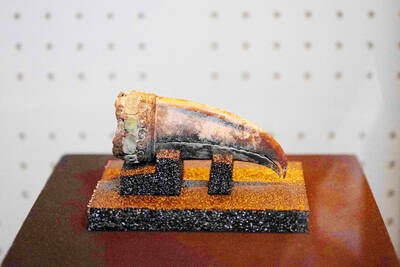
Archeologists in Peru on Thursday said they found the 5,000-year-old remains of a noblewoman at the sacred city of Caral, revealing the important role played by women in the oldest center of civilization in the Americas. “What has been discovered corresponds to a woman who apparently had elevated status, an elite woman,” archeologist David Palomino said. The mummy was found in Aspero, a sacred site within the city of Caral that was a garbage dump for more than 30 years until becoming an archeological site in the 1990s. Palomino said the carefully preserved remains, dating to 3,000BC, contained skin, part of the

TRUMP EFFECT: The win capped one of the most dramatic turnarounds in Canadian political history after the Conservatives had led the Liberals by more than 20 points Canadian Prime Minister Mark Carney yesterday pledged to win US President Donald Trump’s trade war after winning Canada’s election and leading his Liberal Party to another term in power. Following a campaign dominated by Trump’s tariffs and annexation threats, Carney promised to chart “a new path forward” in a world “fundamentally changed” by a US that is newly hostile to free trade. “We are over the shock of the American betrayal, but we should never forget the lessons,” said Carney, who led the central banks of Canada and the UK before entering politics earlier this year. “We will win this trade war and
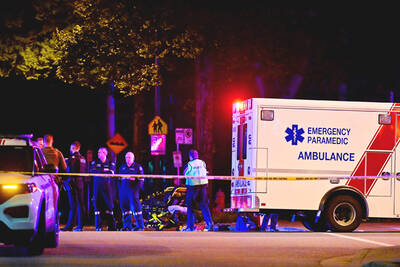
‘BODIES EVERYWHERE’: The incident occurred at a Filipino festival celebrating an anti-colonial leader, with the driver described as a ‘lone suspect’ known to police Canadian police arrested a man on Saturday after a car plowed into a street party in the western Canadian city of Vancouver, killing a number of people. Authorities said the incident happened shortly after 8pm in Vancouver’s Sunset on Fraser neighborhood as members of the Filipino community gathered to celebrate Lapu Lapu Day. The festival, which commemorates a Filipino anti-colonial leader from the 16th century, falls this year on the weekend before Canada’s election. A 30-year-old local man was arrested at the scene, Vancouver police wrote on X. The driver was a “lone suspect” known to police, a police spokesperson told journalists at the
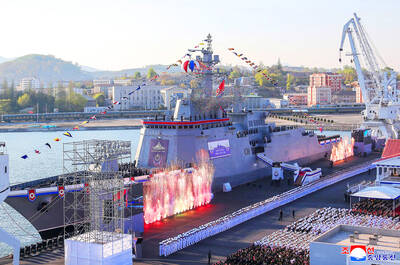
North Korean leader Kim Jong-un has unveiled a new naval destroyer, claiming it as a significant advancement toward his goal of expanding the operational range and preemptive strike capabilities of his nuclear-armed military, state media said yesterday. North Korea’s state-run Korean Central News Agency (KCNA) said Kim attended the launching ceremony for the 5,000-tonne warship on Friday at the western port of Nampo. Kim framed the arms buildup as a response to perceived threats from the US and its allies in Asia, who have been expanding joint military exercises amid rising tensions over the North’s nuclear program. He added that the acquisition


 RSS
RSS