


The Caribbean state of Antigua and Barbuda, still reeling from the fraud scandal surrounding Texas billionaire Allen Stanford, on Thursday found a new foreign benefactor in Venezuelan President Hugo Chavez.
Antigua and Barbuda Prime Minister Baldwin Spencer told the nation in a broadcast that the leftist Venezuelan leader was providing US$50 million in urgent financial assistance to the twin-island state, which was at the heart of Stanford’s far-reaching business empire-that collapsed in February.
“Today, I am pleased to advise the nation that at one o’clock this morning President Hugo Chavez signed the necessary paperwork to approve the immediate transfer of the full amount of US$50 million to the government’s call account at the Eastern Caribbean Central Bank,” Spencer said in his address.
ALBA CONNECTION
Spencer, who led his Caribbean country to join Chavez’s Bolivarian Alternative for the Americas (ALBA), an alliance of leftist Latin American states — just two months ago, said the funds would be used to help Antigua and Barbuda confront the effects of the global financial crisis.
He said that the Venezuelan emergency help came “completely without precondition,” but gave no details of the terms.
Antigua and Barbuda Finance Minister Harold Lovell said in a statement the Venezuelan assistance would involve “some grant element and a loan on very concessionary terms,” although he added the terms were being finalized.
Stanford, a flamboyant sports entrepreneur who was granted a knighthood by Antigua and Barbuda and was once its biggest investor, faces US civil and criminal charges related to an alleged US$7 billion fraud that prosecutors say was centered on certificates of deposit issued by his Stanford International Bank in Antigua. Venezuelan investors were among those who suffered losses.
US prosecutors have accused Antigua’s former chief financial regulator, Leroy King, with abetting the fraud.
LAWSUITS
Investors from the US, Mexico, Colombia and Peru are suing the Caribbean state for up to US$24 billion in damages, alleging it was a “partner in crime” with Stanford.
Antigua and Barbuda’s government denies this.
The government says the Stanford scandal badly hurt the economy of the small state of around 85,000 people, causing losses and layoffs and damaging the nation’s image as an offshore finance destination.
Antigua and Barbuda is the third member of the 15-nation mostly English-speaking Caribbean Community (Caricom) to join ALBA, an alliance which critics say the outspoken Venezuelan president uses to try to counter US influence in Latin America.
Some Caricom leaders have expressed concern about its members joining the Venezuelan-led alliance, saying this threatens Caribbean unity at a time when the region faces huge challenges posed by the global economic crisis.
But others say it is precisely these pressures, such as falling revenues from tourism and remittances, which are forcing small Caribbean states to seek beneficial alliances.
TIMELY AID
Acknowledging Antigua’s financial woes, Lovell said US$35 million of the “generous and timely” Venezuelan support would be used for “budgetary support,” US$7 million would be employed for “economic stimulus,” while US$6.5 million would go toward improving administration of revenues and spending.
The remaining US$1.5 million would be used to fund activities and programs that provide social protection for the poor and unemployed, Lovell said.
Antigua and Barbuda is also a member of PetroCaribe, a group set up by Chavez that allows poor, oil importing countries in the region to buy Venezuelan oil on credit.

An American scientist convicted of lying to US authorities about payments from China while he was at Harvard University has rebuilt his research lab in Shenzhen, China, to pursue technology the Chinese government has identified as a national priority: embedding electronics into the human brain. Charles Lieber, 67, is among the world’s leading researchers in brain-computer interfaces. The technology has shown promise in treating conditions such as amyotrophic lateral sclerosis and restoring movement in paralyzed people. It also has potential military applications: Scientists at the Chinese People’s Liberation Army have investigated brain interfaces as a way to engineer super soldiers by boosting
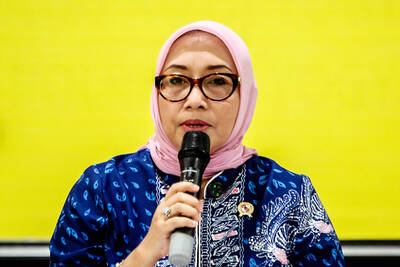
Indonesian police have arrested 13 people after shocking images of alleged abuse against small children at a daycare center went viral, sparking outrage across the nation, officials said on Monday. Police on Friday last week raided Little Aresha, a daycare center in Yogyakarta on Java island, following a report from a former employee. CCTV footage circulating on social media showed children, most younger than two, lying on the floor wearing only diapers, their hands and feet bound with rags. The police have confirmed that the footage is authentic. Police said they also found 20 children crammed into a room just 3m by 3m. “So
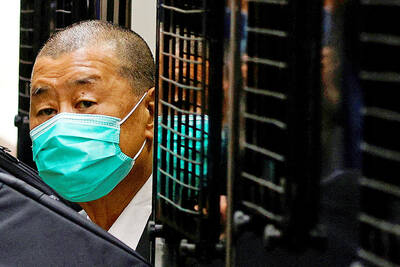
Jailed media entrepreneur Jimmy Lai (黎智英) has been awarded Deutsche Welle’s (DW) freedom of speech award for his contribution to Hong Kong’s pro-democracy movement. The German public broadcaster on Thursday said Lai would be presented in absentia with the 12th iteration of the award on June 23 at the DW Global Media Forum in Bonn. Deutsche Welle director-general Barbara Massing praised the 78-year-old founder of the now-shuttered news outlet Apple Daily for standing “unwaveringly for press freedom in Hong Kong at great personal risk.” “With Apple Daily, he gave journalists a platform for free reporting and a voice to the democracy movement in
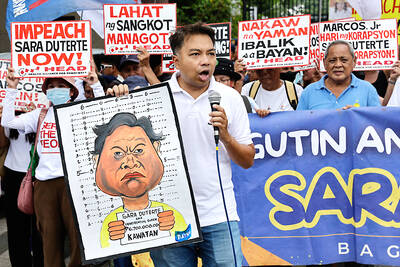
PHILIPPINE COMMITTEE: The head of the committee that made the decision said: ‘If there is nothing to hide, there is no reason to hide, there is no reason to obstruct’ A Philippine congressional committee on Wednesday ruled that there was “probable cause” to impeach Philippine Vice President Sara Duterte after hearing allegations of unexplained wealth, misuse of state funds and threats to have the president assassinated. The unanimous decision of the 53-member committee in the Philippine House of Representatives sends the two impeachment complaints to deliberations and voting by the entire lower chamber, which has more than 300 lawmakers. The complaints centered on Duterte’s alleged illegal use and mishandling of intelligence funds from the vice president’s office, and from her time as education secretary under Philippine President Ferdinand Marcos Jr. Duterte and the


 RSS
RSS