


Former US vice president Dick Cheney grew increasingly disenchanted with US president George W. Bush during the latter’s second term, believing the president was going soft in the so-called war on terror, it emerged on Wednesday.
The rift came to light as the Cheney, the driving force behind many of Bush’s hardline actions — the invasion of Iraq, the torture of terrorist suspects — discussed his memoir, due out in 2011, with former colleagues, policy experts and diplomats, the Washington Post reported on Wednesday
What emerged from the latest account of Cheney’s disgruntlement was that he thought Bush had gone soft in the last years of his presidency as he veered away from the “you are with us or you are against us” approach following the Sept. 11 attacks.
In the last days of his administration, Bush halted the use of waterboarding for terrorist suspects, closed secret CIA prisons, sought congressional approval for domestic surveillance and put out feelers to Iran and North Korea, which he had previously denounced as part of the “axis of evil.”
Those who have been speaking to the former vice-president say that shift stuck in Cheney’s craw.
“In the second term, he felt Bush was moving away from him,” an unnamed source told the Post. “He said Bush was shackled by the public reaction and the criticism he took. Bush was more malleable to that. The implication was that Bush had gone soft on him, or rather Bush had hardened against Cheney’s advice. He’d showed an independence that Cheney didn’t see coming.”
In contrast to Bush, who has maintained a discreet silence since US President Barack Obama’s election, Cheney has rebuked the new president as the Democrat disavows one Bush policy after another, such as the closing of Guantanamo Bay. Cheney has been rather more committed than his former boss in defending the Bush legacy.
The first inkling of Cheney’s disenchantment came in a long account in Time magazine of his failed attempt to win a presidential pardon for his aide Lewis Libby. Despite much badgering, Bush refused to pardon Libby, who was convicted in 2007 of perjury and the obstruction of an investigation into the outing of Valerie Plame as a CIA agent.
Robert Barnett, who negotiated Cheney’s book contract, passed word to potential publishers that the memoir would be packed with news, said the article published on the Post Web site, and Cheney himself has said, without explanation, that “the statute of limitations has expired” on many of his secrets.
The book will cover Cheney’s long career from chief of staff under former US president Gerald Ford to vice president under Bush.
“When the president made decisions that I didn’t agree with, I still supported him and didn’t go out and undercut him,” Cheney said, according to Stephen Hayes, his authorized biographer. “Now we’re talking about after we’ve left office. I have strong feelings about what happened … And I don’t have any reason not to forthrightly express those views.”
According to the author of the Post piece, Barton Gellman, who earlier wrote a book on Cheney called Angler, the former vice president believes Bush made concessions to public sentiment, something Cheney views as moral weakness. After years of praising Bush as a man of resolve, Cheney now intimates that the former president turned out to be more like an ordinary politician in the end, Gellman says.
As Cheney works on his memoirs, some have pointed out the irony of what he is doing. He was none too pleased when former Bush officials wrote theirs, particularly when Paul Bremer, who led the occupation of Iraq, revealed that Cheney shared Bremer’s concern about US military strategy.
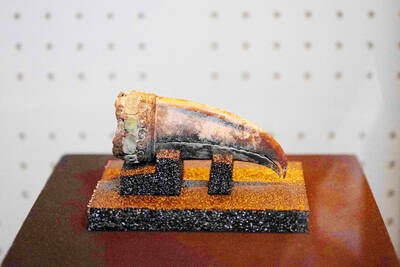
Archeologists in Peru on Thursday said they found the 5,000-year-old remains of a noblewoman at the sacred city of Caral, revealing the important role played by women in the oldest center of civilization in the Americas. “What has been discovered corresponds to a woman who apparently had elevated status, an elite woman,” archeologist David Palomino said. The mummy was found in Aspero, a sacred site within the city of Caral that was a garbage dump for more than 30 years until becoming an archeological site in the 1990s. Palomino said the carefully preserved remains, dating to 3,000BC, contained skin, part of the
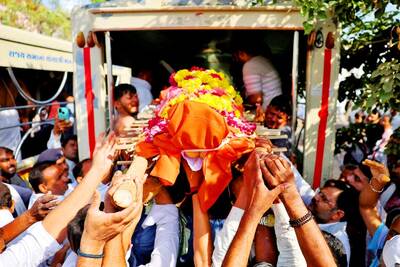
‘WATER WARFARE’: A Pakistani official called India’s suspension of a 65-year-old treaty on the sharing of waters from the Indus River ‘a cowardly, illegal move’ Pakistan yesterday canceled visas for Indian nationals, closed its airspace for all Indian-owned or operated airlines, and suspended all trade with India, including to and from any third country. The retaliatory measures follow India’s decision to suspend visas for Pakistani nationals in the aftermath of a deadly attack by shooters in Kashmir that killed 26 people, mostly tourists. The rare attack on civilians shocked and outraged India and prompted calls for action against their country’s archenemy, Pakistan. New Delhi did not publicly produce evidence connecting the attack to its neighbor, but said it had “cross-border” links to Pakistan. Pakistan denied any connection to

TRUMP EFFECT: The win capped one of the most dramatic turnarounds in Canadian political history after the Conservatives had led the Liberals by more than 20 points Canadian Prime Minister Mark Carney yesterday pledged to win US President Donald Trump’s trade war after winning Canada’s election and leading his Liberal Party to another term in power. Following a campaign dominated by Trump’s tariffs and annexation threats, Carney promised to chart “a new path forward” in a world “fundamentally changed” by a US that is newly hostile to free trade. “We are over the shock of the American betrayal, but we should never forget the lessons,” said Carney, who led the central banks of Canada and the UK before entering politics earlier this year. “We will win this trade war and
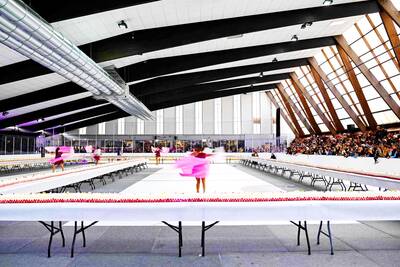
Armed with 4,000 eggs and a truckload of sugar and cream, French pastry chefs on Wednesday completed a 121.8m-long strawberry cake that they have claimed is the world’s longest ever made. Youssef El Gatou brought together 20 chefs to make the 1.2 tonne masterpiece that took a week to complete and was set out on tables in an ice rink in the Paris suburb town of Argenteuil for residents to inspect. The effort overtook a 100.48m-long strawberry cake made in the Italian town of San Mauro Torinese in 2019. El Gatou’s cake also used 350kg of strawberries, 150kg of sugar and 415kg of


 RSS
RSS