


At least 23 soldiers and 20 Abu Sayyaf militants were killed when the army raided a training camp run by al-Qaeda-linked rebels in the southern Philippines, the military said yesterday.
Fourteen other soldiers were also wounded when the military launched a major offensive on the Islamist militants’ camp in the town of Ungkaya Pukan on the remote island of Basilan on Wednesday, officials said.
Government troops managed to overrun the camp, but reports from the field said day-long clashes that followed were fierce and led to the heavy casualties, regional commander Major General Benjamin Dolorfino said.
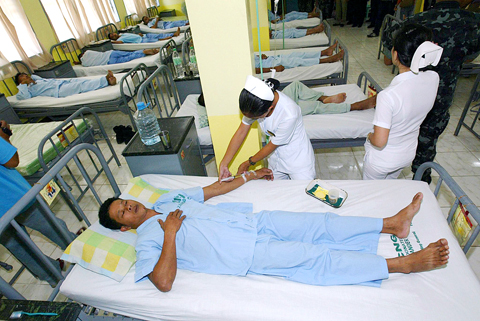
PHOTO: EPA
Numerous home-made bombs, ready for detonation, were recovered along with 13 high-powered firearms, he said.
The fighting was the heaviest since at least 29 soldiers were killed in two separate clashes with the Abu Sayyaf in July and August 2007 — with the bodies of 10 soldiers later found mutilated.
The military “launched a decisive law enforcement operation targeting the Abu Sayyaf’s main training camp in the province,” army spokeswoman Lieutenant Steffani Cacho said. “Recovered from the camp were sizeable quantities of IEDs [improvised explosive devices] rigged to explode, while others were ready for use,” she said.
The military said they were going after about 200 Abu Sayyaf militants who were involved in the clash and that additional troops may be poured into the remote area.
“The terrain is really very difficult to penetrate,” said Lieutenant Colonel Romeo Brawner, overall armed forces spokesman in Manila. “Follow [up] operations are ongoing and we hope we will be able to get the remnants of this Abu Sayyaf group.”
He said the military was “studying whether we need to pour in more troops into the area.”
Soldiers who airlifted their dead comrades to a military base in nearby Zamboanga City said those who died were hit by sniper fire.
The clashes were over, General Dolorfino said, but troops were still clearing the area to ensure no insurgents remained.
The Abu Sayyaf was formed in the early 1990s by Islamic firebrand Abdurajak Abubakar Janjalani upon his return from Afghanistan, where he fought the Soviets alongside al-Qaeda leader Osama bin Laden.
Janjalani formed the Abu Sayyaf ostensibly to fight for an independent Islamic state.
He was killed in a 1998 clash with police, and the group quickly degenerated into a terror organization specializing in bombings and high-profile kidnappings.
The group has raised money by ransoming hostages, but has also killed some, mostly through beheading, when they were not paid promptly.
While the Philippine military has killed and captured many Abu Sayyaf leaders — partly with US assistance — the extremists remained active and in January they held three international Red Cross workers hostage for several months.
Two hostages were freed in April while the last, Italian Eugenio Vagni, was released on July 12 after nearly six months in captivity.

Through the noise of rushing papers and whirring belts at a print factory in Kyoto, two creators watch their photo essay come to life in broadsheet form — part of an effort to win new audiences in the age of artificial intelligence (AI). Despite the decline of the publishing industry, self-publication and handmade “zine” magazines are growing in popularity in Japan, reflecting the nation’s enduring love of paper in the digital era. While speaking to Agence France-Presse at the plant, his hands black with ink, one of the creators, Kazuma Obara, said: “I think [paper] is a medium that engages all five
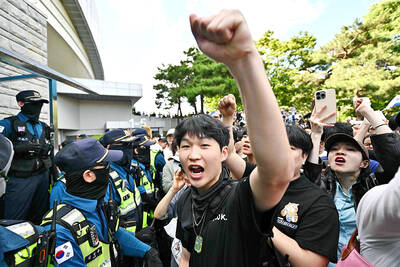
‘ABSURD MISTAKE’: The election commission said that there had been a failure to anticipate turnout after 14 polling stations ran short of ballot papers South Korean riot police yesterday cleared protesters from a Seoul polling station after a 35-hour blockade sparked by a shortage of ballot papers during local elections earlier this week. Wednesday’s election was the first nationwide vote since South Korean President Lee Jae-myung took office following the ouster of Yoon Suk-yeol over his short-lived martial law declaration. Lee’s ruling Democratic Party swept most races, but failed to flip the crucial Seoul mayoral seat. The South Korean National Election Commission apologized, blaming a failure to anticipate turnout after 14 polling stations in Seoul ran short of ballot papers. Some polling stations stayed open until 10pm to

Australian researchers have trained lab-grown brain cells on a silicon computer chip to play the 1990s shooter game Doom and said they are just scratching the surface of what the neurons could be capable of doing. It is the science-fiction work of biotech boffins at Cortical Labs, who researched and developed the technology that harnesses the workings of the brain’s networking system. Each so-called “biological computer” contains about 200,000 living human brain cells, grown from stem cells that were harvested from blood donations. Having mastered the simple computer game Pong, where a paddle is moved up and down to send a ball

France experienced its hottest spring on record, the French weather service said on Tuesday, after an exceptional early heat wave that also broke highs for the season in England and Wales. Meteo-France said the average nationwide temperature over March to May was 13.8°C — about 1.7°C above the norm, and surpassing records set in 2011 and 2020. “The warmest spring since records began in 1900,” it said in a bulletin. All three months were warmer than average, but the onset of an “unprecedented heatwave” late last month pushed the mercury to highs typically seen at the height of the summer. “Our country had never


 RSS
RSS