


Robots in the sky and on the ground are transforming warfare, and the US military is rushing to recruit the new warriors that never sleep and never bleed. The latest robotics were on display at an industry show this week at a naval airfield in Maryland, with a pilotless helicopter buzzing overhead and a “Wall-E” look-alike robot on the ground craning its neck to peer into a window.
The chopper, the MQ-8B Fire Scout, is no tentative experiment and later this year will be operating from a naval frigate, the USS McInerney, to help track drug traffickers in the eastern Pacific Ocean, Navy officers said.
The rugged little robot searching an enemy building is called a Pakbot, which can climb over rocks with tank treads, pick up an explosive with its mechanical arm and dismantle it while a soldier directs the machine from a safe distance.
There are already 2,500 of them on the ground in Iraq and Afghanistan, and a lighter version weighing 6kg has arrived that can be carried in a backpack, according to iRobot, the same company that sells a robot vacuum to civilians, the Roomba.
Monday’s demonstration of robotic wonders was organized by defense contractors and the US Navy, which says it wants to lead the US military into a new age where tedious or high-risk jobs are handed over to robots.
“I think we’re at the beginning of an unmanned revolution,” said Gary Kessler, who oversees unmanned aviation programs for the US Navy and Marines.
“We’re spending billions of dollars on unmanned systems.”
Kessler and other Pentagon officials compare the robots to the introduction of the aircraft or the tank, a new technology that dramatically changes strategy and tactics.
Robots or “unmanned systems” are now deployed by the thousands in Iraq and Afghanistan, spying from the sky for hours on end, searching for booby-traps and firing lethal missiles without putting US soldiers at risk.
The use of robotics in the military has exploded in the past several years as technology has advanced while Washington faced a new kind of enemy that required patient, precise surveillance. In 2003, the US military had almost no robots in its arsenal but now has 7,000 unmanned aircraft and at least 10,000 ground vehicles.
The US Air Force, which initially resisted the idea of pilotless planes, said it trains more operators for unmanned aircraft than pilots for its fighter jets and bombers.
Peter Singer, author of Wired for War, writes that future wars may see tens of thousands of unmanned vehicles in action, possibly facing off against fleets of enemy robots.
Unlike expensive weapons from the Cold War-era, robotic vehicles are not off-limits to countries with modest defense budgets and dozens of governments are investing in unmanned programs.

An American scientist convicted of lying to US authorities about payments from China while he was at Harvard University has rebuilt his research lab in Shenzhen, China, to pursue technology the Chinese government has identified as a national priority: embedding electronics into the human brain. Charles Lieber, 67, is among the world’s leading researchers in brain-computer interfaces. The technology has shown promise in treating conditions such as amyotrophic lateral sclerosis and restoring movement in paralyzed people. It also has potential military applications: Scientists at the Chinese People’s Liberation Army have investigated brain interfaces as a way to engineer super soldiers by boosting

Indonesian police have arrested 13 people after shocking images of alleged abuse against small children at a daycare center went viral, sparking outrage across the nation, officials said on Monday. Police on Friday last week raided Little Aresha, a daycare center in Yogyakarta on Java island, following a report from a former employee. CCTV footage circulating on social media showed children, most younger than two, lying on the floor wearing only diapers, their hands and feet bound with rags. The police have confirmed that the footage is authentic. Police said they also found 20 children crammed into a room just 3m by 3m. “So
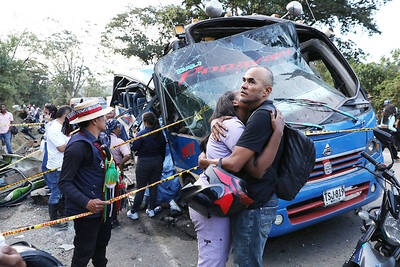
A highway bomb attack in a restive region of southwestern Colombia on Saturday killed 14 people and injured at least 38, the latest spate of violence ahead of next month’s presidential election. Authorities blamed the attack in the Cauca department — a conflict-ridden, coca-growing region — on dissidents of the now-disbanded FARC guerrilla army, who have been sowing violence across the country. “Those who carried out this attack ... are terrorists, fascists and drug traffickers,” Colombian President Gustavo Petro said on social media. “I want our very best soldiers to confront them,” he added. The leftist leader blamed the bombing
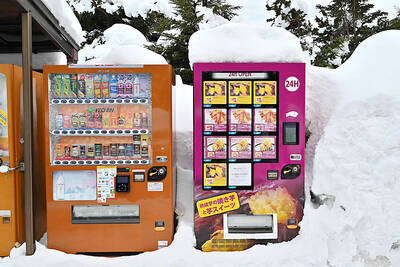
From post offices and parks to stations and even the summit of Mount Fuji, Japan’s vending machines are ubiquitous, but with the rapid pace of inflation cooling demand for their drinks, operators are being forced to rethink the business. Last month beverage giant DyDo Group Holdings announced it would remove about 20,000 vending machines — about 7 percent of their stock nationwide — by January next year, to “reconstruct a profitable network.” Pokka Sapporo Food & Beverage, based in Nagoya, also said last month it would sell its 40,000-machine operation to Osaka-based Lifedrink Co. “The strength of the vending machine


 RSS
RSS