


More than a year ago, the UN dropped the Russian air transport company Vertikal-T from its approved list of vendors after a fatal helicopter crash in Nepal.
Yet NATO continued to use helicopters owned by Vertikal-T in Afghanistan. On July 19, one of those choppers crashed at southern Afghanistan’s largest NATO base, killing 16 civilians on board.
The crash reflects a little-known reality behind NATO’s military push in Afghanistan: It is relying on Russian aviators flying Soviet-design aircraft who have lucrative contracts in a country Russian troops left two decades ago.
Aviation industry analysts say many of these contractors have bad safety records and that NATO has hired some operators with questionable backgrounds through arms-length leasing deals.
“Normally this would be handled by the military, but the military have been cut back ... They are plugging the gaps with dodgy operators,” said Hugh Griffiths, an analyst at the Stockholm International Peace Research Institute.
Spokesman Ari Gaitanis wrote in an e-mail that the UN suspended and removed Vertikal-T from its list of approved companies because of “serious violation of international safety requirements.”
But the company said it was dropped because “Vertikal-T could not sufficiently prove that it could comply with the requirements and regulations of the UN”
“There is no mention of safety,” it said.
Vertikal-T also said it was subject to Russian safety regulators and recently had its Russian commercial license renewed as an air carrier.
Russian firms play a big role in providing non-combat air support in NATO’s war against the Taliban. In Russia, where the NATO alliance is still viewed as a threat, Russia’s involvement in Afghanistan is seldom discussed.
In 1989, the Soviet Union limped away from a 10-year war in Afghanistan that cost 15,000 Soviet lives and hastened the end of the empire. Moscow then armed both sides of a vicious war that pitted Afghan factions against one another. When the US went to war with Afghanistan in the wake of Sept. 11, the Russians continued to play a clandestine supporting role.
Now the Russians are back in Afghanistan in force.
“We never left,” said Pavel Felgenhauer, a Moscow-based military analyst. “Officially, Russia is not involved. Unofficially, it is.”
Faced with a shortage of helicopters, NATO countries are turning to cheap Eastern European and particularly Russian operators to ferry supplies and civilian contractors, as well as recover downed choppers.
The modified Russian planes are ideally suited to the dust, heat and high altitudes of Afghanistan and their pilots are used to punishing conditions.
Western analysts say they are also prepared to take risks.
Russia’s aviation sector has a spotty safety record, they say, with helicopters crashing on a frequent basis. Poor maintenance is often cited as the cause.
Intermediaries such as Skylink Aviation, based in Canada, often handle the subleasing for NATO forces, giving governments an element of “plausible deniability,” experts say.
Fluor, a Texas-based company providing logistical back-up to US military operations, said Skylink provided the Vertikal-T helicopter that most recently crashed in Afghanistan. The helicopter was transporting contractors on behalf of Fluor.
Vertikal-T’s reputation is as the “hot zone provider of choice,” said Mark Galeotti, a military and organized crime expert at New York University.
“If you want a pretty professional but slightly cowboyish outfit that doesn’t mind flying into war zones, doesn’t mind taking off from unsurfaced runways, then Vertikal-T now seems to be the front runner,” he said.
These companies generally provide legitimate air transport services, but often draw the wrong kind of publicity.
Vertikal-T was left red-faced in Sudan after authorities accused it of dropping arms to rebels, an allegation the company denied.
A NATO spokesman declined to provide information on individual companies, but said it was “important to bear in mind the great demands placed on our countries’ forces ... Missions carried out by the individual nations, the United Nations and the European Union involve calling on nations’ assets, both manpower and equipment.”
NATO uses Russian aircraft in two main ways. At one end of the scale, Russian choppers take on simple supply missions. At the other end, massive Russian-owned Antonov planes take off from distant air bases bound for the deserts of Afghanistan with heavy and sometimes classified freight.
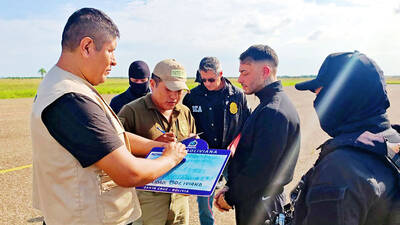
KINGPIN: Marset allegedly laundered the proceeds of his drug enterprise by purchasing and sponsoring professional soccer teams and even put himself in the starting lineups Notorious Latin American narco trafficker Sebastian Marset, who eluded police for years, was handed over to US authorities after his arrest on Friday in Bolivia. Marset, a Uruguayan national who was on the US most-wanted list, was passed to agents of the US Drug Enforcement Administration at Santa Cruz airport in Bolivia, then put on a US airplane, Bolivian state television showed. “The arrest and deportation were carried out pursuant to a court order issued by the US justice system,” Bolivian Minister of Government Marco Antonio Oviedo told reporters. The alleged kingpin was arrested in an upscale neighborhood of Santa
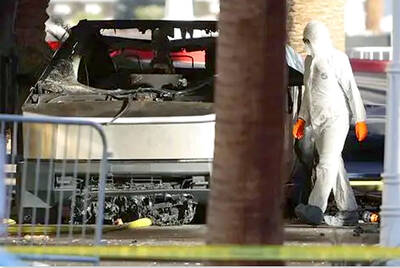
ACTIONABLE ADVICE: The majority of chatbots tested provided guidance on weapons, tactics and target selections, with Perplexity and Meta AI deemed to be the least safe From school shootings to synagogue bombings, leading artificial intelligence (AI) chatbots helped researchers plot violent attacks, according to a study published on Wednesday that highlighted the technology’s potential for real-world harm. Researchers from the nonprofit watchdog Center for Countering Digital Hate and CNN posed as 13-year-old boys in the US and Ireland to test 10 chatbots, including ChatGPT, Google Gemini, Perplexity, Deepseek and Meta AI. Eight of the chatbots assisted the make-believe attackers in more than half the responses, providing advice on “locations to target” and “weapons to use” in an attack, the study said. The chatbots had become a “powerful accelerant for
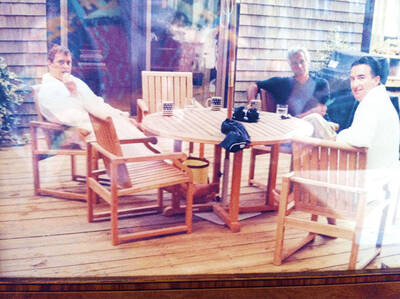
SCANDAL: Other images discovered earlier show Andrew bent over a female and lying across the laps of a number of women, while Mandelson is pictured in his underpants A photograph of former British prince Andrew and veteran politician Peter Mandelson sitting in bathrobes alongside late sex offender Jeffrey Epstein was unearthed on Friday in previously published documents. The image is believed to be the first known photograph of the two men with Epstein. They are currently engulfed in scandal in the UK over their ties to their mutual friend. The undated photograph, first reported by ITV News, shows King Charles III’s disgraced brother and former British ambassador to the US sitting barefoot outside on a wooden deck. They appear to have mugs with a US flag on them
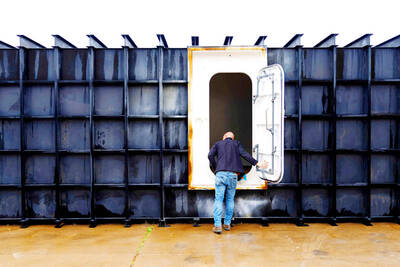
Since the war in the Middle East began nearly two weeks ago, the telephone at Ron Hubbard’s bomb shelter company in Texas has not stopped ringing. Foreign and US clients are rushing to buy his bunkers, seeking refuge in case of air raids, nuclear fallout or apocalypse. With the US and Israel pounding Iran, and Tehran retaliating with strikes across the region, Hubbard has seen demand for his product soar, mostly from Gulf nation customers in Bahrain, Qatar, Kuwait and the United Arab Emirates. “You can imagine how many people are thinking: ‘I wish I had a bomb shelter,’” Hubbard, 63, said in


 RSS
RSS