


Exit polls yesterday gave Indonesian President Susilo Bambang Yudhoyono an unassailable lead as voting closed in the second direct presidential election since the fall of the Suharto dictatorship.
A poll broadcast by MetroTV gave the liberal former general 58.51 percent of the vote, compared with 26.32 percent for opposition leader Megawati Sukarnoputri and 15.18 percent for outgoing Vice President Jusuf Kalla.
Another “quick count” poll broadcast by TV One gave Yudhoyono 60.10 percent, Megawati 27.33 percent and Kalla 12.58 percent.

PHOTO: AFP
Final official results are not expected for several days but the unofficial figures suggest Yudhoyono will avoid a second-round run-off in September.
He needs more than 50 percent of the vote and 20 percent in all 33 provinces to win in the first round.
“The vote count hasn’t finished yet ... but the poll surveys in their quick counts show the success of my comrades,” he said at his residence in Bogor, south of Jakarta, after polling closed across the archipelago.
Megawati and Kalla complained before the election about incomplete voting lists and missing polling booths, but Yudhoyono called on his rivals to resolve any objections peacefully.
“Let’s work together to maintain a peaceful situation in this country. If there are objections or protests, please do it through mechanisms and procedures in line with our law,” he said.
Megawati, the daughter of independence hero Sukarno and an ex-president who lost to Yudhoyono in 2004, has made no comment and a spokesman said she was not ready to concede defeat.
Kalla said he was “shocked” at his poor performance but offered his congratulations to Yudhoyono, his boss in the outgoing administration and running mate in 2004.
“Based on the quick count result I congratulate SBY, but I’m still waiting for the official results,” he said in an interview with TV One, using Yudhoyono’s nickname.
Some 170 million people were eligible to vote in the world’s largest Muslim-majority country, from eastern Papua province to Sumatra island in the west — spanning three time zones and 17,000 islands.
Yudhoyono has promised to boost growth and clean up the corrupt bureaucracy, but has been attacked as a “neo-liberal” by his rivals who championed populist policies of “self-reliance.”
The 59-year-old — who likes to write love songs in his spare time — is the most popular Indonesian leader in the democratic era despite a reputation for indecisiveness and his background as a Suharto loyalist.
His centrist Democratic Party almost tripled its vote in April general elections to become the largest in parliament, allowing him to pack his new Cabinet with hand-picked technocrats instead of political appointments.
If re-elected, he will be the first president to serve consecutive terms at the helm of the world’s third-biggest democracy behind India and the US, after its violent birth at the end of 32 years of dictatorship in 1998.
There were no reports of violence disrupting voting, despite communal tensions in several provinces.
Security forces opened fire on a group of people who attacked a police post and set three vehicles ablaze before dawn in Papua, but no one was injured.
With some 30 million people living below the poverty line, wages and jobs came well ahead of religious and security issues for many voters.

An American scientist convicted of lying to US authorities about payments from China while he was at Harvard University has rebuilt his research lab in Shenzhen, China, to pursue technology the Chinese government has identified as a national priority: embedding electronics into the human brain. Charles Lieber, 67, is among the world’s leading researchers in brain-computer interfaces. The technology has shown promise in treating conditions such as amyotrophic lateral sclerosis and restoring movement in paralyzed people. It also has potential military applications: Scientists at the Chinese People’s Liberation Army have investigated brain interfaces as a way to engineer super soldiers by boosting
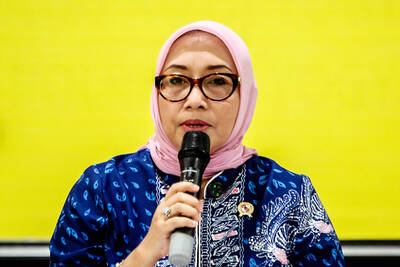
Indonesian police have arrested 13 people after shocking images of alleged abuse against small children at a daycare center went viral, sparking outrage across the nation, officials said on Monday. Police on Friday last week raided Little Aresha, a daycare center in Yogyakarta on Java island, following a report from a former employee. CCTV footage circulating on social media showed children, most younger than two, lying on the floor wearing only diapers, their hands and feet bound with rags. The police have confirmed that the footage is authentic. Police said they also found 20 children crammed into a room just 3m by 3m. “So
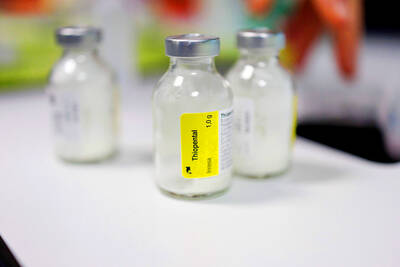
A grieving mother has ended her life at a clinic in Switzerland four years after the death of her only child. Wendy Duffy, 56, a physically healthy woman, died at the Pegasos clinic in Basel after struggling to cope with the death of her 23-year-old son, Marcus. The former care worker, from the West Midlands, England, had previously attempted to take her own life. The case comes as assisted dying would not become law in England and Wales after proposed legislation, branded “hopelessly flawed” by opponents, ran out of time. Ruedi Habegger, the founder of Pegasos, described Duffy’s death as
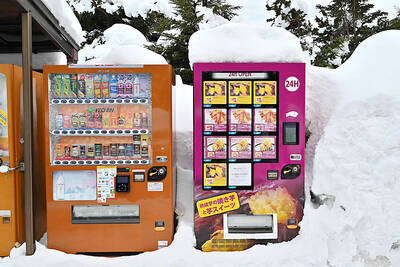
From post offices and parks to stations and even the summit of Mount Fuji, Japan’s vending machines are ubiquitous, but with the rapid pace of inflation cooling demand for their drinks, operators are being forced to rethink the business. Last month beverage giant DyDo Group Holdings announced it would remove about 20,000 vending machines — about 7 percent of their stock nationwide — by January next year, to “reconstruct a profitable network.” Pokka Sapporo Food & Beverage, based in Nagoya, also said last month it would sell its 40,000-machine operation to Osaka-based Lifedrink Co. “The strength of the vending machine


 RSS
RSS