


Moroccans were known as some of the fiercest fighters among the troops of right-wing General Francisco Franco in Spain’s 1936-1939 civil war.
But 70 years later, Moroccan campaigners see Franco’s “Moorish troops” as victims and seek an investigation to establish “the truth” about their fate.
Moroccans who fought for Franco were often recruited by force, says Abdesslam Boutayeb, president of the Moroccan Center for Common Memory and the Future (CMCA), which is trying to raise the issue with Spain.
Spanish historian Maria Rosa de Madariaga questions such views, saying Moroccans joined Franco’s troops voluntarily.
When Franco set out to topple Spain’s republican government, he launched his uprising from Morocco, the north of which was a Spanish protectorate at the time.
An estimated 80,000 Moroccans were recruited to fight alongside Francoists in the war, which claimed about 500,000 lives.
The Moroccans had a savage reputation and were greatly feared, as was Franco’s personal Moorish Guard after the war.
Francoists spread stories about the Moroccans’ cruelty to frighten their opponents, Moroccan researcher Boughaleb El Attar wrote in the Spanish daily El Pais.
The stories, which El Attar sees as having a racist component, contributed to a negative image of Moroccans that still lingers in Spain to this day.
Franco’s Moroccan soldiers were usually poor inhabitants of the northern mountainous Rif region, who joined the general’s troops to be fed and to get a salary, according to testimonies of war veterans.
Despite Catholicism forming an important part of his nationalist ideology, Franco did not hesitate to recruit Muslims to whom he presented his uprising as a joint Christian-Muslim fight against godless “reds.”
The Moroccans joined a foreign war the real causes of which they knew nothing about, El Attar writes.
Many were recruited against their will, Boutayeb said.
The CMCA wants to take advantage of Spain’s 2007 Law of Historic Memory, which seeks to restore the dignity of Franco’s forgotten republican victims.
Measures include support to groups digging up remains of republicans from mass graves.
The mass graves are also believed to contain bones of Moroccan soldiers, tens of thousands of whom went missing in the war, according to figures given by Boutayeb.
The CMCA has the backing of the National Rally of Independents, one of the main parties in Morocco’s coalition government.
Emilio Silva represents the Association for the Recovery of Historic Memory, the biggest group exhuming republican remains from mass graves.
The Moroccan soldiers “supported a coup” against Spain’s legal government, and “came here to kill people,” Silva said.
“They were given pensions, while the republicans got nothing,” he complains.
Most observers, however, agree that the pensions now received by about 2,000 Moroccan war veterans or widows are miserably small.
Although the Franco regime fixed the level of the pensions in an “irrevocable” decision, it would be fair for the Moroccans to get the same — higher — amount of pension money that Spanish war veterans get, de Madariaga wrote.

SPEAKING OUT: After Siranudh Scott’s allegations surfaced, celebrities and public figures took to social media to share their own experiences of sexual misconduct and abuse A high-profile alleged sexual abuse case within a wealthy Thai beer brewing family has prompted a wave of painful accounts from survivors of unconnected abuse in the conservative nation. Siranudh Scott, a member of the billionaire Thai family that founded the ubiquitous Singha beer brand, posted an emotional video this month accusing his elder brother Sunit of repeatedly abusing him when he was a teenager. Sunit, who is in his 30s, later denied the allegations in a video posted online, but Singha parent Boonrawd dismissed him from his executive role with the company on Tuesday last week. “I felt I needed to speak

SEEKING ORDER: Rodrigo Paz said that ‘anyone who wants to destroy the nation will have to deal with this president and the full force of the constitution’ Bolivian President Rodrigo Paz on Wednesday said that the nation was at a “breaking point” after nearly a month of protests that have caused shortages of food, fuel and medicine. Paz, who took office six months ago amid the worst economic crisis there in four decades, is battling a groundswell of fury over his policies. The political capital, La Paz, has been besieged by low-income workers and members of the indigenous majority calling for his resignation. “The country needs order and is reaching breaking point,” the 58-year-old said at a public event in La Paz, renewing his appeal for dialogue. On Tuesday, the Bolivian

A Hong Kong astronaut is to join a Chinese space mission for the first time as part of a three-person crew launching today, as Beijing edges closer to its goal of landing people on the moon. The Tiangong space station — crewed by teams of three astronauts that are typically rotated every six months — is the crown jewel of China’s space program, boosted by billions in state investment in a bid to catch up with the US and Russia. The Shenzhou-23 mission is to blast off at 11:08pm from the Jiuquan Satellite Launch Center in northwestern China, carrying three astronauts to
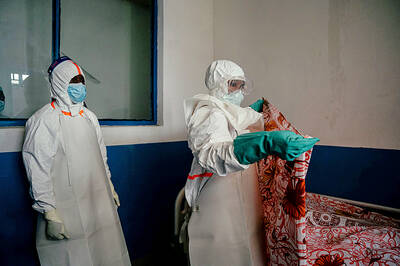
UPGRADED ALERT: The risk inside DR Congo is now considered ‘very high,’ while neighboring countries face a ‘high’ threat as the outbreak continues, the WHO said Ebola is spreading faster than responders can track it in eastern Congo, where health workers managed to follow up with barely one in five identified contacts in a single day. Authorities in the Democratic Republic of the Congo (DR Congo) reported 83 confirmed infections, 746 suspected cases and 1,603 identified contacts as of Thursday, but health workers were able to follow up on only 342 contacts that day — about 21 percent of the total under monitoring — data released by the DR Congo Ministry of Public Health on Friday showed. The figures suggest the response is falling behind the outbreak itself,


 RSS
RSS