


Protesters rallied on Saturday in the Thai capital to demand the resignation of court-suspended Thai Prime Minister Paetongtarn Shinawatra and in support of the armed forces following a violent border dispute with Cambodia that killed more than three dozen people and displaced more than 260,000.
Gathered at Bangkok’s Victory Monument despite soaring temperatures, many sang patriotic songs and listened to speeches denouncing Paetongtarn and her father, former Thai prime minister Thaksin Shinawatra, and voiced their backing of the country’s army, which has always retained substantial power in the Southeast Asian country.
Police said there were about 2,000 protesters by mid-afternoon, although more were expected to join as the temperature cooled.
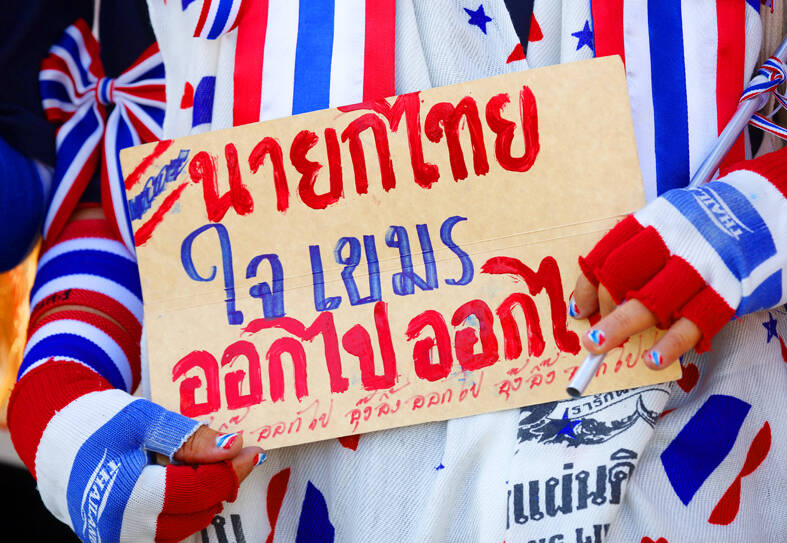
Photo: EPA
Some locals accuse Paetongtarn and her family of allowing the conflict — which stretches back decades with both sides claiming pockets of land near the shared border — to escalate due to their close ties with former Cambodian prime minister Hun Sen.
A court suspended Paetongtarn last month after Hun Sen, still a major power in his own country, leaked a phone call in which she called him “uncle” and appeared to denigrate a Thai general, angering many.
The most recent clashes ended with an uneasy Malaysian-brokered ceasefire on Tuesday last week.
“Ung Ing, you need to leave,” said one well-known conservative columnist and protester, Jittakorn Bussaba, using Paetongtarn’s nickname.
“Because there’s blood on your hands. People have died because of you,” he said from the stage to general applause.
“Ung Ing has damaged the country. Everyone needs to help out,” 58-year-old Ammorn Khunthong said. “Thaksin and his family should not run or command this country anymore.”
There were many familiar faces from a conservative, pro-royalist group once known as the Yellow Shirts, long-time foes of Paetongtarn’s father, who was toppled in a military coup in 2006.
Thaksin, a billionaire tycoon, entered politics by founding his own political party and buying the loyalty of local political bosses nationwide. He was often accused of bullying critics and not separating his business dealings from those of the government.
Yellow Shirts rallies also helped oust the elected government of Thaksin’s sister, then-Thai prime minister Yingluck Shinawatra, in a 2014 coup.
The army in Thailand plays a major role in politics and has staged 13 successful coups since the country became a constitutional monarchy in 1932.

Four contenders are squaring up to succeed Antonio Guterres as secretary-general of the UN, which faces unprecedented global instability, wars and its own crushing budget crisis. Chile’s Michelle Bachelet, Argentina’s Rafael Grossi, Costa Rica’s Rebeca Grynspan and Senegal’s Macky Sall are each to face grillings by 193 member states and non-governmental organizations for three hours today and tomorrow. It is only the second time the UN has held a public question-and-answer, a format created in 2016 to boost transparency. Ultimately the five permanent members of the UN’s top body, the Security Council, hold the power, wielding vetoes over who leads the

South Korea’s air force yesterday apologized for a 2021 midair collision involving two fighter jets, a day after auditors said the pilots were taking selfies and filming during the flight and held them responsible for the accident. “We sincerely apologize to the public for the concern caused by the accident that occurred in 2021,” an air force spokesman told a news conference, adding that one of the pilots involved had been suspended from flying duties, received severe disciplinary action and has since left the military. The apology followed a report released on Wednesday by the South Korean Board of Audit and Inspection,

Young Chinese, many who fear age discrimination in their workplace after turning 35, are increasingly starting “one-person companies” that have artificial intelligence (AI) do most of the work. Smaller start-ups are already in vogue in Silicon Valley and elsewhere, with rapidly advancing AI tools seen as a welcome teammate even as they threaten layoffs at existing firms. More young people in China are subscribing to the model, as cities pledge millions of dollars in funding and rent subsidies for such ventures, in alignment with Beijing’s political goal of “technological self-reliance.” “The one-person company is a product of the AI era,” said Karen Dai

About 240 Indians claiming descent from a Biblical tribe landed at Tel Aviv airport on Thursday as part of a government operation to relocate them to Israel. The newcomers passed under a balloon arch in blue and white, the colors of the Israeli flag, as dozens of well-wishers welcomed them with a traditional Jewish song. They were the first “bnei Menashe” (“sons of Manasseh”) to arrive in Israel since the government in November last year announced funding for the immigration of about 6,000 members of the community from the states of Manipur and Mizoram in northeast India. The community claims to descend from


 RSS
RSS