


It has the wingspan of a Boeing 747 but weighs less than a small car. And it is powered entirely by the sun.
Adventurer Bertrand Piccard on Friday unveiled the Solar Impulse, which, with its sleek white wings and pink trimming, aims to make history as the prototype for a solar-powered flight around the world.
“Yesterday it was a dream, today it is an airplane, tomorrow it will be an ambassador of renewable energies,” said Piccard, who in 1999 copiloted the first round-the-globe nonstop balloon flight.
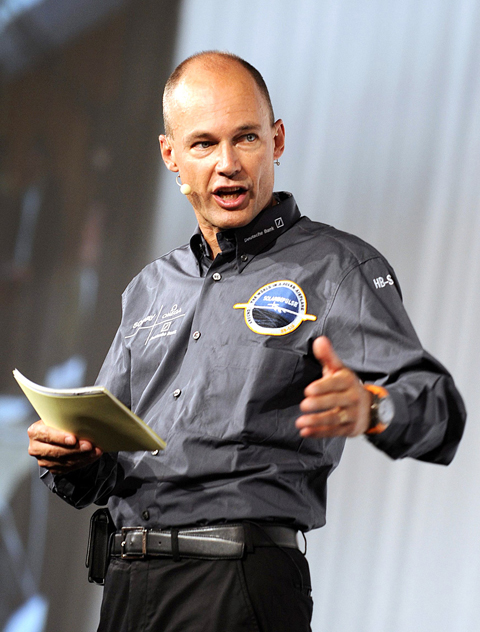
PHOTO: REUTERS
The plane will take part in a series of test flights over the next two years, and based on the results, a new plane will be constructed for the big takeoff, in 2012.
In a swank ceremony at a military airfield near Zurich, Piccard and co-pilot Andre Borschberg hugged as the curtain was pulled back to give the public its first glimpse of the plane. Numerous dignitaries were in attendance, including Prince Albert of Monaco and major sponsors.
The budget for the project is US$98 million, Piccard said.
He and Borschberg said the plane would fly day and night using almost 12,000 solar cells, rechargeable lithium batteries and four electric motors. It will not use an ounce of fuel.
But the maiden flight around the planet will take time.
With the engines providing only 40 horsepower, the plane will fly almost like a scooter in the sky. It will take off at the pedestrian pace of 35kph, accelerating at altitude to an average flight speed of 70kph.
Unlike the nonstop balloon trip, the solar flight will have to make stops to allow for pilots to switch over and stretch after long periods in the cramped cockpit.
“You can see it’s really small,” Borschberg said. “Thirty-six hours is already a challenge. It tests your patience.”
The first test flights will be later this year, with a complete night voyage planned for next year.
Solar plane technology is reminiscent of the early days of manned flight.
“It will be like the Wright brothers,” said the 51-year-old Piccard, who comes from a long line of adventurers.
His late father Jacques plunged deeper beneath the ocean than any other man, and grandfather Auguste was the first man to take a balloon into the stratosphere.
“We will start 1 meter above the ground, then 3 meters, then 5 meters,” he said. “When that works, we’ll be able to take it to altitude.”
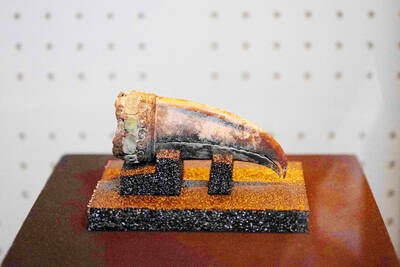
Archeologists in Peru on Thursday said they found the 5,000-year-old remains of a noblewoman at the sacred city of Caral, revealing the important role played by women in the oldest center of civilization in the Americas. “What has been discovered corresponds to a woman who apparently had elevated status, an elite woman,” archeologist David Palomino said. The mummy was found in Aspero, a sacred site within the city of Caral that was a garbage dump for more than 30 years until becoming an archeological site in the 1990s. Palomino said the carefully preserved remains, dating to 3,000BC, contained skin, part of the
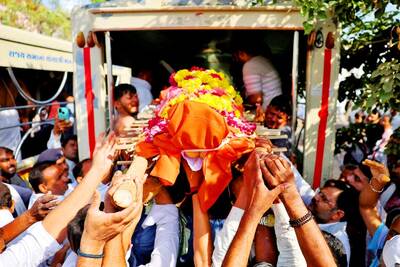
‘WATER WARFARE’: A Pakistani official called India’s suspension of a 65-year-old treaty on the sharing of waters from the Indus River ‘a cowardly, illegal move’ Pakistan yesterday canceled visas for Indian nationals, closed its airspace for all Indian-owned or operated airlines, and suspended all trade with India, including to and from any third country. The retaliatory measures follow India’s decision to suspend visas for Pakistani nationals in the aftermath of a deadly attack by shooters in Kashmir that killed 26 people, mostly tourists. The rare attack on civilians shocked and outraged India and prompted calls for action against their country’s archenemy, Pakistan. New Delhi did not publicly produce evidence connecting the attack to its neighbor, but said it had “cross-border” links to Pakistan. Pakistan denied any connection to

TRUMP EFFECT: The win capped one of the most dramatic turnarounds in Canadian political history after the Conservatives had led the Liberals by more than 20 points Canadian Prime Minister Mark Carney yesterday pledged to win US President Donald Trump’s trade war after winning Canada’s election and leading his Liberal Party to another term in power. Following a campaign dominated by Trump’s tariffs and annexation threats, Carney promised to chart “a new path forward” in a world “fundamentally changed” by a US that is newly hostile to free trade. “We are over the shock of the American betrayal, but we should never forget the lessons,” said Carney, who led the central banks of Canada and the UK before entering politics earlier this year. “We will win this trade war and
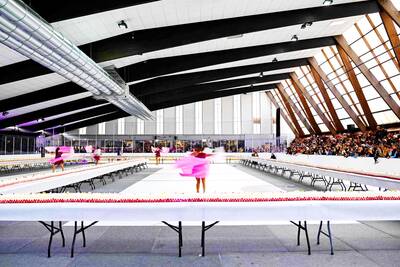
Armed with 4,000 eggs and a truckload of sugar and cream, French pastry chefs on Wednesday completed a 121.8m-long strawberry cake that they have claimed is the world’s longest ever made. Youssef El Gatou brought together 20 chefs to make the 1.2 tonne masterpiece that took a week to complete and was set out on tables in an ice rink in the Paris suburb town of Argenteuil for residents to inspect. The effort overtook a 100.48m-long strawberry cake made in the Italian town of San Mauro Torinese in 2019. El Gatou’s cake also used 350kg of strawberries, 150kg of sugar and 415kg of


 RSS
RSS