


One contributor to global warming is being left out of efforts by the administration of US President Barack Obama and House Democrats to limit greenhouse gas emissions — cow burps.
Belching from 170 million cattle, sheep and pigs produces about one-quarter of the methane released in the US each year, according to the Environmental Protection Agency (EPA). That makes them the largest source of the heat-trapping gas.
In part because of an adept farm lobby campaign that equates government regulation with a cow tax, the gas that farm animals pass is exempt from legislation being considered by Congress to limit greenhouse gas emissions.
The EPA has said it has no plans to regulate the gas, even though it recently included methane among six greenhouse gases it believes are endangering human welfare.
The message circulating in farm co-ops has US’ farms facing financial ruin if the EPA requires them to purchase air-pollution permits. The cost of those permits amounted to a cow tax, farm groups argued.
“It really has taken on a life of its own,” said Rick Krause, a lobbyist with the American Farm Bureau Federation. “This is something that people understand. All that we have to say is that [cows] are the next step with these proposed permit fees.”
Administration officials and House Democratic leaders have tried to assure farm groups that they have no intention of regulating cows but lawmakers and farm groups are pressing for the climate legislation to guarantee that farmers will be compensated for taking steps to reduce greenhouse gases. That could lead to farmers getting paid if their cows pass less gas.
Research has shown that changing cattle diet and boosting efficiency can result in less gas, said Frank Mitloehner, an associate professor at the University of California at Davis.
But laws designed to reduce emissions from smokestacks and tailpipes won’t work with cattle.
The climate bill specifically excludes enteric fermentation — the term for the gas created by digestion — from the limit it would place on greenhouse gas emissions.
The legislation directs the EPA not to include it among the various sources that could be subject to new performance standards.
EPA administrator Lisa Jackson has called rumors of the cow tax “ridiculous notions.”
House aides and EPA officials say that controlling such emissions is unworkable but allies of farmers in Congress say the reluctance to step into the cow tax debate has a lot to do with the outcry from the agriculture industry and moderate Democrats from rural states whose votes are needed to pass the bill.
The origins of the cow tax can be traced to last July, when former US president George W. Bush’s EPA released documents outlining how the Clean Air Act could regulate greenhouse gases.
Farm groups seized on a paragraph in the comments from various federal agencies and the Agriculture Department warned that if the EPA regulated agricultural sources of greenhouse gases, numerous farms would face a costly process to acquire permits for barnyard burping and the cow tax was born.

A US YouTuber who caused outrage for filming himself kissing a statue commemorating Korean wartime sex slaves has been sentenced to six months in prison, a court in Seoul said yesterday. Johnny Somali, 25, gained notoriety several years ago for recording himself doing a series of provocative stunts in South Korea and Japan, and streaming them on platforms such as YouTube and Twitch. South Korean authorities indicted Somali — whose real name is Ramsey Khalid Ismael — in 2024 on public order violations and obstruction of business, and banned him from leaving the country. “The court has sentenced him to six months in
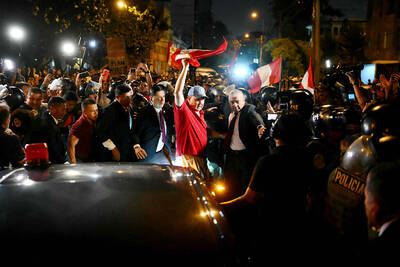
Former Lima mayor Rafael Lopez Aliaga, a Peruvian presidential hopeful, gathered hundreds of supporters in Lima on Tuesday and gave authorities 24 hours to annul the first round of the country’s election over allegations of fraud. Lopez Aliaga is locked in a tight three-way race with two other candidates for second place in Sunday’s vote. The election runner-up wins a ticket to June’s presidential run-off against front-runner Keiko Fujimori. “I am giving them 24 hours to declare this electoral fraud null and void,” said Lopez Aliaga, surrounded by a crowd of several hundred supporters. “If it is not declared null and void tomorrow,
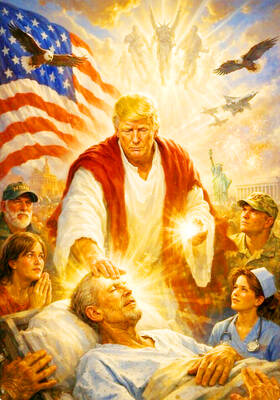
PAPAL RETORT: Pope Leo told reporters that he has ‘no fear, neither of the Trump administration nor speaking out loudly about the message of the Gospel’ US President Donald Trump has feuded with Pope Leo XIV over the Iran conflict — setting off an unholy row that could have serious political implications for the Republican leader back in the US. Trump has drawn barbs even from some allies over the attacks on the US-born pontiff, who has criticized the Trump administration over its immigration crackdown, the intervention in Venezuela and the Iran war. The president risks alienating the religious right in November’s crucial US midterm elections. So far the unprecedented clash between the leader of the most powerful military on Earth and the head of the world’s 1.4 billion

A 16-year-old boy has been charged with murder and aggravated sexual abuse in Florida in the death of his 18-year-old stepsister on a Carnival Cruise ship, the US Department of Justice said on Monday. Timothy Hudson was initially charged in February and subsequently indicted on March 10, but the breadth of the case was not known until a seal was lifted on Friday last week, weeks after US District Judge Beth Bloom in Miami said that he would be prosecuted as an adult at the request of the government. Anna Kepner had been traveling on the Carnival Horizon ship in November last


 RSS
RSS