


The Japanese parliament yesterday was set to pass an anti-piracy law that would allow the nation’s military wider scope to use force and protect foreign-flagged ships off Somalia, officials said.
Japan in March joined the US, China and other countries in the maritime operation against pirates who have attacked ships in the Gulf of Aden, a key maritime route leading to the Suez Canal.
Because of limits on Japan’s military imposed under its post-World War II pacifist Constitution, Japan’s two destroyers so far have no mandate to use force except in self-defense and to protect Japanese interests.
RULES OF ENGAGEMENT
The government-sponsored bill would widen their rules of engagement and allow them to fire at the hulls of pirate vessels — but not at the pirates themselves — after repeated warnings and as a last resort.
The new bill would also allow the Japanese Maritime Self-Defense Force to protect any commercial ships threatened by pirates, not just those sailing under the Japanese flag or carrying Japanese nationals or cargo.
Japan’s lower house first passed the bill in April, but the opposition-controlled upper house rejected it early yesterday after lawmakers voiced concern about expanding Japan’s military reach.
OVERRIDE
However, the lower house, which can override upper house vetos on certain bills, was expected to turn the bill into law later yesterday.
The opposition, led by the Democratic Party of Japan (DPJ), has called for a revision to the bill to strengthen the role of the coast guard instead of the military in anti-piracy activities in waters far from Japan.
Conservative Japanese Prime Minister Taro Aso, who faces an election this year, has strongly promoted the bill, arguing Japan should play a greater role in international security.
Aso has also said security of maritime transport was vitally important for Japan, a resource-poor island country that draws much of its energy needs from the Middle East.
DESTROYERS
In addition to two destroyers, with some 400 crew, Japan last month dispatched two maritime surveillance aircraft and scores of military personnel to beef up its anti-piracy mission.
The operation is an unprecedented military mission abroad for Japan, which raises the likelihood its armed forces could face armed combat abroad for the first time since World War II.
Japan’s major past overseas military missions — including in Iraq, near Afghanistan and as UN peacekeepers — have focused on logistical and support operations such as refueling, transport and reconstruction.

‘IN A DIFFERENT PLACE’: The envoy first visited Shanghai, where he attended a Chinese basketball playoff match, and is to meet top officials in Beijing tomorrow US Secretary of State Antony Blinken yesterday arrived in China on his second visit in a year as the US ramps up pressure on its rival over its support for Russia while also seeking to manage tensions with Beijing. The US diplomat tomorrow is to meet China’s top brass in Beijing, where he is also expected to plead for restraint as Taiwan inaugurates president-elect William Lai (賴清德), and to raise US concerns on Chinese trade practices. However, Blinken is also seeking to stabilize ties, with tensions between the world’s two largest economies easing since his previous visit in June last year. At the

UNSETTLING IMAGES: The scene took place in front of TV crews covering the Trump trial, with a CNN anchor calling it an ‘emotional and unbelievably disturbing moment’ A man who doused himself in an accelerant and set himself on fire outside the courthouse where former US president Donald Trump is on trial has died, police said yesterday. The New York City Police Department (NYPD) said the man was declared dead by staff at an area hospital. The man was in Collect Pond Park at about 1:30pm on Friday when he took out pamphlets espousing conspiracy theories, tossed them around, then doused himself in an accelerant and set himself on fire, officials and witnesses said. A large number of police officers were nearby when it happened. Some officers and bystanders rushed

Beijing is continuing to commit genocide and crimes against humanity against Uyghurs and other Muslim minorities in its western Xinjiang province, U.S. Secretary of State Antony Blinken said in a report published on Monday, ahead of his planned visit to China this week. The State Department’s annual human rights report, which documents abuses recorded all over the world during the previous calendar year, repeated language from previous years on the treatment of Muslims in Xinjiang, but the publication raises the issue ahead of delicate talks, including on the war in Ukraine and global trade, between the top U.S. diplomat and Chinese
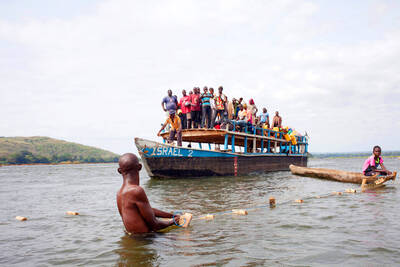
RIVER TRAGEDY: Local fishers and residents helped rescue people after the vessel capsized, while motorbike taxis evacuated some of the injured At least 58 people going to a funeral died after their overloaded river boat capsized in the Central African Republic’s (CAR) capital, Bangui, the head of civil protection said on Saturday. “We were able to extract 58 lifeless bodies,” Thomas Djimasse told Radio Guira. “We don’t know the total number of people who are underwater. According to witnesses and videos on social media, the wooden boat was carrying more than 300 people — some standing and others perched on wooden structures — when it sank on the Mpoko River on Friday. The vessel was heading to the funeral of a village chief in


 RSS
RSS