


A top Indian leader on Thursday called for an end to protests that left dozens dead in Peru’s Amazon after Congress revoked two decrees that indigenous groups said would spur oil and gas exploitation and other development on their ancestral lands.
At a news conference after lawmakers voted 82-14 to lift the disputed decrees, Daysi Zapata, vice president of the Amazon Indian confederation that led the protests, urged activists to lift blockades of jungle rivers and roads set up in April at points across six jungle provinces.
“This is a historic day for indigenous people because it shows that our demands and our battles were just,” Zapata told a news conference.
She added that the confederation was calling its members to “tell them to lift the measures.”
While government officials in Lima reported that protests were already subsiding, Indians contacted at a roadblock outside the jungle town of Yurimaguas had not yet lifted their blockade.
The protests turned bloody on June 5 outside the jungle town of Bagua when security forces broke up a road blockade manned by activists. The government says 23 police and 10 civilians were killed, with one police officer missing. Indian leaders say at least 30 civilians died.
Confederation president Alberto Pizango left Peru for political asylum in Nicaragua on Wednesday after being charged with sedition and rebellion, and Indian leader Marcial Mudarra said by telephone on Thursday that he and 35 others were still in hiding to avoid arrest.
Indians have opposed the 11 pro-investment decrees that were issued by Peruvian President Alan Garcia early last year under special legislative powers granted him by Peru’s Congress to enact a free-trade agreement with the US. They say the laws could affect 56 Amazon nations representing hundreds of thousands of Indians.
The legislature revoked two of the decrees last August after Indians blocked highways, waterways and a state oil pipeline. The protests had affected pumping by state oil company Petroperu through its northern pipeline, as well as production by Argentina’s Pluspetrol.
Garcia initially refused to review the remaining decrees when Indians resumed their protests in April and his party blocked votes on them in Congress, arguing they were needed to bring investment and development to Peru’s impoverished jungle.
Following the bloodshed, however, the government promised to ask Congress to revoke two of the most hotly opposed decrees, regulating forestry and agricultural land use. The two decrees fast-tracked large-scale farming, logging and other private companies looking to acquire land in the Amazon, where Indians have had difficulty getting legal title to their traditional lands.
On Wednesday, Garcia recognized a “series of errors” in his management of the protests and apologized for failing to consult Indian leaders before enacting the decrees.

Hungarian authorities temporarily detained seven Ukrainian citizens and seized two armored cars carrying tens of millions of euros in cash across Hungary on suspicion of money laundering, officials said on Friday. The Ukrainians were released on Friday, following their detention on Thursday, but Hungarian officials held onto the cash, prompting Ukraine to accuse Hungary’s Russia-friendly government of illegally seizing the money. “We will not tolerate this state banditism,” Ukrainian Minister of Foreign Affairs Andrii Sybiha said. The seven detained Ukrainians were employees of the Ukrainian state-owned Oschadbank, who were traveling in the two armored cars that were carrying the money between Austria and

Kosovar President Vjosa Osmani on Friday after dissolving the Kosovar parliament said a snap election should be held as soon as possible to avoid another prolonged political crisis in the Balkan country at a time of global turmoil. Osmani said it is important for Kosovo to wrap up the upcoming election process and form functional institutions for political stability as the war rages in the Middle East. “Precisely because the geopolitical situation is that complex, it is important to finish this electoral process which is coming up,” she said. “It is very hard now to imagine what will happen next.” Kosovo, which declared

MORE BANS: Australia last year required sites to remove accounts held by under-16s, with a few countries pushing for similar action at an EU level and India considering its own ban Indonesia on Friday said it would ban social media access for children under 16, citing threats from online pornography, cyberbullying, online fraud and Internet addiction. “Accounts belonging to children under 16 on high-risk platforms will start to be deactivated, beginning with YouTube, TikTok, Facebook, Instagram, Threads, X, Bigo Live and Roblox,” Indonesian Minister of Communications and Digital Meutya Hafid said. “The government is stepping in so that parents no longer have to fight alone against the giants of the algorithm. Implementation will begin on March 28, 2026,” she said. The social media ban would be introduced in stages “until all platforms fulfill their
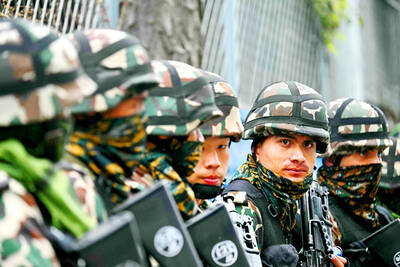
Counting was under way in Nepal yesterday, after a high-stakes parliamentary election to reshape the country’s leadership following protests last year that toppled the government. Key figures vying for power include former Nepalese prime minister K. P. Sharma Oli, rapper-turned-mayor Balendra Shah, who is bidding for the youth vote, and newly elected Nepali Congress party leader Gagan Thapa. In Kathmandu’s tea shops and city squares, people were glued to their phones, checking results as early trends flashed up — suggesting Shah’s centrist Rastriya Swatantra Party (RSP) was ahead. Nepalese Election Commission spokesman Prakash Nyupane said the counting was ongoing “in a peaceful manner”


 RSS
RSS