


Pakistan’s military chief denounced terrorists as enemies of the country and Islam, but warned his officers to avoid killing civilians as they widen their operations against the Taliban.
The government is seeking to capitalize on public support for its 6-week-old offensive in the Swat Valley region and open a new front in a nearby lawless tribal zone where al-Qaeda and the Taliban are entrenched.
The military action is being welcomed by the US as a strong stand against militants after years of failed offensives and striking deals rather than confronting Taliban hard-liners directly.
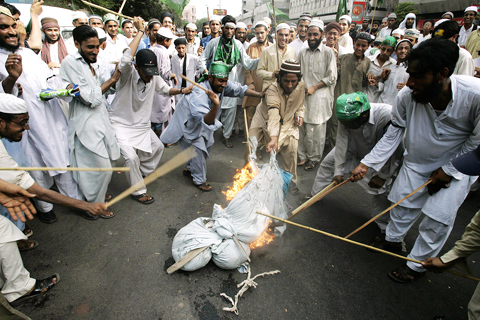
PHOTO: AP
But the weak government is also keenly aware that public support could sour if civilian casualties escalate or the task of resettling more than 2 million refugees displaced by fighting is badly handled.
A top official in the northwest said on Sunday that the government had given the order to send the military after Pakistani Taliban leader Baitullah Mehsud. The announcement was interpreted as effectively giving the go-ahead for a fresh military offensive in Waziristan, the semiautonomous tribal region on the border with Afghanistan that is rumored to be a hiding place of Osama bin Laden and where Mehsud makes his base.
In a carefully stage-managed event on Monday, selected television outlets taped armed forces chief General Ashfaq Parvez Kayani dressed in a tight-fitting flight suit clambering into the copilot’s seat of an F-16 fighter-bomber before taking off for a flight over the Swat Valley.
In an address to officers before the trip, Kayani denounced Mehsud and the Taliban leader in Swat, Maulana Fazlullah, saying they had nothing to do with Islam.
“Terrorists are the enemies of Pakistan and enemies of Islam. We have to eliminate them,” Kayani was quoted as saying by Geo TV, one of three networks invited to cover the event.
No questions were allowed.
He also stressed the importance of avoiding civilian casualties.
“In the present circumstances ... it is difficult to differentiate between friend and enemy,” Kayani told the officers. “The problem is that you have to separate black from white ... to avoid collateral damage.”
In the southern city of Karachi on Monday, hundreds of protesters furiously beat and kicked effigies of Mehsud and a hardline cleric who negotiated a failed peace deal that handed control of Swat to the militants prior to the military operation.
“They are the murderers of the Muslims,” the mob chanted, setting the effigies alight.
Meanwhile, Pakistan’s military shelled rebel hideouts in the northwest tribal belt yesterday, where forces are believed to be on the brink of an all-out onslaught to crush the Taliban, officials said.
Artillery struck insurgent hideouts in districts of South Waziristan, a semi-autonomous northwest tribal region on the Afghan border and Mehsud stronghold.
“Security forces used heavy artillery to pound militant hideouts. We have reports that several miscreants have been killed but we do not know the exact number,” said an intelligence official in the northwest’s main city Peshawar.
A government official based in the area confirmed the strikes, which began overnight and continued into early yesterday.
Residents also reported shelling in the area, which ended in the morning.
“There is heavy firing since midnight — we can hear it,” Spainkai Raghzai resident Aftab Wazir said.
North West Frontier Province governor Owais Ahmad Ghani vowed to track down Mehsud, blaming him for a string of recent deadly bomb attacks.
The army has so far stayed silent on any new campaign in the tribal areas and it is not clear when an all-out offensive would begin. It has officially confirmed only some retaliatory strikes in and around South Waziristan.
New York-based watchdog Human Rights Watch on Tuesday urged the military to do all it could to avoid civilian casualties in any fresh offensive.
The group said that during the ongoing Swat campaign, many families have been trapped in the conflict zone, without being given ample chance to flee.
“The Taliban’s disregard for civilian life should not be mimicked by the Pakistani military,” said the group’s Asia director Brad Adams.

‘CROSSING THE LINE’: China’s embassy in Seoul criticized US Forces Korea Commander General Xavier Brunson, asking if his ‘hostile’ remarks were authorized by Washington South Korea and the US are in talks over recent public remarks by the commander of US Forces Korea, Seoul’s presidential office said yesterday, after the comments drew sharp criticism from China. In a recent podcast interview, US Forces Korea Commander General Xavier Brunson described South Korea as “the dagger in the heart of Asia” from China’s east coast, prompting the Chinese embassy in Seoul to say that he had “truly crossed the line.” The interview came amid growing speculation that Washington might seek to expand the role of US Forces Korea in countering the growing regional influence of China, a key

Through the noise of rushing papers and whirring belts at a print factory in Kyoto, two creators watch their photo essay come to life in broadsheet form — part of an effort to win new audiences in the age of artificial intelligence (AI). Despite the decline of the publishing industry, self-publication and handmade “zine” magazines are growing in popularity in Japan, reflecting the nation’s enduring love of paper in the digital era. While speaking to Agence France-Presse at the plant, his hands black with ink, one of the creators, Kazuma Obara, said: “I think [paper] is a medium that engages all five

Australian researchers have trained lab-grown brain cells on a silicon computer chip to play the 1990s shooter game Doom and said they are just scratching the surface of what the neurons could be capable of doing. It is the science-fiction work of biotech boffins at Cortical Labs, who researched and developed the technology that harnesses the workings of the brain’s networking system. Each so-called “biological computer” contains about 200,000 living human brain cells, grown from stem cells that were harvested from blood donations. Having mastered the simple computer game Pong, where a paddle is moved up and down to send a ball

France experienced its hottest spring on record, the French weather service said on Tuesday, after an exceptional early heat wave that also broke highs for the season in England and Wales. Meteo-France said the average nationwide temperature over March to May was 13.8°C — about 1.7°C above the norm, and surpassing records set in 2011 and 2020. “The warmest spring since records began in 1900,” it said in a bulletin. All three months were warmer than average, but the onset of an “unprecedented heatwave” late last month pushed the mercury to highs typically seen at the height of the summer. “Our country had never


 RSS
RSS