


Pakistani tribesmen avenging a mosque attack surrounded two militant strongholds and destroyed the homes of some Taliban commanders, an official said yesterday as the death toll in the fighting hit 13.
As many as 1,600 tribesmen have joined a citizens’ militia in Upper Dir district — an indication of rising anti-Taliban sentiment in Pakistan as the military pursues its offensive against the militant group in the nearby Swat Valley.
The militias, known as lashkar, were focusing on two villages known as Taliban strongholds, said Khaista Rehman, a local police chief. Officials said Sunday the tribesmen had managed to clear three other villages.
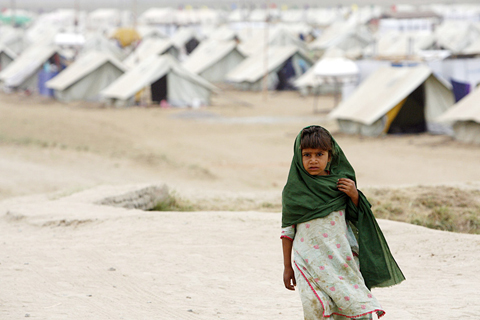
PHOTO: REUTERS
“An intense fight between the lashkar and the Taliban is still going on and the lashkar has destroyed 25 homes of Taliban commanders and their fighters in various villages,” Rehman said by phone. “The Taliban had set up their offices in those villages but the local residents and the lashkar have attacked them, and we hope the lashkar will succeed.”
The attack on the mosque on Friday left 33 worshippers dead and wounded dozens more during prayers, angering residents of the Haya Gai area of Upper Dir district, where minor clashes with local militants have occurred for months.
Including 11 militants killed over the weekend, the insurgent death toll reached 13 yesterday, senior police official Nawaz Khan said. Two tribesmen were wounded during yesterday’s fighting in the two villages.
The government has encouraged citizens to set up militias to oust Taliban fighters, especially in the regions that border Afghanistan where al-Qaeda and the Taliban have hide-outs. But villagers’ willingness to do so has often hinged on confidence that authorities will back them up if necessary.
With the army reporting advances against the Taliban in Swat — an operation that also reaches into Lower Dir district and has broad public support — that confidence appears to be growing.
Already, military officials say that as they’ve proceeded with the operation in Swat, local residents who have remained in the region have grown increasingly cooperative, providing tips on militants’ hide-outs and more.
The month-old Swat offensive, the latest round in a valley that has experienced fighting for two years, is seen as a test of Pakistan’s resolve to take on al-Qaeda and Taliban fighters on its soil.
The US hopes the offensive will eliminate a potential sanctuary for militants implicated in attacks on Western forces across the border in Afghanistan.
The military says more than 1,300 militants and 105 soldiers have died so far in the offensive, which has generally broad public support. The Taliban have threatened to stage suicide attacks in major Pakistani cities in revenge for the Swat operation.
Also yesterday, the leader of a Taliban faction at odds with Pakistani Taliban chief Baitullah Mehsud denounced Mehsud for staging attacks inside the country — a sign of rivalries within the collection of groups identified as the Taliban.
In an interview Qari Zainuddin urged tribal leaders to resist Mehsud and said his fighters would stay neutral if the army launches an operation in South Waziristan, Mehsud’s stronghold.

‘CROSSING THE LINE’: China’s embassy in Seoul criticized US Forces Korea Commander General Xavier Brunson, asking if his ‘hostile’ remarks were authorized by Washington South Korea and the US are in talks over recent public remarks by the commander of US Forces Korea, Seoul’s presidential office said yesterday, after the comments drew sharp criticism from China. In a recent podcast interview, US Forces Korea Commander General Xavier Brunson described South Korea as “the dagger in the heart of Asia” from China’s east coast, prompting the Chinese embassy in Seoul to say that he had “truly crossed the line.” The interview came amid growing speculation that Washington might seek to expand the role of US Forces Korea in countering the growing regional influence of China, a key

Through the noise of rushing papers and whirring belts at a print factory in Kyoto, two creators watch their photo essay come to life in broadsheet form — part of an effort to win new audiences in the age of artificial intelligence (AI). Despite the decline of the publishing industry, self-publication and handmade “zine” magazines are growing in popularity in Japan, reflecting the nation’s enduring love of paper in the digital era. While speaking to Agence France-Presse at the plant, his hands black with ink, one of the creators, Kazuma Obara, said: “I think [paper] is a medium that engages all five

Australian researchers have trained lab-grown brain cells on a silicon computer chip to play the 1990s shooter game Doom and said they are just scratching the surface of what the neurons could be capable of doing. It is the science-fiction work of biotech boffins at Cortical Labs, who researched and developed the technology that harnesses the workings of the brain’s networking system. Each so-called “biological computer” contains about 200,000 living human brain cells, grown from stem cells that were harvested from blood donations. Having mastered the simple computer game Pong, where a paddle is moved up and down to send a ball

France experienced its hottest spring on record, the French weather service said on Tuesday, after an exceptional early heat wave that also broke highs for the season in England and Wales. Meteo-France said the average nationwide temperature over March to May was 13.8°C — about 1.7°C above the norm, and surpassing records set in 2011 and 2020. “The warmest spring since records began in 1900,” it said in a bulletin. All three months were warmer than average, but the onset of an “unprecedented heatwave” late last month pushed the mercury to highs typically seen at the height of the summer. “Our country had never


 RSS
RSS