

Police in Islamabad were on high alert yesterday after a deadly suicide blast as the prime minister insisted a spike in attacks would not deter an ongoing anti-Taliban offensive.
Two policemen were killed late on Saturday when a suicide bomber walked up to a police emergency help-line center in an Islamabad residential district where many government officials live and detonated explosives strapped to his body.
Witnesses said police shot the suicide bomber before he was able to enter the compound but he was still able to detonate the bomb, which also injured three people.
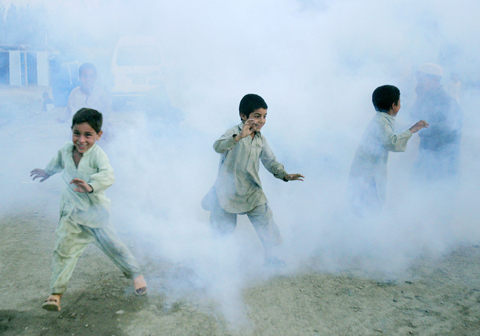
PHOTO: REUTERS
The night-time assault came after a suicide blast killed 38 people during Friday prayers at a mosque in Upper Dir, near three northwest districts hit by a six-week military offensive against Taliban fighters.
“Islamabad police are on high alert. We have taken tough security measures after the bombing on Saturday,” a senior police official said, asking not to be named as he was not authorized to speak to the media.
“They are conducting surprise checks of vehicles. A combing operation is underway to trace the culprits. We are hopeful the accused would be arrested over the next few days,” he said.
No group has claimed responsibility for the attack.
Saturday’s bombing is the latest in a series of attacks on civilian and security targets — attacks widely seen as retribution by Islamist extremists for Pakistan’s blistering air and ground offensive in northwestern Swat.
Since the offensive began in late April, more than a dozen bomb blasts have killed more than 100 people, with Peshawar, the main city in the northwest, Pakistan’s cultural capital Lahore and now Islamabad all hit.
Pakistani Prime Minister Yousuf Raza Gilani condemned the Islamabad attack, calling it a “cowardly act of terrorism,” a statement from his office said late on Saturday.
“The prime minister reiterated his government’s resolve to stamp out the menace of militancy and terrorism, adding that such incidents will not deter the government’s commitment to eliminate this scourge from the country,” it said.
It was the first such attack in Islamabad in more than two months, after a suicide bomber killed eight paramilitary police at a camp on April 4 on the edge of an upmarket residential area.
Bomb attacks blamed on Islamist extremists have killed more than 1,900 people in Pakistan in the past two years.
Pakistan launched its northwest push after the Taliban advanced to within 100km of Islamabad in early April, violating a deal to put the region’s 3 million people under Shariah law in exchange for peace.
Operations are now focused on the Taliban bastion of Swat valley, where Pakistani jets and helicopter gunships yesterday pounded militant strongholds and troops hunted down fighters allegedly holed up in the rugged mountains.
A senior military official said the jets were targeting Taliban in Qambar district outside the scenic valley’s main town of Mingora, while helicopters shelled Barikot, about 20km north of the town.
Waqif Khan, a local police chief in Swat’s Sher Garh town, said three civilians had been killed in the valley yesterday when security forces opened fire on them for violating a curfew.
Elsewhere in the troubled northwest, four people were killed in a clash between rival factions of the Pakistani Taliban in the tribal region of Bajaur near the Afghan border, local administration official Faramosh Khan said.
Meanwhile, hundreds of people banded together and attacked Taliban strongholds, killing 11 militants, to avenge the suicide bombing in Upper Dir, officials said yesterday.
Some 400 villagers near Upper Dir, where Friday’s attack killed 33 worshippers, formed a militia and attacked five villages in the nearby Dhok Darra area, said Atif-ur-Rehman, the district coordination officer.
The citizens’ militia has occupied three of the villages since Saturday and is trying to push the Taliban out of the other two.
Some 20 houses suspected of harboring Taliban were destroyed, he said.
At least 11 militants were killed, the district police chief, Ejaz Ahmad, said.
The government has encouraged local citizens to set up militias known as lashkar to oust Taliban fighters.
“It is something very positive that tribesmen are standing against the militants. It will discourage the miscreants,” Rehman said.
Ahmad said around 200 militants were putting up a stiff resistance in their strongholds surrounded by the villagers.
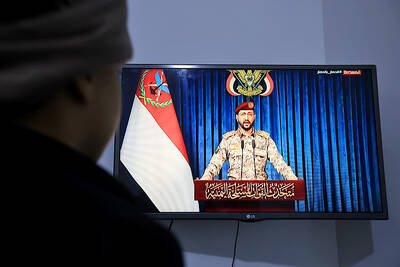
ON THE MOVE: Trump unexpectedly cut short a trip to return to the White House, while the State Department warned Americans to avoid travel to the Middle East The US on Saturday warned that hostilities between Saudi Arabia and Iran-backed Houthis could “escalate rapidly” after a missile attack targeted Riyadh for the first time since the Yemen conflict resumed. US President Donald Trump on Saturday cut short a weekend at Camp David, a secluded presidential complex in rural Maryland, to return unexpectedly to the White House. The White House gave no explanation for the early return, which comes as a new threshold was crossed in the conflict between Saudi Arabia and the Houthis, who control a large part of Yemen and are fighting government forces backed by a coalition led

The US military came close to boarding a Chinese vessel in the Middle East earlier this year based on a flawed intelligence report prepared with the help of artificial intelligence (AI), CNN said on Friday. US intelligence indicated the ship was carrying nuclear weapons-related components, leading US forces to prepare to intercept it, the broadcaster reported, citing four anonymous sources familiar with the incident. However, the operation was called off after officials determined that an AI chatbot used by an analyst had misidentified the material the ship was carrying. The report was “entirely false,” but “almost started a war,” CNN quoted one source

World leaders gather in New York this week for the UN General Assembly, bracing for US President Donald Trump’s return to the rostrum for a second year running, with talks centering on the widening conflicts in the Middle East and Ukraine and the risks of artificial intelligence (AI). Nearly 130 heads of state meet with the post-World War II order under strain and with the UN itself struggling to remain relevant and weathering attacks from Trump, who has slashed the US’ contributions and withdrawn from dozens of UN bodies. Chinese President Xi Jinping (習近平), who last addressed the diplomatic jamboree via video

Typhoon Dujuan forced the cancellation of at least 275 flights in Japan today and prompted warnings of potentially record-breaking rainfall as the storm nears Tokyo. The typhoon, which is accompanied by high winds, has also led to the early closure in Tokyo of one the world’s biggest video game trade fairs and knocked out power for thousands. The Japan Meteorological Agency (JMA) warned yesterday that rain and winds were expected to intensify even before the typhoon’s arrival. “The total rainfall through Tuesday could exceed the average monthly rainfall for September, resulting in record-breaking heavy rain,” the agency said. The typhoon’s wind speeds were at


 RSS
RSS