


Four days of voting for the EU Parliament started yesterday with the union’s leaders braced for high abstention rates and protest votes that could boost extremist parties.
Britain and the Netherlands started the 27-nation election in which 375 million people are eligible to take part. The turnout and the impact on national governments are the key stakes in the election.
Several extremist anti-EU right and left wing parties hope to pick up votes and even a few seats in the 736-member assembly.
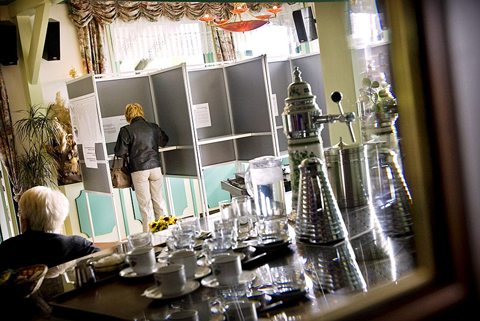
PHOTO: AFP
British Prime Minister Gordon Brown is under increasing pressure amid a scandal over expenses by members of the country’s national parliament which has seen ministerial heads roll.
His ruling Labour Party looks likely to be beaten into third place, at best, in the European polls, opinion polls showed, with even the anti-EU UK Independence Party snapping at its heels.
A Sunday Telegraph/ICM poll this week suggested Labour would garner just 17 percent of the vote, behind David Cameron’s opposition Conservatives and the third party, the centrist Liberal Democrats.
This was the worst Brown’s party had done in an opinion poll since 1987 and surveys on the local elections also predicted a weak performance.
Brown’s position is also under threat after four ministers, including two members of his Cabinet, quit in the past two days, and reports suggesting backbench Labour members of parliament (MP) are trying to unseat him.
British Communities Secretary Hazel Blears, who faced criticism over her expenses, resigned on Wednesday, and Home Secretary Jacqui Smith said she would step down at the next Cabinet reshuffle, expected within days.
After two other junior ministers quit on Tuesday, Cameron said: “The government is collapsing before our eyes.”
An opinion poll in the Netherlands predicted the Christian Democratic party of Prime Minister Jan Peter Balkenende would get 14 percent of the vote, and its governing partner, the labour PvdA party, 12 percent.
That leaves no comfort zone for the main parties as the Party for Freedom of controversial far-right MP Geert Wilders could also get 12 percent of the vote, the liberal VVD 11 percent, and the Socialist Party 10 percent.
The Dutch government will give preliminary results from the vote yesterday, but other countries will wait until Sunday — after the final 19 countries have voted to give the official results.
The European People’s Party (EPP) — an umbrella group for center-right parties from across the EU — is expected to remain the biggest political bloc in the parliament.
That is despite the fact that the British and Czech Conservatives have left the EPP, deeming it too europhile.
The European Socialists, currently the second-largest group in the European Parliament, are also preparing for mediocre results.
After the British and Dutch votes, attention shifts today to Ireland and the Czech Republic.
Cyprus, Latvia, Malta and Slovakia will go to the polls tomorrow before Europe’s Super Sunday, when the other 17 EU nations — including France, Germany, Italy and Spain — will round off the voting.
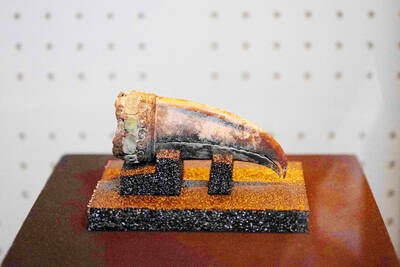
Archeologists in Peru on Thursday said they found the 5,000-year-old remains of a noblewoman at the sacred city of Caral, revealing the important role played by women in the oldest center of civilization in the Americas. “What has been discovered corresponds to a woman who apparently had elevated status, an elite woman,” archeologist David Palomino said. The mummy was found in Aspero, a sacred site within the city of Caral that was a garbage dump for more than 30 years until becoming an archeological site in the 1990s. Palomino said the carefully preserved remains, dating to 3,000BC, contained skin, part of the
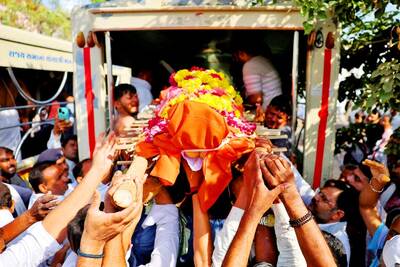
‘WATER WARFARE’: A Pakistani official called India’s suspension of a 65-year-old treaty on the sharing of waters from the Indus River ‘a cowardly, illegal move’ Pakistan yesterday canceled visas for Indian nationals, closed its airspace for all Indian-owned or operated airlines, and suspended all trade with India, including to and from any third country. The retaliatory measures follow India’s decision to suspend visas for Pakistani nationals in the aftermath of a deadly attack by shooters in Kashmir that killed 26 people, mostly tourists. The rare attack on civilians shocked and outraged India and prompted calls for action against their country’s archenemy, Pakistan. New Delhi did not publicly produce evidence connecting the attack to its neighbor, but said it had “cross-border” links to Pakistan. Pakistan denied any connection to

TRUMP EFFECT: The win capped one of the most dramatic turnarounds in Canadian political history after the Conservatives had led the Liberals by more than 20 points Canadian Prime Minister Mark Carney yesterday pledged to win US President Donald Trump’s trade war after winning Canada’s election and leading his Liberal Party to another term in power. Following a campaign dominated by Trump’s tariffs and annexation threats, Carney promised to chart “a new path forward” in a world “fundamentally changed” by a US that is newly hostile to free trade. “We are over the shock of the American betrayal, but we should never forget the lessons,” said Carney, who led the central banks of Canada and the UK before entering politics earlier this year. “We will win this trade war and

Armed with 4,000 eggs and a truckload of sugar and cream, French pastry chefs on Wednesday completed a 121.8m-long strawberry cake that they have claimed is the world’s longest ever made. Youssef El Gatou brought together 20 chefs to make the 1.2 tonne masterpiece that took a week to complete and was set out on tables in an ice rink in the Paris suburb town of Argenteuil for residents to inspect. The effort overtook a 100.48m-long strawberry cake made in the Italian town of San Mauro Torinese in 2019. El Gatou’s cake also used 350kg of strawberries, 150kg of sugar and 415kg of


 RSS
RSS