


The US on Sunday welcomed Cuba’s decision to hold talks on migration and direct mail service, but said it must still improve human rights before its isolation can be fully ended.
“We’re very pleased that the Cuban government has agreed to talks on migration and direct mail links,” US Secretary of State Hillary Clinton told reporters during a visit to El Salvador for yesterday’s inauguration of Salvadoran President Mauricio Funes.
The move to resume talks on migration and hold talks on direct mail service are in the interests of both countries, she said.
“At the same time we will continue to press the Cuban government to protect basic rights, release political prisoners and move toward democratic reform,” she said.
Clinton said she was taking her message on the need for Cuba to embrace democracy to Honduras, where she will attend the 35-member Organization of American States (OAS) general assembly today. The OAS is beset by a row over the pace of normalization with Cuba.
US President Barack Obama’s administration insists Cuba release political prisoners and improve political freedoms before it is readmitted. Some OAS states want Cuba readmitted right away, but Clinton on Sunday reiterated that the US would stand firm.
“We believe that membership in the OAS comes with responsibilities and that we must all hold each other accountable,” she said. “These responsibilities include abiding by the principles of democracy and human rights enshrined in the OAS charter and in the Inter-American democratic charter.”
It was Washington that proposed recently to resume direct mail service, the official said, adding mail has for years, if not decades, been sent between the US and Cuba through a third country. US officials said on May 23 that the Obama administration also had proposed to resume the discussions on migration issues, which had been conducted every two years until they were suspended in 2003 by former US president George W. Bush.
A senior US official, who is traveling with Clinton, told reporters that Havana informed Washington on Saturday that it would take up the US offer to resume long-stalled talks on migration issues and on direct mail service.
“We and the Cubans have to determine a mutually convenient place and time,” he said on the condition of anonymity.
The official said the Cubans “also indicated they would like to explore areas of additional dialogue,” such as in counter-narcotics, counterterrorism, hurricane and disaster preparedness response.
And when asked if the new steps to engage Cuba would affect the OAS meeting in San Pedro Sula, the senior official said “it is hoped ... that the region will recognize that anything done within the ambit of the OAS ... should support and foster this development, as opposed to hinder it.”
US officials earlier declined to even rule out the possibility of Clinton’s skipping the OAS meeting altogether if negotiators fail to agree on terms for bringing Cuba back within the OAS.
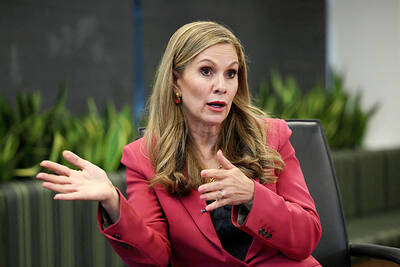
Australians were downloading virtual private networks (VPNs) in droves, while one of the world’s largest porn distributors said it was blocking users from its platforms as the country yesterday rolled out sweeping online age restriction. Australia in December became the first country to impose a nationwide ban on teenagers using social media. A separate law now requires artificial intelligence (AI)-powered chatbot services to keep certain content — including pornography, extreme violence and self-harm and eating disorder material — from minors or face fines of up to A$49.5 million (US$34.6 million). The country also joined Britain, France and dozens of US states requiring
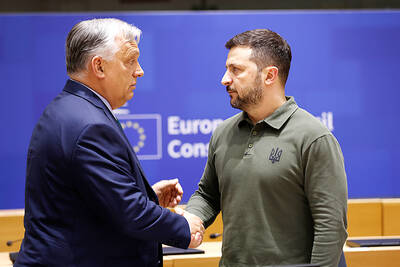
Hungarian authorities temporarily detained seven Ukrainian citizens and seized two armored cars carrying tens of millions of euros in cash across Hungary on suspicion of money laundering, officials said on Friday. The Ukrainians were released on Friday, following their detention on Thursday, but Hungarian officials held onto the cash, prompting Ukraine to accuse Hungary’s Russia-friendly government of illegally seizing the money. “We will not tolerate this state banditism,” Ukrainian Minister of Foreign Affairs Andrii Sybiha said. The seven detained Ukrainians were employees of the Ukrainian state-owned Oschadbank, who were traveling in the two armored cars that were carrying the money between Austria and
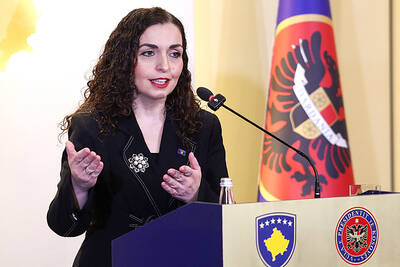
Kosovar President Vjosa Osmani on Friday after dissolving the Kosovar parliament said a snap election should be held as soon as possible to avoid another prolonged political crisis in the Balkan country at a time of global turmoil. Osmani said it is important for Kosovo to wrap up the upcoming election process and form functional institutions for political stability as the war rages in the Middle East. “Precisely because the geopolitical situation is that complex, it is important to finish this electoral process which is coming up,” she said. “It is very hard now to imagine what will happen next.” Kosovo, which declared

MORE BANS: Australia last year required sites to remove accounts held by under-16s, with a few countries pushing for similar action at an EU level and India considering its own ban Indonesia on Friday said it would ban social media access for children under 16, citing threats from online pornography, cyberbullying, online fraud and Internet addiction. “Accounts belonging to children under 16 on high-risk platforms will start to be deactivated, beginning with YouTube, TikTok, Facebook, Instagram, Threads, X, Bigo Live and Roblox,” Indonesian Minister of Communications and Digital Meutya Hafid said. “The government is stepping in so that parents no longer have to fight alone against the giants of the algorithm. Implementation will begin on March 28, 2026,” she said. The social media ban would be introduced in stages “until all platforms fulfill their


 RSS
RSS