


Russian and US negotiators are scheduled to meet in Geneva today for a second round of talks on renewing a key Cold War-era arms reduction deal, a month before their leaders hold a landmark summit.
Diplomats said the three day meeting on the Strategic Arms Reduction Treaty (START) treaty would be held behind closed doors at an undisclosed location, mirroring the discretion surrounding the first round in Moscow nearly two weeks ago.
“On the details of the negotiation, I think we prefer to keep that in private right now. I think that’s just the best way to conduct these kinds of negotiations,” US State Department spokesman Ian Kelly said in Washington.
First results from the talks are expected to be unveiled by US President Barack Obama and Russian President Dmitry Medvedev during their summit meeting in Moscow from July 6 through July 8, a Russian diplomat said.
Despite a thaw in US-Russian relations following the departure of the Bush administration, analysts were expecting little concrete progress on the 1991 START, which expires on Dec. 5.
On top of the complex technical issues surrounding the landmark treaty — which took a decade to reach agreement on the deep cuts in US and Soviet nuclear arsenals after the fall of the Iron Curtain — the negotiations are also hampered by differing ambitions.
“The sides are not in the same position. Obama needs a result to demonstrate that the ‘reset’ of US-Russian relations is getting somewhere,” said Evgeny Volk at the Heritage Foundation think tank.
Earlier this year, US Vice President Joseph Biden unveiled the Obama administration’s fresh approach to fractious US relations with the old Cold War foe, saying it wanted to press the “reset” button.
Disarmament expert Jozef Goldblat said the START talks allowed the US to create a climate “propitious for help with other more complicated subjects” where Washington needs Moscow’s support, such as Iran and North Korea’s controversial nuclear programs.
However, Russian Foreign Minister Sergei Lavrov has not concealed Moscow’s desire to broaden the talks to take account of the planned US anti-missile shield in Europe.
The US insists that the defensive shield is meant to counter an Iranian threat.
But Russia regards the shield, which would partly be based in former eastern bloc countries close to its borders, as a threat to its own security.
“The number one stumbling block is the anti missile shield,” Volk said. “Moscow wants Washington to give up deployment but the Americans are against that.”

Crowds in Bangladesh are flocking to snap photographs with an unlikely social media star — an albino buffalo with flowing blond hair nicknamed “Donald Trump” that is due to be sacrificed within days. Owner Zia Uddin Mridha, 38, said his brother named the 700kg bull over its flowing helmet of hair resembling the signature look of the US president. “My younger brother picked this name because of the buffalo’s extraordinary hair,” he said at his farm in Narayanganj, just outside the capital, Dhaka. Mridha said that a constant stream of curious visitors — social media fans, onlookers and children — have come throughout
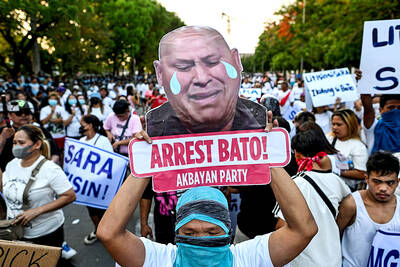
The Philippines said it has asked the country’s Supreme Court to allow it to arrest former Philippine president Rodrigo Duterte’s chief drug war enforcer to stand trial in an international tribunal. The International Criminal Court (ICC) last week unsealed an arrest warrant against Philippine Senator Ronald dela Rosa, accusing him along with Duterte and other “coperpetrators” of the “crime against humanity of murder.” Dela Rosa briefly sought refuge in the Philippine Senate last week while asking the Philippine Supreme Court to stop an ongoing attempt by government agents to arrest him. “By his own conduct, he has placed himself outside the protection of

It began as a satirical online project. Now millions of young people in India are flocking to it as an outlet for their frustration. A parody political party called the Cockroach Janta Party, with the insect as its symbol, has exploded across India’s social media by turning absurdist humor into protest. Memes and short videos mocking corruption, joblessness and political dysfunction have flooded social media sites, where millions of users are embracing the cockroach — known for its ability to survive harsh conditions — as a tongue-in-cheek symbol of endurance. The online movement’s rise has been unusually rapid. The Cockroach Janta Party (CJP)
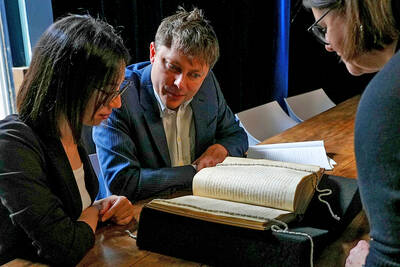
The researchers in Ireland looked at their computer screen, marveling at a medieval book tracked down in a Roman library. They flipped through its digitized pages and found their sought-after treasure: the oldest surviving English poem. “We were extremely surprised. We were speechless. We couldn’t believe our eyes when we first saw that,” said Elisabetta Magnanti, a visiting research fellow at Trinity College Dublin’s school of English. The poem was also within the main body of Latin text, she said, calling it “extraordinary.” Composed in Old English by a Northumbrian agricultural worker in the 7th century, Caedmon’s Hymn appears within some copies of


 RSS
RSS