


Climate change is causing 300,000 deaths a year and is affecting 300 million people, according to the first comprehensive study of the human impact of global warming.
The study projects that increasingly severe heatwaves, floods, storms and forest fires will be responsible for as many as 500,000 deaths a year by 2030, making it the greatest humanitarian challenge the world faces.
Climate change is also causing economic losses, amounting to more than US$125 billion a year — more than all the present world aid. The report comes from former UN secretary-general Kofi Annan’s think tank, the Global Humanitarian Forum. By 2030, the report says, climate change could cost US$600bn a year.
Writing in yesterday’s edition of the London-based Guardian newspaper, Rajendra Pachauri, chair of the UN intergovernmental panel on climate change, says: “The scale of devastation is so great that it is hard to believe the truth behind it, or how it is possible that so many people remain ignorant of this crisis.”
Civil unrest may also increase because of weather-related events, the report says: “Four billion people are vulnerable now and 500 million are now at extreme risk. Weather-related disasters ... bring hunger, disease, poverty and lost livelihoods. They pose a threat to social and political stability.”
If emissions are not brought under control within 25 years, the report states that:
• 310 million more people will suffer adverse health consequences related to temperature increases.
• 20 million more will fall into poverty.
• 75 million more will be displaced.
The study also compares, for the first time, the number of people affected by climate change in rich and poor countries. Nearly 98 percent of people seriously affected, 99 percent of all deaths from weather-related disasters and 90 percent of the total economic losses are borne by developing countries. The populations most at risk are in sub-Saharan Africa, the Middle East, south Asia and small Pacific island states.
But of the 12 countries considered least at risk, including Britain, all but one are industrially developed. Together they have made nearly US$72 billion available to adapt themselves to climate change but have pledged only US$400 million to help poor countries.
“This is less than one state in Germany is spending on improving its flood defenses,” the report said.
Annan, who launched the report in London on Friday, said: “The world is at a crossroads. We can no longer afford to ignore the human impact of climate change. This is a call to the negotiators to come to the most ambitious agreement ever negotiated or to continue to accept mass starvation, mass sickness and mass migration on an ever growing scale.”
Annan blamed politicians for the impasse in negotiations and widespread ignorance in many countries.
“Weak leadership, as evident today, is alarming. If leaders cannot assume responsibility they will fail humanity. Agreement is in the interests of every human,” he said.
On Friday, Todd Stern, US President Barack Obama’s special envoy on climate change, said the US planned emission cuts of 17 percent below 2005 levels by 2020 and up to 80 percent cuts by 2050.
“The proposed cuts are around the same as the EU. That would be hard policy, with a cap that gets progressively higher from 2012,” he said.
But he accepted poor countries needed money to adapt.
“We have requested US$300 million for international adaptation in our budget. There is no money on the table yet, as things have not gelled yet,” he said.
Barbara Stocking, head of Oxfam, said: “Adaptation efforts need to be scaled up. The world’s poorest are the hardest hit, but they have done the least to cause it.”
“Climate change is life or death. It is the new global battlefield,” Nobel peace prizewinner Wangari Maathai told the Guardian. “It is being presented as if it is the problem of the developed world. But it’s the developed world that has precipitated global warming.”
The report is based on data provided by the World Bank, the WHO, the UN, the Potsdam Institute and others, including top insurance companies and Oxfam. The authors accept the estimates carry uncertainties and could be higher or lower. But the paper was reviewed by 10 leading experts including Pachauri, Jeffrey Sachs of Columbia University and Potsdam’s John Schellnhuber.
Pachauri called it “the most plausible possible estimate of the human impacts of climate change today.”
On Thursday, 20 Nobel prize winners, including Wangari Maathai, Wole Soyinka and US energy secretary Steven Chu, called for a global deal on climate change “that matches the scale and urgency of the human, ecological and economic crises facing the world today.”
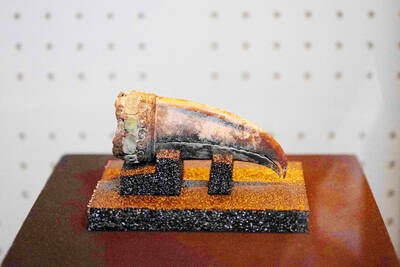
Archeologists in Peru on Thursday said they found the 5,000-year-old remains of a noblewoman at the sacred city of Caral, revealing the important role played by women in the oldest center of civilization in the Americas. “What has been discovered corresponds to a woman who apparently had elevated status, an elite woman,” archeologist David Palomino said. The mummy was found in Aspero, a sacred site within the city of Caral that was a garbage dump for more than 30 years until becoming an archeological site in the 1990s. Palomino said the carefully preserved remains, dating to 3,000BC, contained skin, part of the

TRUMP EFFECT: The win capped one of the most dramatic turnarounds in Canadian political history after the Conservatives had led the Liberals by more than 20 points Canadian Prime Minister Mark Carney yesterday pledged to win US President Donald Trump’s trade war after winning Canada’s election and leading his Liberal Party to another term in power. Following a campaign dominated by Trump’s tariffs and annexation threats, Carney promised to chart “a new path forward” in a world “fundamentally changed” by a US that is newly hostile to free trade. “We are over the shock of the American betrayal, but we should never forget the lessons,” said Carney, who led the central banks of Canada and the UK before entering politics earlier this year. “We will win this trade war and
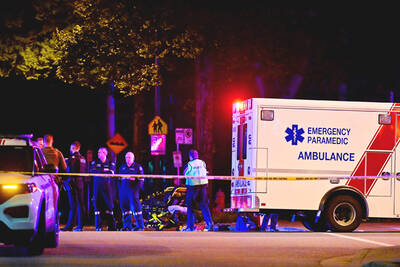
‘BODIES EVERYWHERE’: The incident occurred at a Filipino festival celebrating an anti-colonial leader, with the driver described as a ‘lone suspect’ known to police Canadian police arrested a man on Saturday after a car plowed into a street party in the western Canadian city of Vancouver, killing a number of people. Authorities said the incident happened shortly after 8pm in Vancouver’s Sunset on Fraser neighborhood as members of the Filipino community gathered to celebrate Lapu Lapu Day. The festival, which commemorates a Filipino anti-colonial leader from the 16th century, falls this year on the weekend before Canada’s election. A 30-year-old local man was arrested at the scene, Vancouver police wrote on X. The driver was a “lone suspect” known to police, a police spokesperson told journalists at the

North Korean leader Kim Jong-un has unveiled a new naval destroyer, claiming it as a significant advancement toward his goal of expanding the operational range and preemptive strike capabilities of his nuclear-armed military, state media said yesterday. North Korea’s state-run Korean Central News Agency (KCNA) said Kim attended the launching ceremony for the 5,000-tonne warship on Friday at the western port of Nampo. Kim framed the arms buildup as a response to perceived threats from the US and its allies in Asia, who have been expanding joint military exercises amid rising tensions over the North’s nuclear program. He added that the acquisition


 RSS
RSS