


Sahid Makmud was waiting for a Red Cross truck, which delivered food for hundreds of displaced families in the southern Philippines, when armed men in military uniform took him and two others away.
For almost a week, his pregnant wife and younger brother searched for him without success at army bases in Maguindanao Province on the southern island of Mindanao. The army denied any knowledge about Makmud’s disappearance.
Makmud’s body was eventually found on the edge of marshlands not far from his home.
Residents said his killing, and the likely death of the other two men, are part of a growing pattern of human rights abuses in the region. They blame the army for the wrongdoings.
“There were signs that he [Makmud] was tortured to death,” said his brother, Saudi.
The Philippine military has been regularly accused of human rights abuses and disappearances, including in a report by the UN special rapporteur on political killings.
NOT HERE
The country’s independent human rights body has said the situation improved this year, but residents in the south say not in central Mindanao, the battleground between rogue Muslim rebels and the largely Christian-dominated military.
Immediately after Makmud’s body was found, dozens of families from his village in Maguindanao Province fled to shelters. Tales of similar disappearances, murders and other human rights abuses across the oil and gas-rich wetlands in the region have triggered similar waves of displacement.
More than 1,500 families are camped out at a coconut plantation in Datu Odin Sinsuat town, making it the largest shelter for internal refugees in the province, said Nurhassim Abas, head of a local disaster agency.
HAMLETTING
“They feel much safer here because our community was further away from the conflict zone,” Abas said. “Soldiers seldom patrol this area and it is more accessible to humanitarian and aid agencies [for] delivery [of] food, medicines and other relief goods.”
Rebel factions seeking peace talks with the government say the military was forcing people to flee to a controlled area to deny Muslim guerrillas access to their support bases.
“That’s hamletting,” said Mohaqher Iqbal, a senior leader in the largest Muslim rebel group, the Moro Islamic Liberation Front (MILF).
He was referring to a military term that means the forced grouping of villagers in an effort to deny the enemy access to food, cash and other support.
“That’s clearly a human rights violation,” he said.
Muslim rights groups have noted that some army units now based in the south were transferred from provinces where communist rebels were active.
Many of the abuse cases documented in previous years have related to the crackdown on leftists.
Lieutenant-Colonel Jonathan Ponce, spokesman of the army division operating in Maguindanao, dismissed reports of rising cases of rights violations as propaganda by the MILF.
ROGUE REBELS
“Our soldiers strictly respect human rights and observe the laws of armed conflict,” he said. “We are not trying to force the people to flee from their homes. In fact, we have been helping rebuild communities in areas where we restored peace and order.”
Ponce said the latest wave of displacement in Maguindanao was caused by rogue MILF rebels who have started to attack villages in search for food and other supplies.

Crowds in Bangladesh are flocking to snap photographs with an unlikely social media star — an albino buffalo with flowing blond hair nicknamed “Donald Trump” that is due to be sacrificed within days. Owner Zia Uddin Mridha, 38, said his brother named the 700kg bull over its flowing helmet of hair resembling the signature look of the US president. “My younger brother picked this name because of the buffalo’s extraordinary hair,” he said at his farm in Narayanganj, just outside the capital, Dhaka. Mridha said that a constant stream of curious visitors — social media fans, onlookers and children — have come throughout
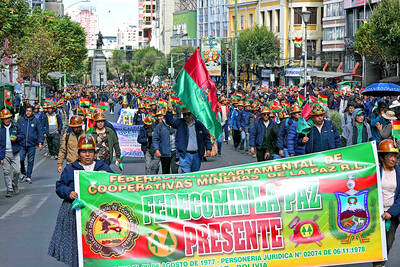
The Bolivian government on Friday struck a deal with protesting miners, but was still grappling with blockades and demonstrations by other workers across La Paz. Other groups are still blocking access roads into the city, which is also the seat of the government. Police on Thursday prevented the miners from entering the main square by using tear gas, while the demonstrators hurled stones and explosives with slingshots. Protests against the policies of Bolivian President Rodrigo Paz have convulsed the Andean nation since early this month, and roadblocks were choking routes into La Paz throughout Friday, the national road authority said. Miners demanded that Paz
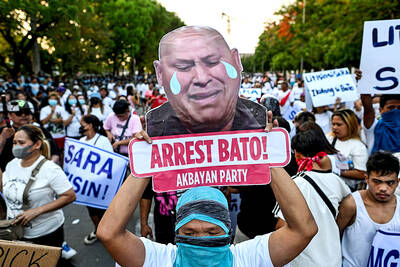
The Philippines said it has asked the country’s Supreme Court to allow it to arrest former Philippine president Rodrigo Duterte’s chief drug war enforcer to stand trial in an international tribunal. The International Criminal Court (ICC) last week unsealed an arrest warrant against Philippine Senator Ronald dela Rosa, accusing him along with Duterte and other “coperpetrators” of the “crime against humanity of murder.” Dela Rosa briefly sought refuge in the Philippine Senate last week while asking the Philippine Supreme Court to stop an ongoing attempt by government agents to arrest him. “By his own conduct, he has placed himself outside the protection of

The researchers in Ireland looked at their computer screen, marveling at a medieval book tracked down in a Roman library. They flipped through its digitized pages and found their sought-after treasure: the oldest surviving English poem. “We were extremely surprised. We were speechless. We couldn’t believe our eyes when we first saw that,” said Elisabetta Magnanti, a visiting research fellow at Trinity College Dublin’s school of English. The poem was also within the main body of Latin text, she said, calling it “extraordinary.” Composed in Old English by a Northumbrian agricultural worker in the 7th century, Caedmon’s Hymn appears within some copies of


 RSS
RSS