


The de facto deputy commander of UN-backed military operations in the Democratic Republic of Congo (DR Congo) is a warlord wanted by the International Criminal Court on war crimes charges, UN experts said.
General Bosco Ntaganda, a rebel who joined a peace deal ending a Tutsi-led rebellion earlier this year, has been indicted by the world court but plays a senior role in operations now being carried out against Rwandan Hutu rebels.
Dynamics have changed dramatically in DR Congo this year, with traditional foes DR Congo and Rwanda launching joint operations, but human rights experts have rounded on the UN peacekeeping force for not challenging Ntaganda’s new role.
“The Group has obtained a document that corroborates General Ntaganda’s role as de facto deputy commander [of the Congolese army],” the UN panel of experts said in an interim report seen by Reuters on Wednesday.
As well as the document, the experts said they had testimonies from senior army commanders and sources close to the former CNDP rebel militia confirming that Ntaganda was deputy commander despite another officer being officially nominated.
The UN peacekeeping mission has vowed not to take part in any operation of which Ntaganda is part, but it maintains it can continue supporting the current operations as Kinshasa has reassured it that the former rebel is not involved.
Attacks on the Rwandan Hutu FDLR rebels, some of whom took part in Rwanda’s 1994 genocide and have since been at the heart of much of the DR Congo’s violence, have helped improve Congo-Rwanda relations and ended the once powerful CNDP rebellion.
Analysts say the rebels have maintained or recovered much of the territory they lost, around 250,000 people have been displaced and Human Rights Watch (HRW) this week accused the army of war crimes in the process.
A UN Security Council delegation visiting Congo this week handed a list of the names of five army officers it wants the government to arrest for raping women as young as 14.
But the list, seen by Reuters, did not include Ntaganda, who is known as “The Terminator” and is accused of recruiting children to fight in the ranks of rebels he has led.
“Commitments by the government to arrest army officers responsible for rape is a step in the right direction,” said Anneke Van Woudenberg, HRW’s senior Africa researcher.
“But failing to add Bosco Ntaganda to the list is baffling. It undermines international justice and puts at risk the people of eastern Congo, who may face further abuses at his hands,” she said.

The Bolivian government on Friday struck a deal with protesting miners, but was still grappling with blockades and demonstrations by other workers across La Paz. Other groups are still blocking access roads into the city, which is also the seat of the government. Police on Thursday prevented the miners from entering the main square by using tear gas, while the demonstrators hurled stones and explosives with slingshots. Protests against the policies of Bolivian President Rodrigo Paz have convulsed the Andean nation since early this month, and roadblocks were choking routes into La Paz throughout Friday, the national road authority said. Miners demanded that Paz
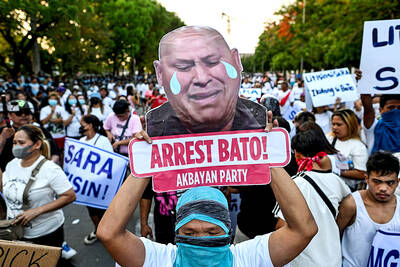
The Philippines said it has asked the country’s Supreme Court to allow it to arrest former Philippine president Rodrigo Duterte’s chief drug war enforcer to stand trial in an international tribunal. The International Criminal Court (ICC) last week unsealed an arrest warrant against Philippine Senator Ronald dela Rosa, accusing him along with Duterte and other “coperpetrators” of the “crime against humanity of murder.” Dela Rosa briefly sought refuge in the Philippine Senate last week while asking the Philippine Supreme Court to stop an ongoing attempt by government agents to arrest him. “By his own conduct, he has placed himself outside the protection of

A ship anchored off the United Arab Emirates (UAE) was seized and taken toward Iran and another — a cargo ship near Oman — sank after being attacked, authorities said on Thursday, as tensions escalated near the Strait of Hormuz. It was not immediately clear who was behind these incidents, but they happened as a senior Iranian official reiterated his country’s claim of control over the waterway and another said it had a right to seize oil tankers connected to the US. The turmoil in the strait has been a sticking point for weeks in talks between the US and Iran to

The researchers in Ireland looked at their computer screen, marveling at a medieval book tracked down in a Roman library. They flipped through its digitized pages and found their sought-after treasure: the oldest surviving English poem. “We were extremely surprised. We were speechless. We couldn’t believe our eyes when we first saw that,” said Elisabetta Magnanti, a visiting research fellow at Trinity College Dublin’s school of English. The poem was also within the main body of Latin text, she said, calling it “extraordinary.” Composed in Old English by a Northumbrian agricultural worker in the 7th century, Caedmon’s Hymn appears within some copies of


 RSS
RSS