


Lithuanians began voting yesterday in a presidential election expected to be won by EU budget commissioner Dalia Grybauskaite, at a time of deep economic recession and disenchantment with politicians.
The president’s role is non-executive and involves mainly overseeing foreign, defense and judicial policies.
But the incumbent can also influence the budget and has a say in government decisions, including after a presidential election, when the government has to resign and be re-appointed after consultations between the president and prime minister.
Grybauskaite, 53, a former finance minister, is widely expected to win in the first round, but may face a runoff to become the Baltic state’s first female president. Lithuania has already had a female prime minister in the early 1990s.
Grybauskait is running as an independent, which adds to her popularity as a tough-talking, competent leader, while the main political parties are widely disliked in the current downturn and after earlier corruption allegations.
If elected, she has pledged to help solve the economic crisis, notably a 12.6 percent drop in GDP in the first quarter.
A recent opinion poll gave her 60 percent support and her closest rival just 8.4 percent. Seven candidates are running.
Though broadly backing center-right Prime Minister Andrius Kubilius and his austerity measures to plug a widening budget deficit, she has criticized some tax rises and said she might replace some ministers.
“Grybauskaite is known to be a forceful character and she may choose a shakeup from the start,” said Kestutis Girnius, analyst at the Institute of International Relations and Political Sciences.
Grybauskaite has said Lithuania must stabilize its public finances, stimulate exports, absorb EU aid faster and provide tax breaks for small and medium-sized businesses. She is expected to try to improve ties with EU partners.
To win in the first round, a candidate must gain 50 percent of the votes with no less than a 50 percent turnout among the 2.67 million voters. If turnout is below 50 percent, a candidate needs backing from a third of all eligible voters.
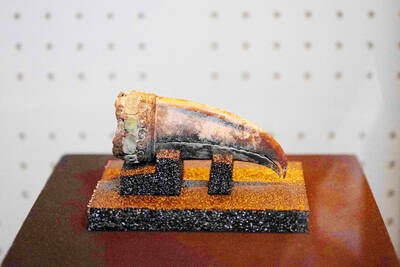
Archeologists in Peru on Thursday said they found the 5,000-year-old remains of a noblewoman at the sacred city of Caral, revealing the important role played by women in the oldest center of civilization in the Americas. “What has been discovered corresponds to a woman who apparently had elevated status, an elite woman,” archeologist David Palomino said. The mummy was found in Aspero, a sacred site within the city of Caral that was a garbage dump for more than 30 years until becoming an archeological site in the 1990s. Palomino said the carefully preserved remains, dating to 3,000BC, contained skin, part of the

TRUMP EFFECT: The win capped one of the most dramatic turnarounds in Canadian political history after the Conservatives had led the Liberals by more than 20 points Canadian Prime Minister Mark Carney yesterday pledged to win US President Donald Trump’s trade war after winning Canada’s election and leading his Liberal Party to another term in power. Following a campaign dominated by Trump’s tariffs and annexation threats, Carney promised to chart “a new path forward” in a world “fundamentally changed” by a US that is newly hostile to free trade. “We are over the shock of the American betrayal, but we should never forget the lessons,” said Carney, who led the central banks of Canada and the UK before entering politics earlier this year. “We will win this trade war and

‘BODIES EVERYWHERE’: The incident occurred at a Filipino festival celebrating an anti-colonial leader, with the driver described as a ‘lone suspect’ known to police Canadian police arrested a man on Saturday after a car plowed into a street party in the western Canadian city of Vancouver, killing a number of people. Authorities said the incident happened shortly after 8pm in Vancouver’s Sunset on Fraser neighborhood as members of the Filipino community gathered to celebrate Lapu Lapu Day. The festival, which commemorates a Filipino anti-colonial leader from the 16th century, falls this year on the weekend before Canada’s election. A 30-year-old local man was arrested at the scene, Vancouver police wrote on X. The driver was a “lone suspect” known to police, a police spokesperson told journalists at the
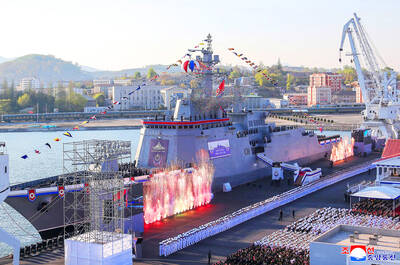
North Korean leader Kim Jong-un has unveiled a new naval destroyer, claiming it as a significant advancement toward his goal of expanding the operational range and preemptive strike capabilities of his nuclear-armed military, state media said yesterday. North Korea’s state-run Korean Central News Agency (KCNA) said Kim attended the launching ceremony for the 5,000-tonne warship on Friday at the western port of Nampo. Kim framed the arms buildup as a response to perceived threats from the US and its allies in Asia, who have been expanding joint military exercises amid rising tensions over the North’s nuclear program. He added that the acquisition


 RSS
RSS