


Japan confirmed its fourth case of the H1N1 virus yesterday in a teenager who recently returned from a school trip to Canada with the three other Japanese who have contracted the new flu strain. In the US, a man in Washington state with H1N1 influenza died last week, health officials said, the third US death among 2,200 confirmed cases in the country.
Worldwide, health officials said the true number of cases could be underestimated. Although most cases are mild, the virus has killed just as seasonal flu does.
Forty-eight people have died in Mexico and one each in Canada and Costa Rica.
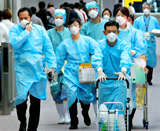
PHOTO: AP
The fourth Japanese patient, who was not identified, is being quarantined at a hospital near the airport, the Japanese Health and Welfare Ministry said. He had been in Oakville, Ontario, since April 24 and returned on Friday on a Northwest Airlines flight from Detroit, Michigan.
Japanese authorities have been busy tracking travelers who arrived on the same flight as the four confirmed to have the virus.
China and Hong Kong said they had quarantined travelers who were on the flight and had continued on to their countries. Hong Kong is keeping two people under observation who have not shown any flu symptoms. China’s Health Ministry said it had placed seven people under observation. Their conditions were not immediately known.
In Japan, medical staff wearing masks and rubber boots have been sent to major airports to isolate anyone suspected of being infected.
In the US, a man in his 30s with underlying heart conditions died last week, Washington Governor Chris Gregoire said on Saturday, describing his death as “a sobering reminder that influenza is serious.”
The virus has moved into the southern hemisphere, where influenza season is just beginning, and could mix with circulating seasonal flu viruses or the H5N1 avian influenza virus to create new strains, health officials said.
“One of the big challenges with influenza viruses is the way that they change, the way they combine and their prevalence in a number of species,” Anne Schuchat of the US Centers for Disease Control and Prevention told a news briefing on Saturday. “This is why it is so important for countries to have a strong capacity to deal with influenza and also why it is very important to understand what happens at the interface between people and animals.”
“Today there are almost 3,000 probable and confirmed cases here in the United States,” Schuchat said. “The good news is we are not seeing a rise above the epidemic threshold.”
Japan reported four cases and globally officials reported more than 4,200 people in 30 countries had been ill. Australia reported its first case, a woman who had been travelling in the US, but officials said she had made full recovery.
“We think this virus is in most of the United States,” Schuchat said. “The individual numbers are likely to be a very great underestimate.”
More Americans are seeing doctors for influenza-like illnesses at a time of year when such visits usually decline.
Schuchat said tests showed they did not all have the new H1N1 virus. Many have seasonal flu — the H1N1 seasonal strain, the H3N2 seasonal strain and influenza B — and other infections.
Seasonal flu kills between 250,000 and 500,000 people globally and infects up to a third of the population each year.
Health experts have not openly criticized efforts by other countries to stop the virus from getting in — most notably China and Hong Kong, which have quarantined travelers in contact with patients.
A spokeswoman in Hong Kong said on Saturday that a Mexican traveller confirmed as Hong Kong’s first and only case of the new flu strain had been discharged from hospital.
The unidentified man, who unwittingly caused the confinement of almost 300 guests and staff at a Hong Kong hotel where he had stayed, had been in hospital for a week.
China put seven people who had been exposed to three Japanese passengers diagnosed with the H1N1 flu in quarantine, Xinhua news agency quoted the government as saying.
Mexican health ministry spokesman Carlos Olmos said the government was testing thousands of samples to confirm which patients with severe respiratory symptoms were actually infected with the flu.
He said more than 5,000 tests had been done on suspected cases and that 1,578 people were ill but being treated.
After the virus was identified on April 23, Mexico banned public events and shut schools, bars, restaurants and many businesses to prevent people from gathering. Officials said disinfection of public spaces had helped control its spread.

Archeologists in Peru on Thursday said they found the 5,000-year-old remains of a noblewoman at the sacred city of Caral, revealing the important role played by women in the oldest center of civilization in the Americas. “What has been discovered corresponds to a woman who apparently had elevated status, an elite woman,” archeologist David Palomino said. The mummy was found in Aspero, a sacred site within the city of Caral that was a garbage dump for more than 30 years until becoming an archeological site in the 1990s. Palomino said the carefully preserved remains, dating to 3,000BC, contained skin, part of the

‘WATER WARFARE’: A Pakistani official called India’s suspension of a 65-year-old treaty on the sharing of waters from the Indus River ‘a cowardly, illegal move’ Pakistan yesterday canceled visas for Indian nationals, closed its airspace for all Indian-owned or operated airlines, and suspended all trade with India, including to and from any third country. The retaliatory measures follow India’s decision to suspend visas for Pakistani nationals in the aftermath of a deadly attack by shooters in Kashmir that killed 26 people, mostly tourists. The rare attack on civilians shocked and outraged India and prompted calls for action against their country’s archenemy, Pakistan. New Delhi did not publicly produce evidence connecting the attack to its neighbor, but said it had “cross-border” links to Pakistan. Pakistan denied any connection to

TRUMP EFFECT: The win capped one of the most dramatic turnarounds in Canadian political history after the Conservatives had led the Liberals by more than 20 points Canadian Prime Minister Mark Carney yesterday pledged to win US President Donald Trump’s trade war after winning Canada’s election and leading his Liberal Party to another term in power. Following a campaign dominated by Trump’s tariffs and annexation threats, Carney promised to chart “a new path forward” in a world “fundamentally changed” by a US that is newly hostile to free trade. “We are over the shock of the American betrayal, but we should never forget the lessons,” said Carney, who led the central banks of Canada and the UK before entering politics earlier this year. “We will win this trade war and

Armed with 4,000 eggs and a truckload of sugar and cream, French pastry chefs on Wednesday completed a 121.8m-long strawberry cake that they have claimed is the world’s longest ever made. Youssef El Gatou brought together 20 chefs to make the 1.2 tonne masterpiece that took a week to complete and was set out on tables in an ice rink in the Paris suburb town of Argenteuil for residents to inspect. The effort overtook a 100.48m-long strawberry cake made in the Italian town of San Mauro Torinese in 2019. El Gatou’s cake also used 350kg of strawberries, 150kg of sugar and 415kg of


 RSS
RSS