


Russian Prime Minister Vladimir Putin has told Japanese media his country expects to sign a nuclear power pact with Japan during his visit here this week, reports said yesterday.
In an interview with Japanese media in Moscow, Putin said he would also present a list of economic cooperation projects during his three-day visit slated to begin today.
Various government-level agreements will be signed as well as between private entities during his visit, he said, adding that a nuclear cooperation pact was also “expected to be signed.”
Japan and Russia are in the final phase of talks over a pact to promote the non-military use of nuclear power, such as for electricity generation. The pact will pave the way for Tokyo to entrust Moscow with uranium enrichment and allow Japan to export nuclear power plant technology to Russia, Kyodo News said.
Calling Japan an “important partner in promoting exchanges based on cutting-edge technologies,” Putin said other potential projects would embrace sectors such as automobiles, energy, aerospace, communications, chemicals and steel, the Nikkei Shimbun said.
Although Putin did not mention the number of projects on the list, sources said there were around 200, Nikkei said.
Putin also said Moscow was ready to talk with Tokyo on the nations’ long-standing territorial dispute over a group of former Japanese islands seized by Soviet troops in the closing days of World War II. But he did not go into specifics about the islands known in Japan as the Northern Territories and referred to in Russia as the Southern Kurils.
“In order to resolve such high-level and difficult problems, it is necessary to show patience, attention to each other’s interests,” Kyodo quoted Putin as saying.
In his first exclusive interview with Japanese media since becoming prime minister la May, Putin also pledged government support for Japanese firms to build car assembly plants in the Russian Far East, Nikkei said.

Crowds in Bangladesh are flocking to snap photographs with an unlikely social media star — an albino buffalo with flowing blond hair nicknamed “Donald Trump” that is due to be sacrificed within days. Owner Zia Uddin Mridha, 38, said his brother named the 700kg bull over its flowing helmet of hair resembling the signature look of the US president. “My younger brother picked this name because of the buffalo’s extraordinary hair,” he said at his farm in Narayanganj, just outside the capital, Dhaka. Mridha said that a constant stream of curious visitors — social media fans, onlookers and children — have come throughout
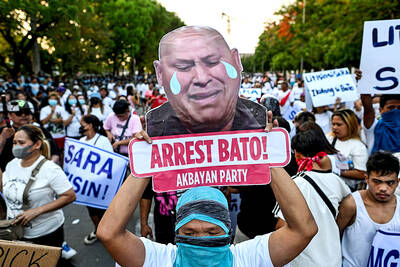
The Philippines said it has asked the country’s Supreme Court to allow it to arrest former Philippine president Rodrigo Duterte’s chief drug war enforcer to stand trial in an international tribunal. The International Criminal Court (ICC) last week unsealed an arrest warrant against Philippine Senator Ronald dela Rosa, accusing him along with Duterte and other “coperpetrators” of the “crime against humanity of murder.” Dela Rosa briefly sought refuge in the Philippine Senate last week while asking the Philippine Supreme Court to stop an ongoing attempt by government agents to arrest him. “By his own conduct, he has placed himself outside the protection of

It began as a satirical online project. Now millions of young people in India are flocking to it as an outlet for their frustration. A parody political party called the Cockroach Janta Party, with the insect as its symbol, has exploded across India’s social media by turning absurdist humor into protest. Memes and short videos mocking corruption, joblessness and political dysfunction have flooded social media sites, where millions of users are embracing the cockroach — known for its ability to survive harsh conditions — as a tongue-in-cheek symbol of endurance. The online movement’s rise has been unusually rapid. The Cockroach Janta Party (CJP)

The researchers in Ireland looked at their computer screen, marveling at a medieval book tracked down in a Roman library. They flipped through its digitized pages and found their sought-after treasure: the oldest surviving English poem. “We were extremely surprised. We were speechless. We couldn’t believe our eyes when we first saw that,” said Elisabetta Magnanti, a visiting research fellow at Trinity College Dublin’s school of English. The poem was also within the main body of Latin text, she said, calling it “extraordinary.” Composed in Old English by a Northumbrian agricultural worker in the 7th century, Caedmon’s Hymn appears within some copies of


 RSS
RSS