


On the wall of his office, sculptor Shravan Prajapati has nailed a typed list of exacting instructions from his most important client.
Statues of his client must: one, show her looking slim; two, make her neck look long; three, not make her chest look too pronounced; four, not include a double chin.
The specifications will guide him as he begins work on the most ambitious statute of his career: a 15m bronze monument of a woman in triumphal pose. That woman is Mayawati Kumari, a diminutive former schoolteacher whose supporters believe she may soon hold the balance of power in the world’s biggest democracy. So confident is she of victory in India’s general election that she has already commissioned Prajapati to start work on the enormous statue that she plans to install in Delhi if she is named Indian prime minister.
This confidence is not shared by many outside her party and with a week to go before results are announced, on May 16, there is little certainty about which parties and individuals are ahead. But no one doubts the size of her long-term ambition or the crucial power-broking role her party will play as the new government is formed.
As chief minister of India’s most populous state, Uttar Pradesh (UP), Mayawati, 52, already controls a region of 190 million people — which, were it a country and not a state, would be the sixth largest in the world.
Born a Dalit — the preferred term for what was once known as an “untouchable” — to poor parents in a Delhi slum, she has defied deep-rooted prejudice throughout her political career. Unmarried, she is one of the few women in India to claim power in her own right, and not as a daughter or a widow.
Her supporters cast her as a symbol of hope for India’s 160 million Dalits and for other low-caste, oppressed members of society. They compare her journey from the lowest rung of society to a position of national power to the rise of US President Barack Obama and keenly hope the end result will be similar.
India’s election is widely expected to end in messy compromise, with no one party able to command a majority. Uttar Pradesh has more seats than any other state in India’s 543-member parliament, and Mayawati’s party, the Bahujan Samaj party (BSP — Party of the Majority of Society) is expanding its reach far beyond the state borders, fielding more than 400 candidates nationwide.
If she wins sufficient seats, there is a scenario — conceivable, if unlikely — in which her party’s support could be so crucial to either the Congress party or the Hindu nationalist Bharatiya Janata party as they scrabble together a coalition of allies that the prime ministership is offered to her in exchange.
“I’m 99 percent certain she will become prime minister,” said Prajapati, who has already completed 18 statues of her and is delighted at the latest and most grandiose commission.
His most famous piece to date was the statue of late Iraqi dictator Saddam Hussein that was pulled down by angry crowds the day the US army arrived in Baghdad.
Uttar Pradesh is scattered with Prajapati’s statues of Mayawati and India’s two other most prominent Dalit leaders, Dr BR Ambedkar, author of the Indian Constitution, and Kanshi Ram, her personal mentor and a fervent campaigner against the caste system. He has also completed 300 elephants, the BSP’s symbol. His work is at the center of an impressive cult of personality that Mayawati has nurtured since she became chief minister for the fourth time in 2007.
He charges about £92,000 (US$138,000) for each 5.5m set of the three leaders. Commentators have remarked with growing disquiet on the combined cost of this and other self-aggrandizing ventures — most notably the vast 50 hectare Ambedkar Park that is being completed in the city center. It is a stupendously ostentatious venture, perhaps four times the size of Trafalgar Square in London, and has no grass but is paved entirely with highly polished, shimmering marble and dotted with giant elephant statues, red sandstone domed buildings and rows of tall marble pillars, each topped with more bronze elephants.
Prajapati, who comes from what is known in curious officialeze as a “backward caste,” shrugs off the criticism, arguing that the aim is to honor the achievements of India’s most oppressed communities.
“This is public money which is being returned to the people. It’s not as if it is being deposited in bank accounts in Switzerland. Monuments are a good way to educate people,” he said. “Dalits worship her as a goddess, as someone who has come to free them from the misery into which they were born. Maybe it is wrong to worship a politician, but it’s their choice.”
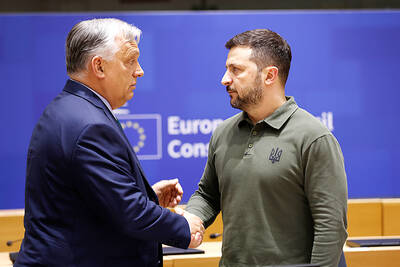
Hungarian authorities temporarily detained seven Ukrainian citizens and seized two armored cars carrying tens of millions of euros in cash across Hungary on suspicion of money laundering, officials said on Friday. The Ukrainians were released on Friday, following their detention on Thursday, but Hungarian officials held onto the cash, prompting Ukraine to accuse Hungary’s Russia-friendly government of illegally seizing the money. “We will not tolerate this state banditism,” Ukrainian Minister of Foreign Affairs Andrii Sybiha said. The seven detained Ukrainians were employees of the Ukrainian state-owned Oschadbank, who were traveling in the two armored cars that were carrying the money between Austria and
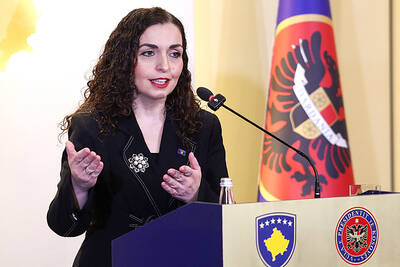
Kosovar President Vjosa Osmani on Friday after dissolving the Kosovar parliament said a snap election should be held as soon as possible to avoid another prolonged political crisis in the Balkan country at a time of global turmoil. Osmani said it is important for Kosovo to wrap up the upcoming election process and form functional institutions for political stability as the war rages in the Middle East. “Precisely because the geopolitical situation is that complex, it is important to finish this electoral process which is coming up,” she said. “It is very hard now to imagine what will happen next.” Kosovo, which declared

MORE BANS: Australia last year required sites to remove accounts held by under-16s, with a few countries pushing for similar action at an EU level and India considering its own ban Indonesia on Friday said it would ban social media access for children under 16, citing threats from online pornography, cyberbullying, online fraud and Internet addiction. “Accounts belonging to children under 16 on high-risk platforms will start to be deactivated, beginning with YouTube, TikTok, Facebook, Instagram, Threads, X, Bigo Live and Roblox,” Indonesian Minister of Communications and Digital Meutya Hafid said. “The government is stepping in so that parents no longer have to fight alone against the giants of the algorithm. Implementation will begin on March 28, 2026,” she said. The social media ban would be introduced in stages “until all platforms fulfill their
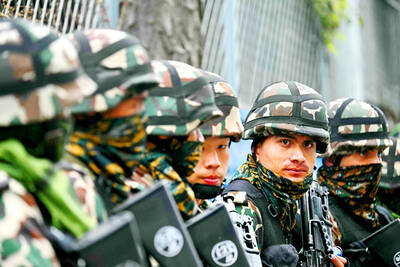
Counting was under way in Nepal yesterday, after a high-stakes parliamentary election to reshape the country’s leadership following protests last year that toppled the government. Key figures vying for power include former Nepalese prime minister K. P. Sharma Oli, rapper-turned-mayor Balendra Shah, who is bidding for the youth vote, and newly elected Nepali Congress party leader Gagan Thapa. In Kathmandu’s tea shops and city squares, people were glued to their phones, checking results as early trends flashed up — suggesting Shah’s centrist Rastriya Swatantra Party (RSP) was ahead. Nepalese Election Commission spokesman Prakash Nyupane said the counting was ongoing “in a peaceful manner”


 RSS
RSS