


With a combined age of 157, the two men vying for the post of Indian prime minister are having a high old time lobbing ageist stones at each other from their respective glasshouses.
Incumbent Manmohan Singh, 76, of the ruling Congress Party and 81-year-old LK Advani of the main opposition Bharatiya Janata Party (BJP) have both made efforts to appear the more spry and energetic on the campaign trail.
The Oxford-educated Singh underwent multiple heart bypass surgery in January, but made a speedy recovery and has not missed the chance to bring up the five years he has on his opponent.
Singh attributed Advani’s accusation that he was India’s “weakest” prime minister to his rival’s “ripe old age” and suggested he change astrologers as he was clearly too old to change his views.
Advani, meanwhile, has been photographed lifting weights in front of supporters and has tried to reach out to younger voters with a blog.
Although both were born in present day Pakistan, they took markedly different routes to reach the corridors of power in New Delhi.
Unlike Advani, a career politician with activist roots, Singh is regarded as an accidental prime minister, a technocrat with an unblemished reputation who rescued India from the brink of bankruptcy but seemed destined to keep a low profile.
His anointment in 2004 by Sonia Gandhi, after she refused the post, has led Advani to label Singh a puppet of the Nehru-Gandhi dynasty.
The challenge of heading a rocky coalition government means Singh has been criticized for his low-key leadership style.
“It’s a little unfair,” said sociologist Andre Biteille, who worked with Singh at the Delhi School of Economics. “He has had to accommodate too many pressures from too many sides.”
Known for his unflappable demeanor, Singh trained as an economist and headed India’s central bank, among other government positions, until former prime minister PV Narasimha Rao made him finance minister in 1991 in the midst of an economic crisis.
Singh is widely praised for phasing out India’s rigid socialist economic system in favor of greater liberalization.
Advani, meanwhile, jumped straight into politics as a teenager by joining the Rashtriya Swayamasevak Sangh, a right-wing Hindu outfit that has groomed many BJP leaders.
The self-professed Hindi film buff is considered a hawk by detractors who see his unabashed pro-Hindu policies as incompatible with multi-faith, officially secular India.
Opponents ridicule his commitment to building a Hindu temple over the remains of a razed mosque in northern India — still a key BJP manifesto pledge despite pressing issues of a slowing economy and dire poverty.
The destruction of the mosque in 1992 by Hindu zealots triggered some of the worst Hindu-Muslim sectarian clashes since India’s independence in 1947.
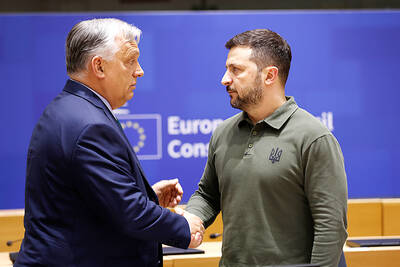
Hungarian authorities temporarily detained seven Ukrainian citizens and seized two armored cars carrying tens of millions of euros in cash across Hungary on suspicion of money laundering, officials said on Friday. The Ukrainians were released on Friday, following their detention on Thursday, but Hungarian officials held onto the cash, prompting Ukraine to accuse Hungary’s Russia-friendly government of illegally seizing the money. “We will not tolerate this state banditism,” Ukrainian Minister of Foreign Affairs Andrii Sybiha said. The seven detained Ukrainians were employees of the Ukrainian state-owned Oschadbank, who were traveling in the two armored cars that were carrying the money between Austria and
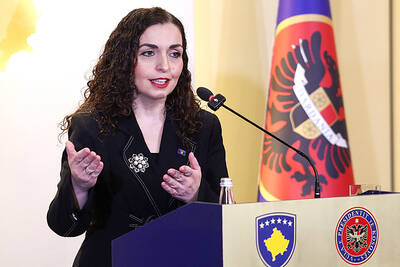
Kosovar President Vjosa Osmani on Friday after dissolving the Kosovar parliament said a snap election should be held as soon as possible to avoid another prolonged political crisis in the Balkan country at a time of global turmoil. Osmani said it is important for Kosovo to wrap up the upcoming election process and form functional institutions for political stability as the war rages in the Middle East. “Precisely because the geopolitical situation is that complex, it is important to finish this electoral process which is coming up,” she said. “It is very hard now to imagine what will happen next.” Kosovo, which declared

MORE BANS: Australia last year required sites to remove accounts held by under-16s, with a few countries pushing for similar action at an EU level and India considering its own ban Indonesia on Friday said it would ban social media access for children under 16, citing threats from online pornography, cyberbullying, online fraud and Internet addiction. “Accounts belonging to children under 16 on high-risk platforms will start to be deactivated, beginning with YouTube, TikTok, Facebook, Instagram, Threads, X, Bigo Live and Roblox,” Indonesian Minister of Communications and Digital Meutya Hafid said. “The government is stepping in so that parents no longer have to fight alone against the giants of the algorithm. Implementation will begin on March 28, 2026,” she said. The social media ban would be introduced in stages “until all platforms fulfill their
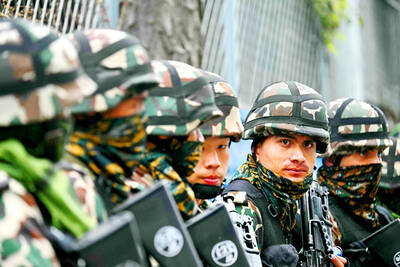
Counting was under way in Nepal yesterday, after a high-stakes parliamentary election to reshape the country’s leadership following protests last year that toppled the government. Key figures vying for power include former Nepalese prime minister K. P. Sharma Oli, rapper-turned-mayor Balendra Shah, who is bidding for the youth vote, and newly elected Nepali Congress party leader Gagan Thapa. In Kathmandu’s tea shops and city squares, people were glued to their phones, checking results as early trends flashed up — suggesting Shah’s centrist Rastriya Swatantra Party (RSP) was ahead. Nepalese Election Commission spokesman Prakash Nyupane said the counting was ongoing “in a peaceful manner”


 RSS
RSS