

A Venezuelan court on Friday sentenced nine former police officials to as long as 30 years in prison for the killings of demonstrators during street protests that led to the failed 2002 coup against President Hugo Chavez.
Former Caracas police chief Henry Vivas, deputy chief Lazaro Forero and city public safety director Ivan Simonovis were sentenced to 30-year terms, the Attorney General’s Office said. It said they were convicted of being accomplices to murder in the killings of two pro-government demonstrators, and accomplices in the attempted murder of two others and the wounding of a dozen people.
Six rank-and-file officers were sentenced to 17-year and 30-year terms for “complicity” to murder in the killings and other crimes, prosecutors said in a statement.
Allies and adversaries of Chavez were among 19 killed on April 11, 2002, as an opposition march led by police approached a pro-Chavez demonstration in Caracas.
The violence preceded a short-lived coup in which Chavez was ousted by dissident military officers. He returned to power two days later with the help of loyalist generals and street protests by supporters.
Government foes blame the violence on National Guard troops and Chavez supporters who were filmed shooting from a bridge. Chavez backers say the police were responsible.
Defense lawyer Jose Luis Tamayo condemned the sentence, calling it “a trophy for President Chavez.”
“They’ve convicted a big group of Venezuelan citizens here without proof,” said Tamayo, who said prosecutors used photographs of several officers holding guns rather than any forensic evidence linking them to the killings.
He said prosecutors “didn’t even prove the metropolitan police’s weapons were fired” and that the judge exercised a “Nazi interpretation” of the evidence.
Lawyer Antonio Molina, who represents some of the government supporters who were killed, said: “This isn’t political vengeance as they’ve wanted to sell it.”
He said the sentence has “done justice” and that police had been acting as the “armed wing” of government opponents who tried to topple Chavez.
The Caracas city government and police force were led by Chavez opponents at the time of the coup.
Relatives of the ex-policemen — some teary-eyed and angry — condemned the decision outside the courthouse in north-central Aragua state. Some accused Chavez’s government of using the legal system to frame opponents.
“I expected this sort of sentence because this is a political trial,” Nubia Vivas, a sister of the former police chief, told reporters.
Yesenia Fuentes, a member of the pro-government Association of April 11 Victims, said she was pleased with the sentence.
“It set a precedent. There won’t be a police officer who messes with a Venezuelan citizen and doesn’t go to jail,” she said.
One police officer who had originally faced charges, Rafael Neazoa, was acquitted by the jury, prosecutors said. Another, Ramon Zapata, was sentenced to three years for covering up police involvement and will go free because he has already spent six years in jail, the Attorney General’s Office said.
Liliana Ortega, director of the Venezuelan human rights watchdog group Cofavic, said the sentence contributes to “impunity because one of the most serious problems we’ve seen concretely in this case is that there have been serious deviations from due process.”

CRACKED SCREEN: The problem is an embarrassing setback for Apple, which spent more than a decade developing the device and touted its durability The iPhone Duo, one of Apple’s biggest new products in years, is drawing a growing number of complaints from customers who say the foldable display cracked after just hours or days of use. In these cases, customers reported hearing a crunching sound when unfolding the phone, followed by a large crack forming along the center crease. Some users also experienced a white patch or other display malfunction on the right side of the screen. Reports of the problem first surfaced on Reddit and other social media platforms. Bloomberg News has since independently verified the issue with more than half a
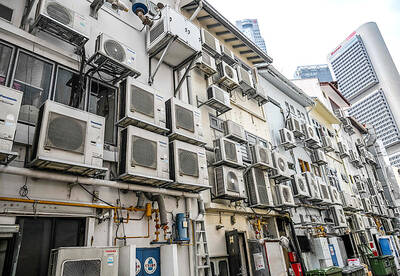
Long dubbed an “air-conditioned nation,” Singapore is experimenting with cooling alternatives from chilled beams to “passive displacement” to curb its thirst for energy-guzzling air-conditioning. The city-state has the highest per-capita air-conditioner ownership rate in Southeast Asia, with about 99 percent of private residences equipped with cooling units. Singapore’s local building sector accounts for one-fifth of its emissions, while cooling itself accounts for 40 to 60 percent of a building’s energy consumption, according to studies. A stroll down Orchard Road highlights that dependence. Shoppers are greeted by blasts of cool air that waft into the street as doors swing open — a major draw
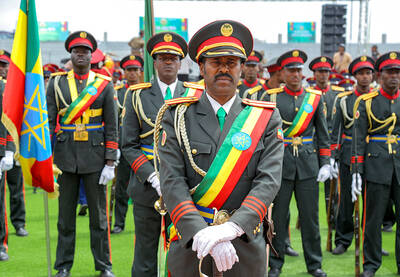
Ethiopian online influencers are pushing for their government to invade neighboring Eritrea and seize access to the sea, following its success against rebel and Eritrean forces in the past few weeks. The Ethiopian army has advanced right up to the border after repelling an offensive by rebels in the northern Tigray State who were supported by Eritrean troops. Ethiopian Prime Minister Abiy Ahmed has repeatedly said that securing a base on the Red Sea is a vital national objective for Ethiopia, which lost its coastline when Eritrea gained independence in 1993. Some online influencers say that the opportunity to invade has arrived. “The time

Beijing yesterday dismissed as “groundless speculation” a report that said Nvidia CEO Jensen Huang (黃仁勳) was the target of a Chinese spy plot. The article by the New York Times, published on Thursday, said that US intelligence officials concluded that a Chinese executive linked to a Singapore-based data center company had been funneling information to Beijing. “The report in question is based on groundless speculation and is nothing more than an attempt to smear China,” Chinese Ministry of Foreign Affairs spokesman Guo Jiakun (郭嘉昆) told a regular briefing. China is in a race for tech dominance with the US, which restricts the export


 RSS