


US Secretary of State Hillary Rodham Clinton on Wednesday pledged to stand with Mexico in its violent struggle against drug cartels and admitted that Americans’ “insatiable” appetite for illegal narcotics and their inability to control weapons smuggling was partly to blame.
Fearing that Mexican drug violence may spill across the border, Clinton promised to boost cooperation to improve security on both sides.
“The criminals and kingpins spreading violence are trying to corrode the foundations of law, order, friendship and trust between us that support our continent,” she told a news conference with Mexican Foreign Relations Secretary Patricia Espinosa. “They will fail.”
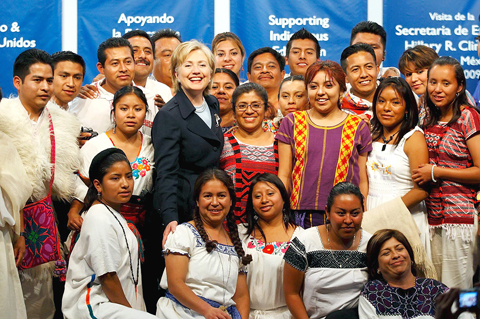
PHOTO: EPA
“We will stand shoulder to shoulder with you,” she said after lengthy talks with Espinosa and Mexican President Felipe Calderon.
On Tuesday, the administration of US President Barack Obama pledged to send more money, technology and manpower to secure the border in the US Southwest and help Mexico battle the cartels.
Clinton said on Wednesday the White House would also seek an additional US$80 million to help Mexico buy Blackhawk helicopters.
All that is in addition to a three-year, US$1.4 billion Bush administration-era program to support Mexico’s efforts. Congress already has approved US$700 million of that. Obama has said he wants to revamp the initiative.
Obama said on Tuesday he wanted the US to do more to prevent guns and cash from illicit drug sales from flowing into Mexico.
But Clinton’s remarks were more forceful in recognizing the US’ share of the blame. In the past, particularly under the Bush administration, Mexican officials have complained that Washington failed to acknowledge the extent that US drug demand and weapons smuggling fuels the violence.
“I feel very strongly we have a co-responsibility,” Clinton told reporters aboard her plane on her way to Mexico.
“Our insatiable demand for illegal drugs fuels the drug trade,” she said. “Our inability to prevent weapons from being illegally smuggled across the border to arm these criminals causes the deaths of police officers, soldiers and civilians.”
Criminals are outgunning law enforcement officials, she said, referring to guns and military-style equipment such as night-vision goggles and body armor that the cartels are smuggling from the US.
“Clearly, what we have been doing has not worked and it is unfair for our incapacity ... to be creating a situation where people are holding the Mexican government and people responsible,” she said. “That’s not right.”
Officials said her priorities included encouraging Calderon’s government to increase its battle against rampant corruption by promoting police and judicial reform.
Clinton was scheduled to visit a police station in the capital yesterday before heading to the northern city of Monterrey, where she was due to speak with university students about US-Mexican relations.
Just hours before she arrived in Mexico, the Mexican army announced it had captured one of the country’s most-wanted smugglers, a man accused of controlling the flow of drugs through Monterrey for the powerful Beltran-Leyva cartel.
The US measures outlined on Tuesday include increasing the number of immigrations and customs agents, drug agents and antigun-trafficking agents operating along the border, as well as sending more US officials to work inside Mexico.
Those measures fall short of calls from some US states that troops be deployed to prevent further spillover of the violence, which has surged since Calderon stepped up the battle against the cartels.

Kouri Richins, a Utah mother who published a children’s book about grief after the death of her husband is to serve a life sentence for his murder without the possibility of parole, a judge ruled on Wednesday. Richins was convicted in March of aggravated murder for lacing a cocktail given to her husband, Eric Richins, with five times the lethal dose of fentanyl at their home near Park City in 2022. A jury also found her guilty of four other felonies, including insurance fraud, forgery and attempted murder for trying to poison her husband weeks earlier on Feb. 14, 2022, with a
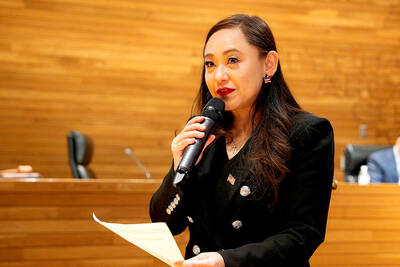
‘PERSONAL MISTAKES’: Eileen Wang has agreed to plead guilty to the felony, which comes with a maximum sentence of 10 years in federal prison A southern California mayor has agreed to plead guilty to acting as an illegal agent for the Chinese government and has resigned from her city position, officials said on Monday. Eileen Wang (王愛琳), mayor of Arcadia, was charged last month with one count of acting in the US as an illegal agent of a foreign government. She was accused of doing the bidding of Chinese officials, such as sharing articles favorable to Beijing, without prior notification to the US government as required by law. The 58-year-old was elected in November 2022 to a five-person city council, from which the mayor is selected

DELA ROSA CASE: The whereabouts of the senator, who is wanted by the ICC, was unclear, while President Marcos faces a political test over the senate situation Philippine authorities yesterday were seeking confirmation of reports that a top politician wanted by the International Criminal Court (ICC) had fled, a day after gunfire rang out at the Philippine Senate where he had taken refuge fearing his arrest. Senator Ronald “Bato” dela Rosa, the former national police chief and top enforcer of former Philippine president Rodrigo Duterte’s “war on drugs,” has been under Senate protection and is wanted for crimes against humanity, the same charges Duterte is accused of. “Several sources confirmed that the senator, Senator Bato, is no longer in the Senate premises, but we are still getting confirmation,” Presidential
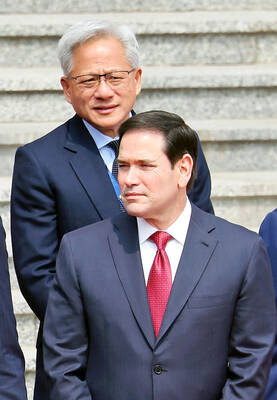
HELP DENIED? The US Department of State said that the Cuban leadership refuses to allow the US to provide aid to Cubans, ‘who are in desperate need of assistance’ US Secretary of State Marco Rubio on Wednesday said that Cuba’s leadership must change, as Washington renewed an offer of US$100 million in aid if the communist nation agrees to cooperate. Cuba has been suffering severe economic tumult led by an energy shortage that plunged 65 percent of the country into darkness on Tuesday. Cuba’s leaders have blamed US sanctions, but Rubio, a Cuban American and critic of the government established by Fidel Castro, said the system was to blame, including corruption by the military. “It’s a broken, nonfunctional economy, and it’s impossible to change it. I wish it were different,” he told


 RSS
RSS