


Bank manager Sudhir has never heard of credit derivates and has no clue about investment funds. He is just about capable of doing basic arithmetic and calculating interest rates.
But while his counterparts in posh Western office towers worry about gaping holes in their balance sheets, the 13-year-old’s business is going strong.
Still, the bank’s staff and customers are far from free of fear of losing their livelihoods. They are street children in New Delhi.
The bank is located in a dark alleyway near the railway station in the old part of Delhi. Before depositing their funds, Sudhir’s clients have to jump over several puddles stinking of urine, navigate around beggars lying on the ground and avoid the long queue snaking out of a nearby homeless shelter.
Sudhir’s headquarters, which consist of a desk with a drawer, can be found in a corner of the offices of an Indian-based charity, Butterflies. A metal grille separates him from his clients.
Every evening, street kids can deposit their earnings at the bank. They have the choice between a daily accessible current account and a savings account, through which they get 3.5 percent interest.
That day, Sudhir administers funds worth around US$190, a sum he has to work for at least 50 days to earn at his day job. The boy makes money helping out at parties, washing the dishes or clearing tables.
“When I am paid well, I get about 200 rupees [US$4] per day,” Sudhir said. “When I’m paid badly, it’s 50 rupees.”
Many of the children, aged 10 to 18, collect garbage and sell whatever can be sold.
Butterflies social worker Sebastian Matthew would prefer it if they did not have to work at all: “But that’s not possible ... The children have to make money.”
At least the Children’s Development Bank offers them a chance to keep their meager earnings safe.
It is not the only project of the charity, which also runs education programs, provides medication and offers simple accommodation — floor space and a blanket. The bank was established to teach the children to assume responsibility.
“We only check the accounts but do not interfere otherwise,” Matthew said.
Sudhir and his colleagues run the bank voluntarily. He was elected manager by the other children who have an account with the bank. He got the job because he is one of the few who goes to school.
“But later I don’t want to work in a bank but do something with computers,” he said.
Children with a business idea can also apply for loans. Most of them want capital to start selling vegetables or clothing. But obtaining a loan is not child’s play.
Prospective borrowers each have to find two children to vouch for them and answer to a street kid committee on how they plan to repay the loan.
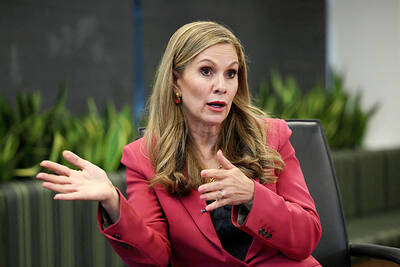
Australians were downloading virtual private networks (VPNs) in droves, while one of the world’s largest porn distributors said it was blocking users from its platforms as the country yesterday rolled out sweeping online age restriction. Australia in December became the first country to impose a nationwide ban on teenagers using social media. A separate law now requires artificial intelligence (AI)-powered chatbot services to keep certain content — including pornography, extreme violence and self-harm and eating disorder material — from minors or face fines of up to A$49.5 million (US$34.6 million). The country also joined Britain, France and dozens of US states requiring
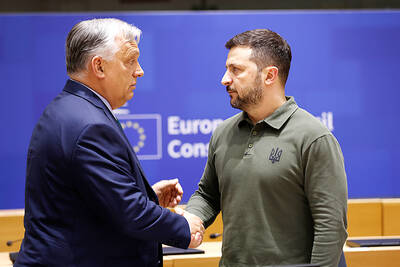
Hungarian authorities temporarily detained seven Ukrainian citizens and seized two armored cars carrying tens of millions of euros in cash across Hungary on suspicion of money laundering, officials said on Friday. The Ukrainians were released on Friday, following their detention on Thursday, but Hungarian officials held onto the cash, prompting Ukraine to accuse Hungary’s Russia-friendly government of illegally seizing the money. “We will not tolerate this state banditism,” Ukrainian Minister of Foreign Affairs Andrii Sybiha said. The seven detained Ukrainians were employees of the Ukrainian state-owned Oschadbank, who were traveling in the two armored cars that were carrying the money between Austria and
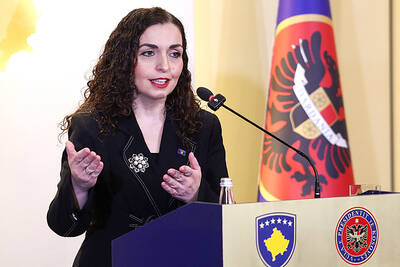
Kosovar President Vjosa Osmani on Friday after dissolving the Kosovar parliament said a snap election should be held as soon as possible to avoid another prolonged political crisis in the Balkan country at a time of global turmoil. Osmani said it is important for Kosovo to wrap up the upcoming election process and form functional institutions for political stability as the war rages in the Middle East. “Precisely because the geopolitical situation is that complex, it is important to finish this electoral process which is coming up,” she said. “It is very hard now to imagine what will happen next.” Kosovo, which declared

MORE BANS: Australia last year required sites to remove accounts held by under-16s, with a few countries pushing for similar action at an EU level and India considering its own ban Indonesia on Friday said it would ban social media access for children under 16, citing threats from online pornography, cyberbullying, online fraud and Internet addiction. “Accounts belonging to children under 16 on high-risk platforms will start to be deactivated, beginning with YouTube, TikTok, Facebook, Instagram, Threads, X, Bigo Live and Roblox,” Indonesian Minister of Communications and Digital Meutya Hafid said. “The government is stepping in so that parents no longer have to fight alone against the giants of the algorithm. Implementation will begin on March 28, 2026,” she said. The social media ban would be introduced in stages “until all platforms fulfill their


 RSS
RSS