


Sudanese authorities have released prominent Islamist opposition leader Hassan al-Turabi after almost two months behind bars, his family said yesterday.
Turabi, a fierce critic of the regime who has been in and out of jail over a career spanning about four decades, was detained in January after calling for Sudanese President Omar al-Bashir to surrender to the International Criminal Court (ICC).
“My father has been freed from the Port Sudan prison. They took him by plane and he is now at home in Manshia [a Khartoum suburb],” his daughter, Omama al-Turabi, said.
Sudanese security officers arrested Turabi on Jan. 14, two days after he urged al-Bashir to surrender to the ICC, saying he thought the head of state was “politically culpable” for crimes committed in conflict-ridden Darfur.
Turabi, 77, a guiding light in the Islamist-inspired bloodless 1989 coup that swept al-Bashir to power, but now his bitter nemesis, said in January that the president should hand himself over to save Sudan from possible UN sanctions.
“Politically we think he is culpable … He should assume responsibility for whatever is happening in Darfur, displacement, burning all the villages, rapes, I mean systematic rapes, continuously, I mean on a wide scale and the killing,” Turabi said.
The ICC on Wednesday issued an arrest warrant for al-Bashir for alleged war crimes and crimes against humanity in Darfur, accusing him of orchestrating a campaign of murder, torture, rape and pillage during the six years of conflict in the western Sudanese region.
Turabi’s daughter said the family had asked the authorities allow his father to return home because of health concerns after he became ill with flu, suffering a high fever and blood pressure.
Regarded as one of the driving forces behind the introduction of Shariah law in Africa’s largest country in 1983, Turabi was Bashir’s mentor.
In 1989, he rallied behind Bashir, then an obscure military man who had just been promoted to general, to overthrow the democratically elected government of his brother-in-law, Sadeq al-Mahdi.
As senior statesman, he became what many considered to be the real power in a country which he directed towards rigorous Islamic practices.

As the sun sets on another scorching Yangon day, the hot and bothered descend on the Myanmar city’s parks, the coolest place to spend an evening during yet another power blackout. A wave of exceptionally hot weather has blasted Southeast Asia this week, sending the mercury to 45°C and prompting thousands of schools to suspend in-person classes. Even before the chaos and conflict unleashed by the military’s 2021 coup, Myanmar’s creaky and outdated electricity grid struggled to keep fans whirling and air conditioners humming during the hot season. Now, infrastructure attacks and dwindling offshore gas reserves mean those who cannot afford expensive diesel

Does Argentine President Javier Milei communicate with a ghost dog whose death he refuses to accept? Forced to respond to questions about his mental health, the president’s office has lashed out at “disrespectful” speculation. Twice this week, presidential spokesman Manuel Adorni was asked about Milei’s English Mastiff, Conan, said to have died seven years ago. Milei, 53, had Conan cloned, and today is believed to own four copies he refers to as “four-legged children.” Or is it five? In an interview with CNN this month, Milei referred to his five dogs, whose faces and names he had engraved on the presidential baton. Conan,

French singer Kendji Girac, who was seriously injured by a gunshot this week, wanted to “fake” his suicide to scare his partner who was threatening to leave him, prosecutors said on Thursday. The 27-year-old former winner of France’s version of The Voice was found wounded after police were called to a traveler camp in Biscarrosse on France’s southwestern coast. Girac told first responders he had accidentally shot himself while tinkering with a Colt .45 automatic pistol he had bought at a junk shop, a source said. On Thursday, regional prosecutor Olivier Janson said, citing the singer, that he wanted to “fake” his suicide
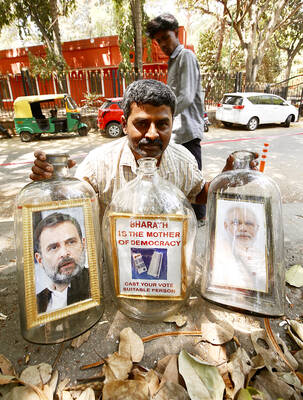
Indian Prime Minister Narendra Modi reaffirmed his pledge to replace India’s religion-based marriage and inheritance laws with a uniform civil code if he returns to office for a third term, a move that some minority groups have opposed. In an interview with the Times of India listing his agenda, Modi said his government would push for making the code a reality. “It is clear that separate laws for communities are detrimental to the health of society,” he said in the interview published yesterday. “We cannot be a nation where one community is progressing with the support of the Constitution while the other


 RSS
RSS