


Fighter jets intercepted a Russian bomber in the Arctic as it approached Canadian airspace on the eve of US President Barack Obama’s visit to Ottawa last week, the Canadian defense minister said on Friday.
Minister of National Defense Peter MacKay said the bomber never entered Canadian airspace. But he said two Canadian CF-18 jets met the Russian plane in international airspace and sent a “strong signal that they should back off.”
“They met a Russian aircraft that was approaching Canadian airspace and as they have done in previous occasions they sent very clear signals that are understood, that the aircraft was to turn around, turn tail, and head back to their airspace, which it did,” MacKay said.
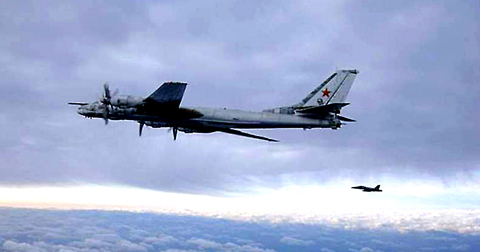
PHOTO: AFP
“I’m not going to stand here and accuse the Russians of having deliberately done this during the presidential visit, but it was a strong coincidence,” he said of the Feb. 18 incident.
Obama arrived in Ottawa the day after the alleged incident and Canadian security services were focused on his arrival.
MacKay also linked the Russian flights to the competition between Canada, Russia, the US and other countries to secure Arctic resources. With polar ice melting there are new opportunities to exploit the region’s oil, gas and mineral reserves.
“We know that the waters are opening up,” he said. “We know that other countries have expressed interest in the Arctic.”
However, the Russian Defense Ministry said on Friday that Russian planes had not approached Canada’s borders and that Canadian authorities had been informed about the flight.
“During the flight, Russian bombers strictly followed international flight regulations and excluded the very possibility of violating Canadian airspace,” ministry spokesman Alexander Drobyshevsky said in a statement. “Border countries have been notified about the flights.”
“The statements by Canada’s defense minister about flights of our aircraft are absolutely incomprehensible,” Drobyshevsky said. “They are nothing but farce.”
MacKay spokesman Dan Dugas said he would not respond to that, but said Canada was not informed about the flight and that it occurred less than 24 hours before Obama visited Ottawa on Feb. 19.
Russian Air Force spokesman Vladimir Drik said in a statement carried by state-owned RIA Novosti news agency that the flight of the Tu-160 bomber had been planned in advance and was part of routine patrols. He said the crew acted according to international agreements and did not violate Canada’s airspace.
Dmitry Trofimov, a counselor at the Russian embassy in Ottawa, said Russia has been informing the North American Aerospace Defense Command — or NORAD — of its flights.
Soviet aircraft regularly flew near North American airspace during the Cold War but stopped after the collapse of the Soviet Union. Several years ago, Russian jets resumed these types of flights.
MacKay said Russia gives no warning prior to the flights.
“They simply show up on a radar screen,” MacKay said. “This is not a game at all.”
Canadian Prime Minister Stephen Harper said his country has expressed “deep concern” about what he called “Russian intrusions into our airspace.”
“This government has responded every time the Russians have done that. We will continue to respond. We will defend our airspace,” he said.

Crowds in Bangladesh are flocking to snap photographs with an unlikely social media star — an albino buffalo with flowing blond hair nicknamed “Donald Trump” that is due to be sacrificed within days. Owner Zia Uddin Mridha, 38, said his brother named the 700kg bull over its flowing helmet of hair resembling the signature look of the US president. “My younger brother picked this name because of the buffalo’s extraordinary hair,” he said at his farm in Narayanganj, just outside the capital, Dhaka. Mridha said that a constant stream of curious visitors — social media fans, onlookers and children — have come throughout
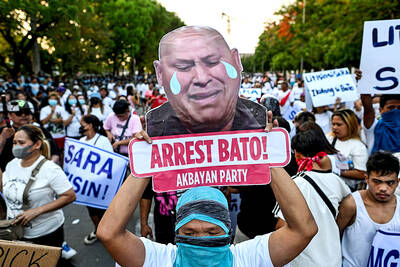
The Philippines said it has asked the country’s Supreme Court to allow it to arrest former Philippine president Rodrigo Duterte’s chief drug war enforcer to stand trial in an international tribunal. The International Criminal Court (ICC) last week unsealed an arrest warrant against Philippine Senator Ronald dela Rosa, accusing him along with Duterte and other “coperpetrators” of the “crime against humanity of murder.” Dela Rosa briefly sought refuge in the Philippine Senate last week while asking the Philippine Supreme Court to stop an ongoing attempt by government agents to arrest him. “By his own conduct, he has placed himself outside the protection of

It began as a satirical online project. Now millions of young people in India are flocking to it as an outlet for their frustration. A parody political party called the Cockroach Janta Party, with the insect as its symbol, has exploded across India’s social media by turning absurdist humor into protest. Memes and short videos mocking corruption, joblessness and political dysfunction have flooded social media sites, where millions of users are embracing the cockroach — known for its ability to survive harsh conditions — as a tongue-in-cheek symbol of endurance. The online movement’s rise has been unusually rapid. The Cockroach Janta Party (CJP)

The researchers in Ireland looked at their computer screen, marveling at a medieval book tracked down in a Roman library. They flipped through its digitized pages and found their sought-after treasure: the oldest surviving English poem. “We were extremely surprised. We were speechless. We couldn’t believe our eyes when we first saw that,” said Elisabetta Magnanti, a visiting research fellow at Trinity College Dublin’s school of English. The poem was also within the main body of Latin text, she said, calling it “extraordinary.” Composed in Old English by a Northumbrian agricultural worker in the 7th century, Caedmon’s Hymn appears within some copies of


 RSS
RSS