


With climate change emerging as a key issue for both the US and China, the two countries have a new platform for cooperation and an opportunity to strengthen their often contentious relationship, a leading China expert said on Thursday.
Kenneth Lieberthal, a China scholar and former White House adviser, laid out a blueprint of different ways the two countries can collaborate on global warming in a report he co-authored for the Brookings Institution, a think tank based in Washington.
“The US clearly wants to increase the level, intensity, transparency and consistency of its dialogue with China,” he told a forum at Tsinghua University in Beijing. “Climate change will be an important part of that strategic dialogue.”
The world’s two largest emitters of greenhouse gases — accounting for an estimated 40 percent of the global total — have long been at odds over how to handle the issue of climate change.
Lieberthal, who served as a top Asia adviser during the Clinton administration, said a key part of that effort will be finding ways for the US to work effectively with China, which has overtaken the US on carbon dioxide emissions, a leading cause of global warming.
If the two major players can agree on ways to reduce carbon emissions, “our cooperation increases the chances that a global agreement will be reached,” Lieberthal said.
The Brookings report recommends co-development of technology, building a framework for energy cooperation and a US-China summit highlighting clean energy.
In a relationship that has been dominated by more contentious issues of security, trade and human rights, climate change can also serve as a less divisive goal.
“If it’s a long-term pillar of cooperation, it may help reduce the current mutual distrust in each of our governments,” Lieberthal said.

Crowds in Bangladesh are flocking to snap photographs with an unlikely social media star — an albino buffalo with flowing blond hair nicknamed “Donald Trump” that is due to be sacrificed within days. Owner Zia Uddin Mridha, 38, said his brother named the 700kg bull over its flowing helmet of hair resembling the signature look of the US president. “My younger brother picked this name because of the buffalo’s extraordinary hair,” he said at his farm in Narayanganj, just outside the capital, Dhaka. Mridha said that a constant stream of curious visitors — social media fans, onlookers and children — have come throughout

It began as a satirical online project. Now millions of young people in India are flocking to it as an outlet for their frustration. A parody political party called the Cockroach Janta Party, with the insect as its symbol, has exploded across India’s social media by turning absurdist humor into protest. Memes and short videos mocking corruption, joblessness and political dysfunction have flooded social media sites, where millions of users are embracing the cockroach — known for its ability to survive harsh conditions — as a tongue-in-cheek symbol of endurance. The online movement’s rise has been unusually rapid. The Cockroach Janta Party (CJP)
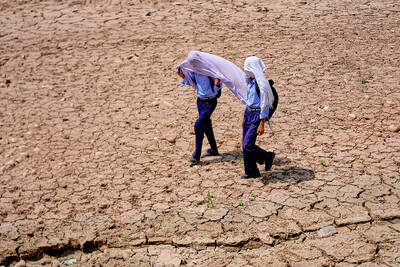
HOTTER: While Indians are accustomed to summer heat, climate change has caused northwestern India to warm faster than other parts of the country, an academic said Roads and markets have emptied during afternoons and some farmers have switched to nighttime work to avoid scorching temperatures as a heat wave grips large parts of India. The India Meteorological Department forecast maximum temperatures for yesterday of about 45°C in the capital, New Delhi, where authorities have opened temporary “cooling zones” to help people cope. The weather department warned that conditions would likely persist across several northern regions in the coming days, with temperatures staying well above seasonal averages. Authorities urged people to stay indoors during the hottest hours and take precautions against heat-related illnesses. India declares a heat wave whenever maximum temperatures

SPEAKING OUT: After Siranudh Scott’s allegations surfaced, celebrities and public figures took to social media to share their own experiences of sexual misconduct and abuse A high-profile alleged sexual abuse case within a wealthy Thai beer brewing family has prompted a wave of painful accounts from survivors of unconnected abuse in the conservative nation. Siranudh Scott, a member of the billionaire Thai family that founded the ubiquitous Singha beer brand, posted an emotional video this month accusing his elder brother Sunit of repeatedly abusing him when he was a teenager. Sunit, who is in his 30s, later denied the allegations in a video posted online, but Singha parent Boonrawd dismissed him from his executive role with the company on Tuesday last week. “I felt I needed to speak


 RSS
RSS