


A man who said he was a former FBI informant has filed a US$54 million federal lawsuit against the government, saying his life was in danger because his identity was compromised after he went undercover to help the agency.
“I was disclosed,” said Anthony Martin, 63, who described himself as a retired bank robber and convicted felon.
Martin said he volunteered to work undercover for the FBI after the Sept. 11 terrorist attacks. He said he was installed as a taxi driver in Las Vegas and provided information that led to the arrests and convictions of at least four “people entering the country illegally” on charges including fabricating false passports.
But while filing a complaint in 2004, he said, a Las Vegas police officer checked a computer database and addressed him as Lee McKnight, the name he gave up when he entered the federal witness protection program.
“I got a promise that my old name would never be disclosed, and it should not have,” Martin said. “They intentionally put me in danger.”
Martin, who is representing himself in court, claimed breach of contract, breach of oral agreement and violations of constitutional free speech, equal protection and the right against cruel and unusual punishment.
He filed the civil lawsuit on Jan. 29 in the US District Court for the District of Columbia.
US Justice Department spokesman Charles Miller declined to comment on the lawsuit, saying his department had not received a copy.
The FBI and US Marshals Service in Las Vegas also declined comment.
The disclosure of an informant’s name faces penalty that includes prison time. Former US vice president Dick Cheney’s then-chief of staff, I. Lewis “Scooter” Libby, was sentenced to two years in prison after being convicted of perjury and obstruction of justice for lying to the FBI about his role in leaking CIA operative Valerie Plame’s name and CIA affiliation to a reporter.
Former US president George W. Bush commuted the sentence, sparing Libby from prison.

Crowds in Bangladesh are flocking to snap photographs with an unlikely social media star — an albino buffalo with flowing blond hair nicknamed “Donald Trump” that is due to be sacrificed within days. Owner Zia Uddin Mridha, 38, said his brother named the 700kg bull over its flowing helmet of hair resembling the signature look of the US president. “My younger brother picked this name because of the buffalo’s extraordinary hair,” he said at his farm in Narayanganj, just outside the capital, Dhaka. Mridha said that a constant stream of curious visitors — social media fans, onlookers and children — have come throughout
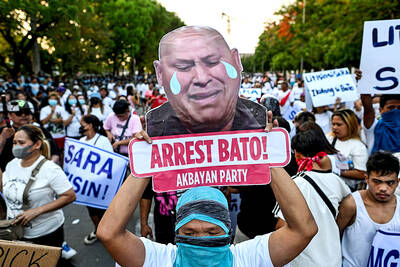
The Philippines said it has asked the country’s Supreme Court to allow it to arrest former Philippine president Rodrigo Duterte’s chief drug war enforcer to stand trial in an international tribunal. The International Criminal Court (ICC) last week unsealed an arrest warrant against Philippine Senator Ronald dela Rosa, accusing him along with Duterte and other “coperpetrators” of the “crime against humanity of murder.” Dela Rosa briefly sought refuge in the Philippine Senate last week while asking the Philippine Supreme Court to stop an ongoing attempt by government agents to arrest him. “By his own conduct, he has placed himself outside the protection of

It began as a satirical online project. Now millions of young people in India are flocking to it as an outlet for their frustration. A parody political party called the Cockroach Janta Party, with the insect as its symbol, has exploded across India’s social media by turning absurdist humor into protest. Memes and short videos mocking corruption, joblessness and political dysfunction have flooded social media sites, where millions of users are embracing the cockroach — known for its ability to survive harsh conditions — as a tongue-in-cheek symbol of endurance. The online movement’s rise has been unusually rapid. The Cockroach Janta Party (CJP)

The researchers in Ireland looked at their computer screen, marveling at a medieval book tracked down in a Roman library. They flipped through its digitized pages and found their sought-after treasure: the oldest surviving English poem. “We were extremely surprised. We were speechless. We couldn’t believe our eyes when we first saw that,” said Elisabetta Magnanti, a visiting research fellow at Trinity College Dublin’s school of English. The poem was also within the main body of Latin text, she said, calling it “extraordinary.” Composed in Old English by a Northumbrian agricultural worker in the 7th century, Caedmon’s Hymn appears within some copies of


 RSS
RSS