


Military judges in a Guantanamo war crimes court were pressing forward yesterday with hearings against five men accused of orchestrating the Sept. 11, 2001, attacks in the US and a Canadian accused of killing a US soldier.
Several days of pretrial motions were scheduled to start a day before the inauguration of US president-elect Barack Obama, who has said he would close the offshore prison at the US Navy base in Cuba.
Lawyers and representatives of human rights groups who have come to observe the hearings believe Obama will suspend the military commission system created by Congress and outgoing US President George W. Bush in 2006 to prosecute dozens of men held at Guantanamo.
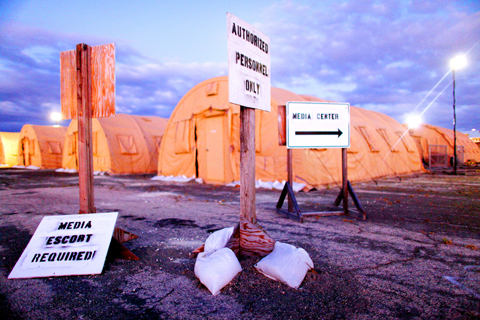
PHOTO: AFP
Many observers doubt the US will go ahead with the Jan. 26 trial of Canadian Omar Khadr, who is accused of killing a US soldier with a grenade during a firefight in Afghanistan in 2002, when the Toronto native was 15.
“This system is discredited and flawed and should not exist one day more, and certainly the signals that we hear from Washington, from the Obama transition team, are that he will act on it as soon as he is in office,” said Jamil Dakwar, a lawyer with the American Civil Liberties Union who is in Guantanamo this week to observe the hearings.
Obama’s nominee for attorney-general, Eric Holder, in his confirmation hearing echoed a major criticism of the commissions: that they lack sufficient legal protections for those charged. He said the detainees could be tried in the US.
Those statements make it unlikely that the commission system will go forward, said Navy Lieutenant-Commander Bill Kuebler, Khadr’s Pentagon-appointed lawyer.
“It is simply unimaginable to think that these proceedings would continue when you have an administration that is on the record saying that so clearly,” Kuebler said. “What’s very clear ... is that they want to take a different course of action on Guantanamo.”
The Pentagon’s chief war crimes prosecutor, Army Colonel Lawrence Morris, said he did not know what the Obama administration would do and had to plan as if the commissions would go forward. Still, prosecutors joined with the defense in asking military judges to postpone this week’s hearings until after the inauguration. The judges rejected the request.
In the Sept. 11 trial, a key issue before the court is whether Ramzi Binalshibh, a Yemeni who is accused of being a key lieutenant to the alleged architect of the plot, is mentally competent to adequately participate in his defense.
His military-appointed lawyers argue they need more information, including testimony from guards and medical personnel who have interacted with him at Guantanamo, to help them determine if he is mentally fit to stand trial.
Before the court can delve into that issue, however, the judge will consider whether the Pentagon must charge and arraign the men all over again after it withdrew and refiled charges in about 20 cases. The Pentagon described the refiling as a procedural step required to appoint new military jury panel members.

China’s military news agency yesterday warned that Japanese militarism is infiltrating society through series such as Pokemon and Detective Conan, after recent controversies involving events at sensitive sites. In recent days, anime conventions throughout China have reportedly banned participants from dressing as characters from Pokemon or Detective Conan and prohibited sales of related products. China Military Online yesterday posted an article titled “Their schemes — beware the infiltration of Japanese militarism in culture and sports.” The article referenced recent controversies around the popular anime series Pokemon, Detective Conan and My Hero Academia, saying that “the evil influence of Japanese militarism lives on in

DIPLOMATIC THAW: The Canadian prime minister’s China visit and improved Beijing-Ottawa ties raised lawyer Zhang Dongshuo’s hopes for a positive outcome in the retrial China has overturned the death sentence of Canadian Robert Schellenberg, a Canadian official said on Friday, in a possible sign of a diplomatic thaw as Canadian Prime Minister Mark Carney seeks to boost trade ties with Beijing. Schellenberg’s lawyer, Zhang Dongshuo (張東碩), yesterday confirmed China’s Supreme People’s Court struck down the sentence. Schellenberg was detained on drug charges in 2014 before China-Canada ties nosedived following the 2018 arrest in Vancouver of Huawei chief financial officer Meng Wanzhou (孟晚舟). That arrest infuriated Beijing, which detained two Canadians — Michael Spavor and Michael Kovrig — on espionage charges that Ottawa condemned as retaliatory. In January

A sign hanging from a rusty ice-green shipping container installed by Thai forces on what they say is the border with Cambodia reads: “Cambodian citizens are strictly prohibited from entering this area.” On opposite sides of the makeshift barricade, fronted by coils of barbed wire, Cambodians lamented their lost homes and livelihoods as Thailand’s military showed off its gains. Thai forces took control of several patches of disputed land along the border during fighting last year, which could amount to several square kilometers in total. Cambodian Kim Ren said her house in Chouk Chey used to stand on what is now the Thai
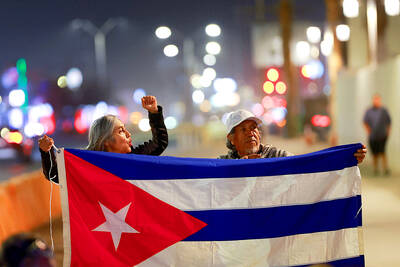
NEW RULES: There would be fewer school days, four-day workweeks, and a reduction in transportation services as the country battles a crisis exacerbated by US pressure The Cuban government on Friday announced emergency measures to address a crippling energy crisis worsened by US sanctions, including the adoption of a four-day work week for state-owned companies and fuel sale restrictions. Cuban Deputy Prime Minister Oscar Perez-Oliva Fraga blamed Washington for the crisis, telling Cuban television the government would “implement a series of decisions, first and foremost to guarantee the vitality of our country and essential services, without giving up on development.” “Fuel will be used to protect essential services for the population and indispensable economic activities,” he said. Among the new measures are the reduction of the working week in


 RSS
RSS