


The extravagant beards and moustaches proudly sported by generations of Indian men are under threat, said two men who studied the country’s finest facial hair.
As India rapidly modernizes, clean chins are becoming the rule among young people, said author, Richard McCallum, who spent months on the road documenting the bushiest bristles he could find before they disappear forever.
With photographer Chris Stowers, McCallum scoured markets, festivals and remote villages to gather specimens now collected in their book Hair India — A Guide to the Bizarre Beards and Magnificent Moustaches of Hindustan.
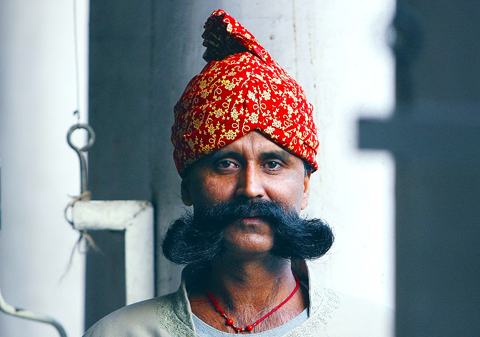
PHOTO: AFP
“It was an idea that started out as a bit of fun but turned into a labor of love,” said McCallum, 30, a British travel business operator who has lived in New Delhi for four years.
“Beards and moustaches tell the story of modern India — how it is becoming a more Westernized, homogenized place, but also how the great traditions and the love of display still exist,” he said. “Male grooming is important to Indians, and facial hair proved a topic that took us to places and into conversations with people we would never have met otherwise.”
The book, lavishly illustrated with hundreds of color photographs, divides facial hair into categories including “the chin strap,” “the soup strainer,” “the wing commander” and “the walrus.”
Among those pictured are both the world’s longest beard, measuring 1.6m long, and the world’s longest moustache, at 3.5m.
The record-breaking moustache is a big earner for Ram Singh Chauman, 54, who charges modeling fees and whose whiskers have starred in Bollywood films and even had a cameo in the 1983 James Bond film Octopussy.
But the stars of the book are perhaps the ordinary stall-owners and rickshaw drivers showing off moustaches and beards that are cut, dyed, waxed and preened in an endless variety of shapes and sizes.
“Some people were confused when we first told them why we wanted to take their picture, but they soon became very keen,” said Stowers, who has worked in more than 50 countries and several war zones. “One photograph might take hours, while others were just snapped in seconds.”
McCallum and Stowers’ search took them from camel fairs in Rajasthan to the Himalayan town of Leh, and from the banana groves of the Western Ghats to military tattoos in New Delhi.
Along the way, they demonstrated their commitment to the job by discarding their razors, with McCallum growing an unruly black beard and Stowers sprouting a moustache which he tweaked into sharp upwards curls.
“We found one guy with fabulous wavy, gray muttonchops in the backstreets of old Delhi via a hand-drawn map by someone who had spotted him,” McCallum said. “In Mysore we chased a guy with a bunch of bananas on his head for three blocks only to discover that his moustache was very ordinary, but he took us to his warehouse where we discovered some of the finest examples in all India.”
Sikhs, for whom kesh (uncut hair) is a religious principle, feature heavily in the book, and moustaches remain a professional requirement for the doormen of five-star hotels.
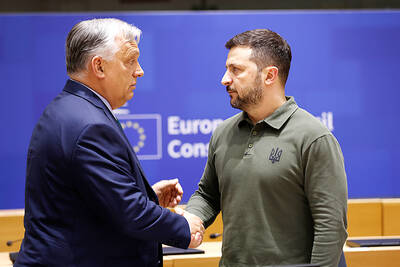
Hungarian authorities temporarily detained seven Ukrainian citizens and seized two armored cars carrying tens of millions of euros in cash across Hungary on suspicion of money laundering, officials said on Friday. The Ukrainians were released on Friday, following their detention on Thursday, but Hungarian officials held onto the cash, prompting Ukraine to accuse Hungary’s Russia-friendly government of illegally seizing the money. “We will not tolerate this state banditism,” Ukrainian Minister of Foreign Affairs Andrii Sybiha said. The seven detained Ukrainians were employees of the Ukrainian state-owned Oschadbank, who were traveling in the two armored cars that were carrying the money between Austria and
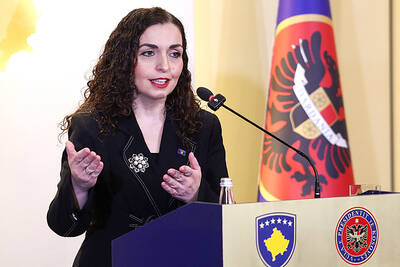
Kosovar President Vjosa Osmani on Friday after dissolving the Kosovar parliament said a snap election should be held as soon as possible to avoid another prolonged political crisis in the Balkan country at a time of global turmoil. Osmani said it is important for Kosovo to wrap up the upcoming election process and form functional institutions for political stability as the war rages in the Middle East. “Precisely because the geopolitical situation is that complex, it is important to finish this electoral process which is coming up,” she said. “It is very hard now to imagine what will happen next.” Kosovo, which declared

MORE BANS: Australia last year required sites to remove accounts held by under-16s, with a few countries pushing for similar action at an EU level and India considering its own ban Indonesia on Friday said it would ban social media access for children under 16, citing threats from online pornography, cyberbullying, online fraud and Internet addiction. “Accounts belonging to children under 16 on high-risk platforms will start to be deactivated, beginning with YouTube, TikTok, Facebook, Instagram, Threads, X, Bigo Live and Roblox,” Indonesian Minister of Communications and Digital Meutya Hafid said. “The government is stepping in so that parents no longer have to fight alone against the giants of the algorithm. Implementation will begin on March 28, 2026,” she said. The social media ban would be introduced in stages “until all platforms fulfill their
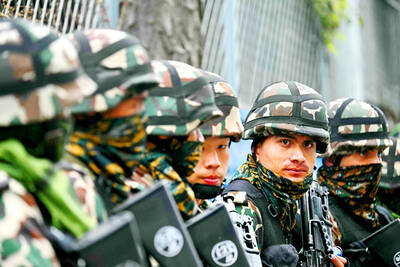
Counting was under way in Nepal yesterday, after a high-stakes parliamentary election to reshape the country’s leadership following protests last year that toppled the government. Key figures vying for power include former Nepalese prime minister K. P. Sharma Oli, rapper-turned-mayor Balendra Shah, who is bidding for the youth vote, and newly elected Nepali Congress party leader Gagan Thapa. In Kathmandu’s tea shops and city squares, people were glued to their phones, checking results as early trends flashed up — suggesting Shah’s centrist Rastriya Swatantra Party (RSP) was ahead. Nepalese Election Commission spokesman Prakash Nyupane said the counting was ongoing “in a peaceful manner”


 RSS
RSS