


Alone among major Western nations, the US refused to sign a declaration presented at the UN on Thursday calling for worldwide decriminalization of homosexuality.
In all, 66 of the UN’s 192 member countries signed the nonbinding declaration — which backers called a historic step to push the General Assembly to deal more forthrightly with any gay discrimination. More than 70 UN members outlaw homosexuality, and in several of them homosexual acts can be punished by execution.
Cosponsored by France and the Netherlands, the declaration was signed by all 27 EU members, as well as Japan, Australia, Mexico and three dozen other countries. There was broad opposition from Muslim nations, and the US refused to sign, indicating that some parts of the declaration raised legal questions that needed further review.
“It’s disappointing,” said Rama Yade, France’s human rights minister, of the US position — which she described as in contradiction with the US’ long tradition as a defender of human rights.
Some of the declaration’s backers said US officials expressed concern in private talks that some parts of the declaration might be problematic in committing the federal government on matters that fall under state jurisdiction. In many states, landlords and employers are allowed to discriminate on the basis of sexual orientation; on the federal level, gays are not allowed to serve openly in the military.
Carolyn Vadino, a spokeswoman for the US mission to the UN, stressed that the US — despite its unwillingness to sign — condemned any human rights violations related to sexual orientation.
Gay rights activists nonetheless were angered by the US position.
“It’s an appalling stance — to not join with other countries that are standing up and calling for decriminalization of homosexuality,” said Paula Ettelbrick, executive director of the International Gay and Lesbian Human Rights Commission.
She expressed hope that the US position might change after president-elect Barack Obama takes office next month.
More than 50 countries opposed to the declaration, including members of the Organization of the Islamic Conference, issued a joint statement on Thursday criticizing the initiative as an unwarranted attempt to give special prominence to gays and lesbians. The statement suggested that protecting sexual orientation could lead to “the social normalization and possibly the legalization of deplorable acts” such as pedophilia and incest.
The declaration also has been opposed by the Vatican. The Reverend Federico Lombardi said the Roman Catholic Church opposed the death penalty and other harsh repression of gays and lesbians, but he expressed concern that the declaration would be used as pressure against those who believe marriage rights should not be extended to gays.
A new Vatican statement, issued on Thursday, endorsed the call to end criminal penalties against gays, but said that overall the declaration “gives rise to uncertainty in the law and challenges existing human norms.”
The European nations backing the declaration waged their campaign in conjunction with the 60th anniversary of the Universal Declaration of Human Rights.
The Dutch foreign affairs minister, Maxime Verhagen, said countries which endorsed that 1948 document had no right to carve out exceptions based on religion or culture that allowed discrimination against gays.
“Human rights apply to all people in all places at all times,” he said. “I will not accept any excuse.”
He acknowledged that the new declaration had only symbolic import, but said it marked the first time such a large number of nations had raised the cause of gay rights in the context of General Assembly proceedings. Although the declaration’s backers were pleased that nations on six continents had signed it, there were only two from Asia and four from Africa.
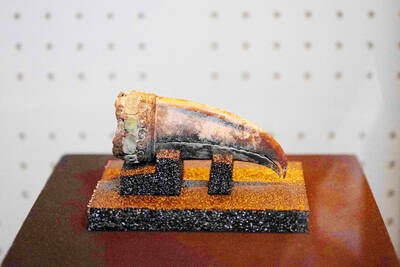
Archeologists in Peru on Thursday said they found the 5,000-year-old remains of a noblewoman at the sacred city of Caral, revealing the important role played by women in the oldest center of civilization in the Americas. “What has been discovered corresponds to a woman who apparently had elevated status, an elite woman,” archeologist David Palomino said. The mummy was found in Aspero, a sacred site within the city of Caral that was a garbage dump for more than 30 years until becoming an archeological site in the 1990s. Palomino said the carefully preserved remains, dating to 3,000BC, contained skin, part of the
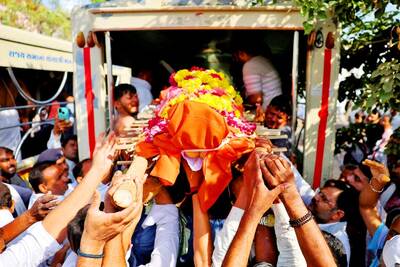
‘WATER WARFARE’: A Pakistani official called India’s suspension of a 65-year-old treaty on the sharing of waters from the Indus River ‘a cowardly, illegal move’ Pakistan yesterday canceled visas for Indian nationals, closed its airspace for all Indian-owned or operated airlines, and suspended all trade with India, including to and from any third country. The retaliatory measures follow India’s decision to suspend visas for Pakistani nationals in the aftermath of a deadly attack by shooters in Kashmir that killed 26 people, mostly tourists. The rare attack on civilians shocked and outraged India and prompted calls for action against their country’s archenemy, Pakistan. New Delhi did not publicly produce evidence connecting the attack to its neighbor, but said it had “cross-border” links to Pakistan. Pakistan denied any connection to

TRUMP EFFECT: The win capped one of the most dramatic turnarounds in Canadian political history after the Conservatives had led the Liberals by more than 20 points Canadian Prime Minister Mark Carney yesterday pledged to win US President Donald Trump’s trade war after winning Canada’s election and leading his Liberal Party to another term in power. Following a campaign dominated by Trump’s tariffs and annexation threats, Carney promised to chart “a new path forward” in a world “fundamentally changed” by a US that is newly hostile to free trade. “We are over the shock of the American betrayal, but we should never forget the lessons,” said Carney, who led the central banks of Canada and the UK before entering politics earlier this year. “We will win this trade war and

Armed with 4,000 eggs and a truckload of sugar and cream, French pastry chefs on Wednesday completed a 121.8m-long strawberry cake that they have claimed is the world’s longest ever made. Youssef El Gatou brought together 20 chefs to make the 1.2 tonne masterpiece that took a week to complete and was set out on tables in an ice rink in the Paris suburb town of Argenteuil for residents to inspect. The effort overtook a 100.48m-long strawberry cake made in the Italian town of San Mauro Torinese in 2019. El Gatou’s cake also used 350kg of strawberries, 150kg of sugar and 415kg of


 RSS
RSS