


The government yesterday refused to bow to demands recently made by the Chinese Nationalist Party (KMT) legislative caucus that the budget for the Public Television Service (PTS) be used as a mechanism to screen the public broadcaster’s news coverage and programming.
“Any programs broadcast by PTS will not be censored by the government in advance or afterwards,” said Vanessa Shih (史亞平), minister of the Government Information Office (GIO), the regulatory agency of the PTS Foundation.
PTS published a statement in major Chinese-language newspapers yesterday saying that a draft legislative motion proposed by the KMT caucus would severely infringe upon its operations, which should be independent from political parties, the government and the military.
On Tuesday during a legislative committee meeting, the KMT proposed that PTS would require prior item-by-item approval from the GIO for all budgetary spending.
The KMT’s motion also demanded that the Council of Indigenous Peoples, the Council of Hakka Affairs and the Overseas Compatriot Affairs Commission be responsible for the operations of Taiwan Indigenous Television, Hakka Television Station and Taiwan Macroview TV respectively, in terms of screening and supervising of the production of their programs.
KMT lawmakers wanted to attach the motion to the service’s budget to make it binding.
Democratic Progressive Party Legislator Chiu Yi-ying (邱議瑩) accused the KMT caucus of interfering with the media, saying that the country’s democracy would take a big step backward should the motion pass the legislature.
“It’s really pathetic that the KMT would meddle in public broadcasting to prevent dissenting views in order to protect its authoritarian rule,” Chiu said.
KMT legislative caucus whip Lin Yi-shih (林益世) rebutted the accusation, saying that the motion was merely intended to urge the government agencies to be responsible for the TV stations they supervise, not to interfere with the media.
The Association of Taiwan Journalists called on the KMT caucus to withdraw the motion, which it said would compromise the independence of the media to the extent of the Martial Law era.
PTS hasn’t been able to use NT$450 million (US$13.5 million), the budget earmarked for the second half year of this year, as it has remained frozen by the KMT-controlled legislature.
Shih said the government would continue to communicate with the KMT caucus to unfreeze the budget and ensure the interests of PTS staffers remained unaffected.

Crowds in Bangladesh are flocking to snap photographs with an unlikely social media star — an albino buffalo with flowing blond hair nicknamed “Donald Trump” that is due to be sacrificed within days. Owner Zia Uddin Mridha, 38, said his brother named the 700kg bull over its flowing helmet of hair resembling the signature look of the US president. “My younger brother picked this name because of the buffalo’s extraordinary hair,” he said at his farm in Narayanganj, just outside the capital, Dhaka. Mridha said that a constant stream of curious visitors — social media fans, onlookers and children — have come throughout

It began as a satirical online project. Now millions of young people in India are flocking to it as an outlet for their frustration. A parody political party called the Cockroach Janta Party, with the insect as its symbol, has exploded across India’s social media by turning absurdist humor into protest. Memes and short videos mocking corruption, joblessness and political dysfunction have flooded social media sites, where millions of users are embracing the cockroach — known for its ability to survive harsh conditions — as a tongue-in-cheek symbol of endurance. The online movement’s rise has been unusually rapid. The Cockroach Janta Party (CJP)
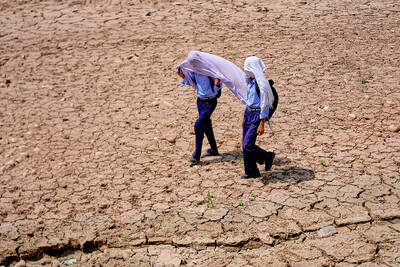
HOTTER: While Indians are accustomed to summer heat, climate change has caused northwestern India to warm faster than other parts of the country, an academic said Roads and markets have emptied during afternoons and some farmers have switched to nighttime work to avoid scorching temperatures as a heat wave grips large parts of India. The India Meteorological Department forecast maximum temperatures for yesterday of about 45°C in the capital, New Delhi, where authorities have opened temporary “cooling zones” to help people cope. The weather department warned that conditions would likely persist across several northern regions in the coming days, with temperatures staying well above seasonal averages. Authorities urged people to stay indoors during the hottest hours and take precautions against heat-related illnesses. India declares a heat wave whenever maximum temperatures
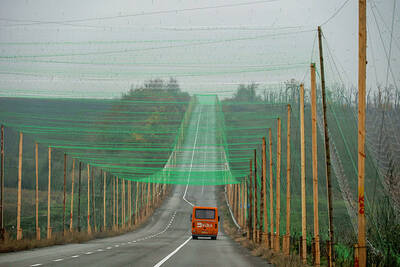
BIGGER ROLE: Beijing has said it maintains an impartial stance on the war in Ukraine, but by training Russian troops, China is far more involved than previously known China’s armed forces secretly trained about 200 Russian military personnel in China late last year, and some have since returned to fight in Ukraine, according to three European intelligence agencies and documents seen by Reuters. While China and Russia have held a number of joint military exercises since Moscow’s full-scale invasion of Ukraine in 2022, Beijing has repeatedly said that it is neutral in the conflict and presents itself as a peace mediator. The covert training sessions, which predominantly focused on the use of drones, were outlined in a dual-language Russian-Chinese agreement signed by senior Russian and Chinese officers in Beijing on


 RSS
RSS