


An Afghan teenager who lost both legs in a cluster bomb explosion has helped persuade his country to change its stance and join nearly 100 nations in signing a treaty banning the disputed weapons.
Afghanistan was initially reluctant to join the pact — which the US and Russia have refused to support — but agreed to after lobbying by victims maimed by cluster munitions, including 17-year-old Soraj Ghulan Habib.
The teenager, who uses a wheelchair, met with his country’s ambassador to Norway, Jawed Ludin, on Wednesday at a two-day signing conference in the Norwegian capital.
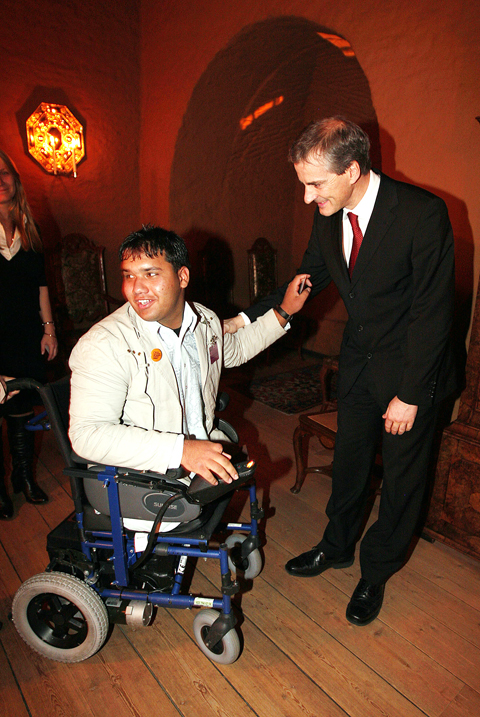
PHOTO: EPA
“I explained to the ambassador my situation and that the people of Afghanistan wanted a ban,” said Habib, who was crippled by a cluster bomb seven years ago.
Speaking through an interpreter, Habib said the ambassador called Afghan President Hamid Karzai, who agreed to change his stance on the treaty.
“Today is a historic day,” Habib said.
Afghanistan’s reversal even surprised the activists who are urging countries to join the pact against cluster munitions, which have been widely criticized for maiming and killing civilians.
“It is just so huge, to get this turnaround. Afghanistan was under a lot of pressure from the United States,” said Thomas Nash, coordinator of The Cluster Bomb Coalition. “If Afghanistan can withstand the pressure, so can others.”
Australian activist Daniel Barty said the Afghan ambassador appeared to start changing his mind after meeting Habib at a reception on Tuesday.
The US, Russia and other countries refusing to sign the pact argue that cluster bombs still have legitimate military uses, such as repelling advancing troop columns.
Cluster bomblets are packed by the hundreds into artillery shells, bombs or missiles, which scatter them over vast areas. Some fail to explode immediately. The unexploded bomblets can then lie dormant for years until they are disturbed, often by children attracted by their small size and bright colors.
The group Handicap International says 98 percent of the victims of cluster bombs are civilians and 27 percent are children.
Organizers hoped that more than 100 of the 125 countries represented would have signed by the end of the conference yesterday. Norwegian Foreign Minister Jonas Gahr Stoere said 92 countries did so on Wednesday.
The treaty must be ratified by 30 countries before it takes effect.
His country, which began the drive to ban cluster bombs 18 months ago, was the first to sign, followed by Laos and Lebanon, both hard-hit by the weapons.
Britain, formerly a major stockpiler of cluster munitions, also signed the treaty, which British Foreign Secretary David Miliband said showed that a NATO country can defend itself without cluster weapons.
Miliband said he would urge US president-elect Barack Obama’s administration to reconsider the US stance.
The Bush administration says a comprehensive ban would hurt world security.
“Although we share the humanitarian concerns of states signing the [accord], we will not be joining them,” the US State Department said in a statement. “Such a general ban on cluster munitions will put the lives of our military men and women, and those of our coalition partners, at risk.”
In Jerusalem, Israeli Foreign Ministry spokesman Yigal Palmor said his government had decided not to join the treaty and instead believes the issue of cluster bomb use should be addressed through the UN Convention on Conventional Weapons.
The anti-cluster bomb campaign gathered momentum after Israel’s month-long war against Hezbollah in 2006, when it scattered up to 4 million bomblets across Lebanon, UN figures show.
“In southern Lebanon, for more than two years, children and the elderly have been victimized [by cluster munitions],” Lebanese Foreign Minister Fawzi Saloukh said.
Activists hoped the treaty would pressure non-signers into shelving the weapons, as many did with land mines after a 1997 treaty banning them.
“The cluster bomb treaty will save countless lives by stigmatizing a weapon that kills civilians even after the fighting ends,” said Steve Goose, arms director of Human Rights Watch.
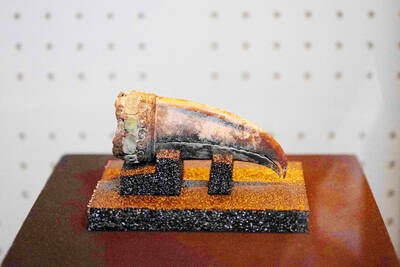
Archeologists in Peru on Thursday said they found the 5,000-year-old remains of a noblewoman at the sacred city of Caral, revealing the important role played by women in the oldest center of civilization in the Americas. “What has been discovered corresponds to a woman who apparently had elevated status, an elite woman,” archeologist David Palomino said. The mummy was found in Aspero, a sacred site within the city of Caral that was a garbage dump for more than 30 years until becoming an archeological site in the 1990s. Palomino said the carefully preserved remains, dating to 3,000BC, contained skin, part of the

TRUMP EFFECT: The win capped one of the most dramatic turnarounds in Canadian political history after the Conservatives had led the Liberals by more than 20 points Canadian Prime Minister Mark Carney yesterday pledged to win US President Donald Trump’s trade war after winning Canada’s election and leading his Liberal Party to another term in power. Following a campaign dominated by Trump’s tariffs and annexation threats, Carney promised to chart “a new path forward” in a world “fundamentally changed” by a US that is newly hostile to free trade. “We are over the shock of the American betrayal, but we should never forget the lessons,” said Carney, who led the central banks of Canada and the UK before entering politics earlier this year. “We will win this trade war and
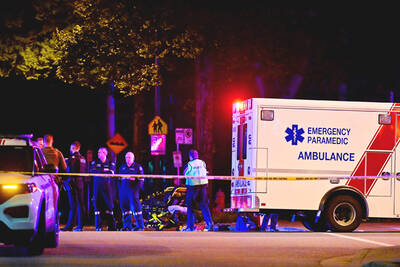
‘BODIES EVERYWHERE’: The incident occurred at a Filipino festival celebrating an anti-colonial leader, with the driver described as a ‘lone suspect’ known to police Canadian police arrested a man on Saturday after a car plowed into a street party in the western Canadian city of Vancouver, killing a number of people. Authorities said the incident happened shortly after 8pm in Vancouver’s Sunset on Fraser neighborhood as members of the Filipino community gathered to celebrate Lapu Lapu Day. The festival, which commemorates a Filipino anti-colonial leader from the 16th century, falls this year on the weekend before Canada’s election. A 30-year-old local man was arrested at the scene, Vancouver police wrote on X. The driver was a “lone suspect” known to police, a police spokesperson told journalists at the
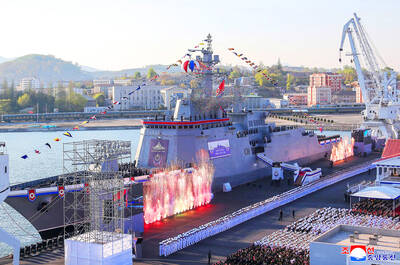
North Korean leader Kim Jong-un has unveiled a new naval destroyer, claiming it as a significant advancement toward his goal of expanding the operational range and preemptive strike capabilities of his nuclear-armed military, state media said yesterday. North Korea’s state-run Korean Central News Agency (KCNA) said Kim attended the launching ceremony for the 5,000-tonne warship on Friday at the western port of Nampo. Kim framed the arms buildup as a response to perceived threats from the US and its allies in Asia, who have been expanding joint military exercises amid rising tensions over the North’s nuclear program. He added that the acquisition


 RSS
RSS