


Russian President Dmitry Medvedev visited old Cold War ally Cuba on Thursday, spending hours with President Raul Castro on the final leg of a Latin America tour designed to increase Moscow’s profile in a region long dominated by the US.
Medvedev arrived in Havana from Venezuela, where he met socialist President Hugo Chavez and agreed to help the oil-rich South American country start a nuclear energy program.
Russian officials deny that Medvedev’s four-nation trip to Latin America is meant to provoke the US, but the voyage included meetings with Washington’s staunchest opponents in the region. Chavez and Medvedev met aboard a Russian warship docked in a Venezuelan port ahead of joint military exercises.
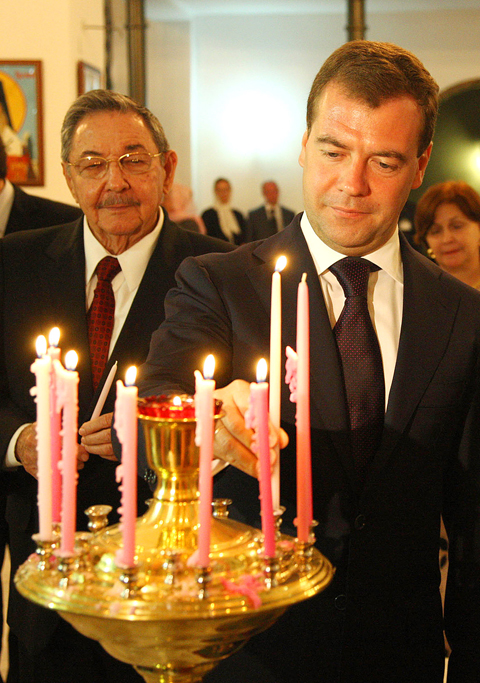
PHOTO: AFP
Medvedev said Russia was stepping up its political ties in Latin America and said Moscow must aggressively seek to shore up its economic position in the region.
“One must admit, to put it simply, we have never had a serious presence here — these have been just episodes,” he told reporters in Cuba, referring to Latin America as a whole.
“We visited states that no Russian leader, and no Soviet leader, ever visited. This means one thing: that attention simply was not paid to these countries,” he said.
“And in some ways we are only now beginning full-fledged, full-format and, I hope, mutually beneficial contacts with the leaders of these states — and, correspondingly, with the economies of these states. We should not be shy and fear competition. We must bravely enter the fight,” he said.
The visit comes at a time when Russia is angry at US plans to build a missile-defense system in Eastern Europe.
The upper chamber of the Czech Parliament on Thursday approved a deal to accept a US missile defense installation. Russia fiercely opposes the plans, saying US military installations in former Soviet satellites threaten its security.
In Cuba, Raul Castro did not greet the Russian president at the airport, but he was by his side just a short time later, accompanying Medvedev to the monument of independence hero Jose Marti and to a recently inaugurated Russian Orthodox Church.
The pair also met privately, then spoke again surrounded by top advisers as part of “official conversations” at the storied Palace of the Revolution, discussing the global financial crisis and other topics.
“We discussed the development of our relations, in the economic sphere and the sphere of military-technical cooperation” — arms sales — “as well as security and regional cooperation,” Medvedev told reporters.
The 77-year-old Castro — who succeeded his brother Fidel as president in February — served as Cuba’s defense minister for nearly five decades and enjoyed an excellent relationship with Soviet defense officials.
A steadfast communist who visited the Soviet Union often, Castro has long been thought of as a great admirer of Moscow and its policies.
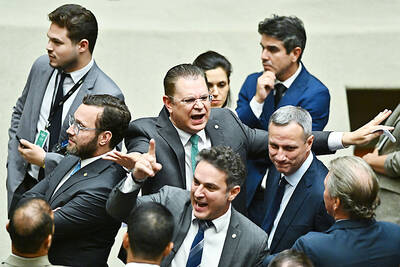
PARLIAMENT CHAOS: Police forcibly removed Brazilian Deputy Glauber Braga after he called the legislation part of a ‘coup offensive’ and occupied the speaker’s chair Brazil’s lower house of Congress early yesterday approved a bill that could slash former Brazilian president Jair Bolsonaro’s prison sentence for plotting a coup, after efforts by a lawmaker to disrupt the proceedings sparked chaos in parliament. Bolsonaro has been serving a 27-year term since last month after his conviction for a scheme to stop Brazilian President Luiz Inacio Lula da Silva from taking office after the 2022 election. Lawmakers had been discussing a bill that would significantly reduce sentences for several crimes, including attempting a coup d’etat — opening up the prospect that Bolsonaro, 70, could have his sentence cut to
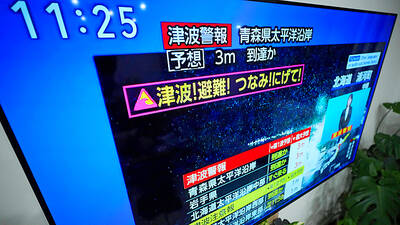
A powerful magnitude 7.6 earthquake shook Japan’s northeast region late on Monday, prompting tsunami warnings and orders for residents to evacuate. A tsunami as high as three metres (10 feet) could hit Japan’s northeastern coast after an earthquake with an estimated magnitude of 7.6 occurred offshore at 11:15 p.m. (1415 GMT), the Japan Meteorological Agency (JMA) said. Tsunami warnings were issued for the prefectures of Hokkaido, Aomori and Iwate, and a tsunami of 40cm had been observed at Aomori’s Mutsu Ogawara and Hokkaido’s Urakawa ports before midnight, JMA said. The epicentre of the quake was 80 km (50 miles) off the coast of
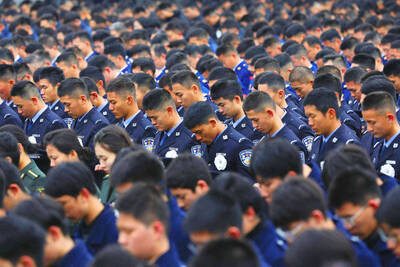
China yesterday held a low-key memorial ceremony for the 1937 Nanjing Massacre, with Chinese President Xi Jinping (習近平) not attending, despite a diplomatic crisis between Beijing and Tokyo over Taiwan. Beijing has raged at Tokyo since Japanese Prime Minister Sanae Takaichi last month said that a hypothetical Chinese attack on Taiwan could trigger a military response from Japan. China and Japan have long sparred over their painful history. China consistently reminds its people of the 1937 Nanjing Massacre, in which it says Japanese troops killed 300,000 people in what was then its capital. A post-World War II Allied tribunal put the death toll
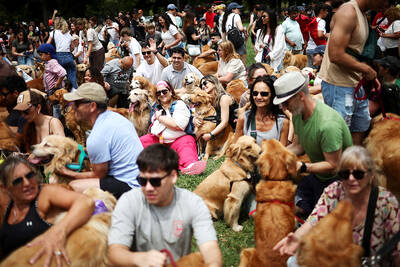
A passerby could hear the cacophony from miles away in the Argentine capital, the unmistakable sound of 2,397 dogs barking — and breaking the unofficial world record for the largest-ever gathering of golden retrievers. Excitement pulsed through Bosques de Palermo, a sprawling park in Buenos Aires, as golden retriever-owners from all over Argentina transformed the park’s grassy expanse into a sea of bright yellow fur. Dog owners of all ages, their clothes covered in dog hair and stained with slobber, plopped down on picnic blankets with their beloved goldens to take in the surreal sight of so many other, exceptionally similar-looking ones.


 RSS
RSS