


Iran announced on Wednesday it was now running 5,000 centrifuges at the country’s single uranium enrichment plant — a substantial increase from four months ago — as Tehran flaunts Iranian “nuclear achievements” and the regime yet again defies UN demands to halt the controversial program.
Vice President Gholam Reza Aghazadeh said Iran would continue to install centrifuges and enrich uranium to produce nuclear fuel for the country’s future nuclear power plants. The number of centrifuges is up from the 4,000 Iran said were running in August at the plant in Natanz.
Uranium enriched to a low level is used to produce nuclear fuel.
More enrichment makes it suitable for use in nuclear weapons.
The additional centrifuges, however, were expected said David Albright, a former UN nuclear inspector and now president of Institute for Science and International Security (ISIS), as Iran is in the process of installing thousands more.
“Expect another 1,000 to start enriching soon,” he said, adding that the number would only get higher as Iranian scientists gain experience. “As Iran runs centrifuges more and more, it’s just going to get better at it.”
The worry internationally is that in several months Iran is going to reach what is called the “break out” point where it will have sufficient low enriched uranium that could reprocess it into enough high enriched uranium to make a nuclear device.
This month, the UN nuclear watchdog estimated Iran had about 630kg of low-enriched uranium. ISIS said that between 700kg and 800kg would be needed to produce a crude fission weapon.
The US and some of its allies accuse Iran of seeking to build nuclear weapons. Tehran denies the claim and insists it has the right under the Nuclear Nonproliferation Treaty to enrich uranium and produce reactor fuel.
“At this point, more than 5,000 centrifuges are operating in Natanz and enriching uranium,” said Aghazadeh, who is head of the Atomic Energy Organization of Iran. He spoke to reporters during an exhibition of Iranian nuclear achievements at Tehran University.
The UN Security Council has already imposed three rounds of sanctions on Iran for its refusal to freeze uranium enrichment.
Flaunting Iran’s defiance, Aghazadeh said the country would never suspend enrichment. “Suspension has not been defined in our lexicon,” he said.
During the enrichment process, uranium gas is spun in a series of centrifuges known as “cascades” to purify it.
At the exhibition, Iran put on public display one of its P-1 centrifuges. Officials at the exhibition explained the various parts of the machine to visitors.
Iran has said it plans to move toward large-scale uranium enrichment that will ultimately involve 54,000 centrifuges.
The International Atomic Energy Agency said in last month’s report that the Islamic Republic was installing, or preparing to install, thousands more of the machines that spin uranium gas to enrich it — with the target of 9,000 centrifuges by next year.
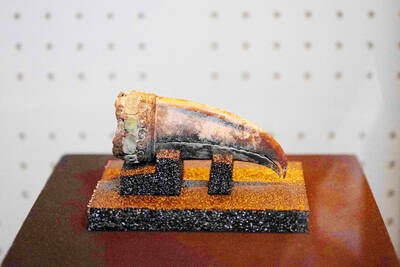
Archeologists in Peru on Thursday said they found the 5,000-year-old remains of a noblewoman at the sacred city of Caral, revealing the important role played by women in the oldest center of civilization in the Americas. “What has been discovered corresponds to a woman who apparently had elevated status, an elite woman,” archeologist David Palomino said. The mummy was found in Aspero, a sacred site within the city of Caral that was a garbage dump for more than 30 years until becoming an archeological site in the 1990s. Palomino said the carefully preserved remains, dating to 3,000BC, contained skin, part of the

‘WATER WARFARE’: A Pakistani official called India’s suspension of a 65-year-old treaty on the sharing of waters from the Indus River ‘a cowardly, illegal move’ Pakistan yesterday canceled visas for Indian nationals, closed its airspace for all Indian-owned or operated airlines, and suspended all trade with India, including to and from any third country. The retaliatory measures follow India’s decision to suspend visas for Pakistani nationals in the aftermath of a deadly attack by shooters in Kashmir that killed 26 people, mostly tourists. The rare attack on civilians shocked and outraged India and prompted calls for action against their country’s archenemy, Pakistan. New Delhi did not publicly produce evidence connecting the attack to its neighbor, but said it had “cross-border” links to Pakistan. Pakistan denied any connection to

TRUMP EFFECT: The win capped one of the most dramatic turnarounds in Canadian political history after the Conservatives had led the Liberals by more than 20 points Canadian Prime Minister Mark Carney yesterday pledged to win US President Donald Trump’s trade war after winning Canada’s election and leading his Liberal Party to another term in power. Following a campaign dominated by Trump’s tariffs and annexation threats, Carney promised to chart “a new path forward” in a world “fundamentally changed” by a US that is newly hostile to free trade. “We are over the shock of the American betrayal, but we should never forget the lessons,” said Carney, who led the central banks of Canada and the UK before entering politics earlier this year. “We will win this trade war and
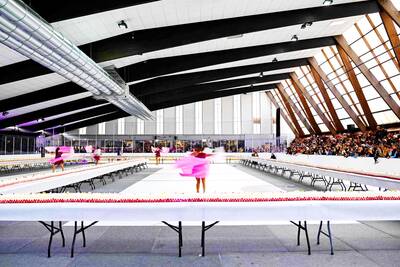
Armed with 4,000 eggs and a truckload of sugar and cream, French pastry chefs on Wednesday completed a 121.8m-long strawberry cake that they have claimed is the world’s longest ever made. Youssef El Gatou brought together 20 chefs to make the 1.2 tonne masterpiece that took a week to complete and was set out on tables in an ice rink in the Paris suburb town of Argenteuil for residents to inspect. The effort overtook a 100.48m-long strawberry cake made in the Italian town of San Mauro Torinese in 2019. El Gatou’s cake also used 350kg of strawberries, 150kg of sugar and 415kg of


 RSS
RSS