


Dark clouds tumbled overhead on that afternoon 30 years ago, in the last hours of the congressman’s mission deep in the jungle of Guyana.
With a small entourage, US Representative Leo Ryan had come to investigate the remote agricultural settlement built by a California-based church.
But while he was there, more than a dozen people had stepped forward: We want to return to the US, they said fearfully.
Suddenly a powerful wind tore through the central pavilion, riffling pages of my notebook, and the skies dumped torrents that bowed plantain fronds. People scrambled for cover as I interviewed the founder of Peoples Temple.
“I feel sorry that we are being destroyed from within,” intoned the Reverend Jim Jones, stunned that members of his flock wanted to abandon the place he called the Promised Land.
That freakish storm and the mood seemed ominous — and not just to me.
“I felt evil itself blow into Jonestown when that storm hit,” recalls Tim Carter, one of the few settlers to survive that day.
Within hours, Carter would see his wife and son die of cyanide poisoning, two of the more than 900 people Jones led in a murder and suicide ritual of epic proportions.
And I would be wounded when a team of temple assassins unleashed a fusillade that killed Ryan — the first congressman slain in the line of duty — and four others, including three newsmen.
By their wiles or happenstance, scores of temple members escaped the events of Nov. 18, 1978. Among the survivors: Members of the group’s basketball team who were playing in Georgetown, 190km away; a woman who escaped Jonestown with her young son, hours before the carnage; a family that had left Peoples Temple months before.
Some of the survivors would commit suicide, die at the hands of others or fall victim to drugs. But many more moved on to new careers, spouses and even churches.
With the passage of time, differences between temple outsiders and insiders, temple defectors and loyalists have faded. They share painful memories, guilt-filled feelings, loss of loved ones and psychological scars from an event that has come to symbolize the ultimate power of a charismatic leader over his followers.
The preacher, who once charmed US politicians and met with future first lady Rosalynn Carter, had turned into a pill-popping dictator who sadistically presided over harsh discipline.
“I felt like I was in a concentration camp and he was Hitler,” Williams said.

Through the noise of rushing papers and whirring belts at a print factory in Kyoto, two creators watch their photo essay come to life in broadsheet form — part of an effort to win new audiences in the age of artificial intelligence (AI). Despite the decline of the publishing industry, self-publication and handmade “zine” magazines are growing in popularity in Japan, reflecting the nation’s enduring love of paper in the digital era. While speaking to Agence France-Presse at the plant, his hands black with ink, one of the creators, Kazuma Obara, said: “I think [paper] is a medium that engages all five
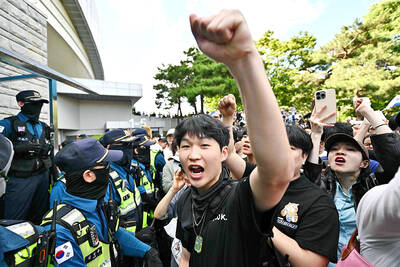
‘ABSURD MISTAKE’: The election commission said that there had been a failure to anticipate turnout after 14 polling stations ran short of ballot papers South Korean riot police yesterday cleared protesters from a Seoul polling station after a 35-hour blockade sparked by a shortage of ballot papers during local elections earlier this week. Wednesday’s election was the first nationwide vote since South Korean President Lee Jae-myung took office following the ouster of Yoon Suk-yeol over his short-lived martial law declaration. Lee’s ruling Democratic Party swept most races, but failed to flip the crucial Seoul mayoral seat. The South Korean National Election Commission apologized, blaming a failure to anticipate turnout after 14 polling stations in Seoul ran short of ballot papers. Some polling stations stayed open until 10pm to

Australian researchers have trained lab-grown brain cells on a silicon computer chip to play the 1990s shooter game Doom and said they are just scratching the surface of what the neurons could be capable of doing. It is the science-fiction work of biotech boffins at Cortical Labs, who researched and developed the technology that harnesses the workings of the brain’s networking system. Each so-called “biological computer” contains about 200,000 living human brain cells, grown from stem cells that were harvested from blood donations. Having mastered the simple computer game Pong, where a paddle is moved up and down to send a ball

France experienced its hottest spring on record, the French weather service said on Tuesday, after an exceptional early heat wave that also broke highs for the season in England and Wales. Meteo-France said the average nationwide temperature over March to May was 13.8°C — about 1.7°C above the norm, and surpassing records set in 2011 and 2020. “The warmest spring since records began in 1900,” it said in a bulletin. All three months were warmer than average, but the onset of an “unprecedented heatwave” late last month pushed the mercury to highs typically seen at the height of the summer. “Our country had never


 RSS
RSS